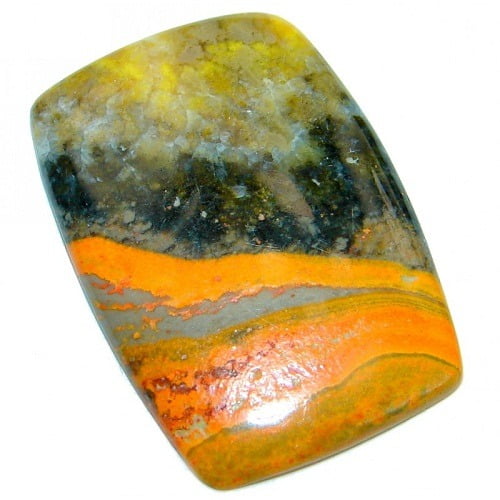
Bumble Bee Jasper is a unique artistry in itself. Bumble Bee is yellowish to Orangish yellow in color. It has very few impurities of Sulphur and Hematite. It is a stone of volcano because each stone erupted from the volcano showing different designs pattern.
An energetic stone, Bumble Bee is further recognized as the boosting stone and provide inspiration to its carrier throughout the life. Bumble Bee develops telepathic communication with the cleric.
Natural Bumble Bee Jasper is immediately recognizable because of its dramatic yellow, orange, black and brown banding. The contrasting patterns resemble the colors of a bumblebee, which explains its popular trade name.
Despite its name, Bumble Bee Jasper is not a true Jasper variety. True Jasper is a silica-rich form of Chalcedony, whereas mineralogical studies describe Bumble Bee Stone as predominantly fibrous Calcite with additional minerals responsible for its distinctive colors.
The yellow and orange coloration has been linked particularly with finely distributed Realgar, while dark or black areas can contain Pyrite. This unusual composition makes the material both visually attractive and mineralogically different from ordinary Jasper.
Bumble Bee Jasper Meaning
Bumble Bee Jasper meaning is traditionally associated with motivation, confidence, creativity and moving forward with personal goals.
Crystal enthusiasts sometimes use it as a symbolic stone for optimism and overcoming hesitation. Its bright yellow and orange coloration also contributes to its metaphysical association with enthusiasm and personal energy.
These meanings are based on crystal traditions and individual spiritual beliefs rather than scientifically established effects.
Bumble Bee Jasper Healing Properties
Bumble Bee Jasper is a remarkable stone that removes the feeling of negativity in a person. It is further known as the gemstone that infuses the power of self-consciousness in a person. Bumble Bee also boosts the physical power of the wearer and helps to gain strength. It also smoothens the chakras of the body. It wipes out the torso toxins as well as other impurities and keeps the body clean from pollution. Bumble Bee also balances the mineral content of the body. It restores the tissue of the internal organs effectively and removes the pain and muscular trauma of a person.
Bumble Bee is also an emotional healer. It helps to understand the situations clearly and act accordingly. It helps to relive the worries and also mitigate the negativity of the mind.
Traditional Bumble Bee Jasper benefits are mainly associated with motivation, emotional confidence, positivity and maintaining determination during challenging situations.
Claims involving detoxification, mineral balance, internal organs, pain, tissue restoration or muscular conditions are not scientifically established medical treatments. Bumble Bee Jasper should not replace professional medical advice, diagnosis or healthcare.
Bumble Bee Jasper Chakra Association
Bumble Bee Jasper is most commonly associated with the Solar Plexus and Sacral Chakras in modern crystal traditions.
Its bright yellow shades are symbolically connected with confidence, personal power and determination, while orange coloration is frequently associated with creativity and emotional expression.
Chakra healing is a spiritual tradition rather than a scientifically measurable property of the stone.
Bumble Bee Jasper Source
Bumble Bee Jasper is mined from the watery mine known as Papandayan. This charm originates at Mount Papandayan.
Bumble Bee Jasper is strongly associated with West Java, Indonesia. Older descriptions frequently connected the material with Mount Papandayan.
More detailed mineralogical research has identified the commercial Bumble Bee Stone mining area south of Kuningan, on the southern slopes of Mount Ciremai in West Java. Therefore, the commonly repeated Mount Papandayan origin should not be treated as the only confirmed locality.
Its association with the volcanic environment of Java is an important part of the stone’s geological and commercial identity.
How Bumble Bee Jasper Forms
Bumble Bee Jasper is associated with mineral-rich environments influenced by volcanic and geothermal activity.
Rather than being lava that simply cooled into Jasper, the material is dominated by fibrous Calcite deposited with additional minerals that create the yellow, orange and dark patterns.
Each piece develops different banding and mineral distribution, which is why polished Bumble Bee Stones rarely look exactly alike.
Bumble Bee Jasper Color
The trinomial crystals system of Bumble Bee is found in carrot, dark blackish, russet brownish and scarlet red color.
Bumble Bee Jasper is best known for vivid combinations of:
- Bright yellow
- Golden yellow
- Orange
- Reddish orange
- Brown
- Grey
- Black
The yellow and orange bands contrast sharply with darker areas and create the characteristic bee-like appearance from which the trade name originates.
Natural specimens can vary greatly in pattern, with some displaying broad bands and others showing irregular swirls and patches.
Bumble Bee Gemological Properties
Color – Carrot Orange, Scarlet Red, Dark Brownish.
Luster – Vitreous to Greasy
Chakra Healing – Sacral Chakra
Moh’s scale – 6.5 to 7
Refractive Index -1.54
Because Bumble Bee Jasper is not true silica-rich Jasper, standard Jasper gemological values such as Mohs hardness 6.5–7 and refractive index around 1.54 should not automatically be applied to it.
Mineralogical studies identify the material mainly as fibrous Calcite. Its hardness is therefore generally significantly lower than genuine Jasper, with documented Bumble Bee Stone material described as having a hardness of approximately 5 or less.
Its composition can also vary because several accessory minerals may occur within the Calcite-rich material.
Mineral Composition of Bumble Bee Stone
Important characteristics include:
- Trade name – Bumble Bee Jasper or Bumble Bee Stone
- Main material – Fibrous Calcite
- Main chemical component – Calcium carbonate, CaCO₃
- Color – Yellow, orange, brown and black
- Yellow/orange coloring material – Commonly associated with Realgar
- Dark areas – Pyrite may be present
- Transparency – Usually opaque
- Origin – West Java, Indonesia
- Hardness – Generally around 5 or lower rather than typical Jasper hardness
For this reason, Bumble Bee Jasper is best understood as a trade name rather than a scientifically defined Jasper variety.
Bumble Bee Jasper Facts
• Bumble Bee is a jasper because of its sandy composition.
• Bumble Bee is a protective as it shields the torso from any other allergic reaction.
• This gem originates from the volcano of Indonesia.
• It was unearthed and acknowledge around 500 B.C
Modern mineralogical analysis provides some important clarification to these traditional descriptions.
Bumble Bee Jasper is not classified as true Jasper because it does not contain the microcrystalline Quartz composition required for Jasper. Instead, studied material is predominantly Calcite.
The claim that Bumble Bee Jasper was recognized around 500 B.C. is also not supported by modern gemological documentation. It is better known as a relatively modern commercial ornamental material from Indonesia.
Its Indonesian volcanic-region origin, unusual mineral composition and striking natural pattern are the main features that make Bumble Bee Stone distinctive.
How to Identify Natural Bumble Bee Jasper
Natural Bumble Bee Jasper is usually identified first by its vivid yellow, orange and black patterns.
When selecting a specimen, consider:
- Strong natural yellow and orange bands
- Contrasting black or dark brown areas
- Irregular natural patterns
- Quality of polish
- Surface condition
- Reliable Indonesian origin information
- Mineral identification where authenticity is important
Appearance alone may not provide complete mineral identification. Similar artificially colored materials can sometimes look convincing, so reliable seller information becomes important for valuable specimens.
Bumble Bee Jasper Safety and Care
Bumble Bee Jasper requires more care than ordinary Jasper because it is softer and may contain arsenic-bearing minerals such as Realgar.
Finished and polished specimens should be handled normally but should not be ground, cut or sanded casually because creating mineral dust should be avoided. It is also unsuitable for direct-contact gemstone elixirs.
Wash hands after prolonged handling of rough material, particularly before eating or preparing food.
For routine cleaning, use a soft cloth and avoid harsh chemicals, abrasive cleaners and prolonged soaking.
Because the material is relatively soft, store it separately from harder gemstones such as Quartz, Sapphire and Diamond to help prevent scratching.
Bumble Bee Jasper Jewelry and Uses
Bumble Bee Jasper is popular for pendants, cabochons, polished stones, beads and collector specimens.
Its dramatic yellow-and-black pattern works especially well in larger cabochons where the natural banding can remain clearly visible.
Because it is softer than true Jasper, protected jewelry designs such as pendants are usually more practical than pieces subjected to frequent knocks and abrasion.
Collectors may also select specimens based on unusual patterning, strong color contrast and association with Indonesian volcanic geology.
Frequently Asked Questions
What is Bumble Bee Jasper?
Bumble Bee Jasper is the commercial name for a colorful Calcite-rich material from West Java, Indonesia. It typically displays striking yellow, orange, brown and black patterns.
Is Bumble Bee Jasper a real Jasper?
No. Despite its trade name, Bumble Bee Jasper is not mineralogically a true Jasper. True Jasper is silica-rich Chalcedony, while Bumble Bee Stone is primarily composed of fibrous Calcite.
What gives Bumble Bee Jasper its yellow color?
Mineralogical studies indicate that yellow and orange colors are mainly associated with finely dispersed Realgar, an arsenic sulfide mineral. Dark areas can also contain minerals such as Pyrite.
What are the traditional benefits of Bumble Bee Jasper?
In metaphysical traditions, Bumble Bee Jasper is associated with confidence, motivation, creativity, positivity and determination. These are traditional crystal beliefs rather than scientifically proven health effects.
Where does Bumble Bee Jasper come from?
Bumble Bee Jasper comes from West Java, Indonesia. It was historically reported from the Mount Papandayan area, while detailed mineral studies identify mining south of Kuningan on the southern slopes of Mount Ciremai.


