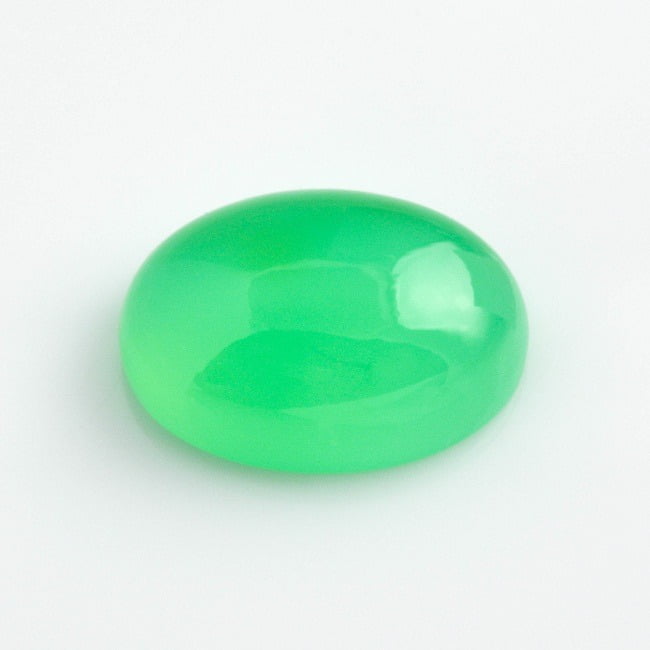
Chrysoprase is a semi precious gemstone of chalcedony quartz. Chrysoprase is apple green to lemon in color. It is mainly cryptocrystalline form of silicon dioxide. It is opaque, flecked, and often small and tumbled in appearance It is found commonly. The word Chrysoprase has been discovered from the Greek word, “chrusos” and “parson”. It is generally found in quartz bearing serpentine stone. It has a hardness of 6.5 to 7 on the Mohs scale. It has a luster of vitreous to waxy.
Gemologically, Natural Chrysoprase is an apple-green to greenish variety of Chalcedony, which consists mainly of microscopic silica or Quartz with the chemical formula SiO₂. Its distinctive green color is associated with nickel, particularly microscopic nickel-bearing silicate material. GIA analysis of modern Australian Chrysoprase confirms Ni²⁺ as the chromophore responsible for its characteristic green coloration.
The name Chrysoprase comes from the Greek chrysos, meaning “gold,” and prasinon, meaning “leek-green.” The original word “parson” is therefore a spelling error. Natural Chrysoprase ranges from yellowish-green and bright apple-green to deeper green and sometimes slightly bluish-green shades. It is usually translucent to opaque rather than always completely opaque.
Origin and Sources of Chrysoprase
Origin: Chrysoprase is mainly found in Russia, Brazil, Australia, Poland and Tanzania.
These are important Chrysoprase-producing regions, with Australia having particular historical and commercial significance. Western Australia has produced large quantities of quality Chrysoprase, and GIA reported new production from another Western Australian deposit in 2026. The studied stones ranged from yellow-green to blue-green and displayed gemological properties consistent with Chalcedony.
Tanzania is another scientifically documented source. GIA has studied commercial gem-quality Chrysoprase from the Haneti area of central Tanzania, where it occurs in altered serpentinite deposits associated with nickel-bearing geology. Poland is historically famous for Chrysoprase from Lower Silesia, while Brazil has also produced gem material.
Chrysoprase Gemological Properties
Natural Chrysoprase belongs to the wider Chalcedony and Quartz family and has good durability for jewelry.
- Gemstone – Chrysoprase
- Mineral family – Chalcedony / Quartz
- Chemical composition – Primarily SiO₂
- Color – Yellowish-green, apple-green to deeper green
- Coloring agent – Nickel
- Mohs hardness – 6.5 to 7
- Specific gravity – Approximately 2.58–2.64
- Refractive index – Approximately 1.530–1.543
- Transparency – Translucent to opaque
- Lustre – Waxy to vitreous when polished
- Cleavage – None
- Tenacity – Brittle but reasonably tough as a fine-grained aggregate
- Pleochroism – Absent
Gemdat records Chrysoprase at Mohs hardness 6.5–7, specific gravity approximately 2.58–2.64 and refractive index about 1.530–1.543. Recent GIA testing of Western Australian material produced comparable readings of RI 1.53–1.54 and specific gravity 2.59–2.65.
What Gives Chrysoprase Its Green Color?
Unlike Emerald, whose green is primarily linked to chromium and/or vanadium, Chrysoprase receives its characteristic apple-green coloration from nickel. Mindat describes the color as resulting from tiny inclusions of nickel-bearing layered silicates such as Willemseite, Népouite or related minerals.
GIA’s 2026 analysis of Western Australian Chrysoprase detected nickel and recorded characteristic Ni²⁺ absorption features. Chromium, iron and copper were not detected as significant color-producing elements in those samples.
Chrysoprase vs Emerald
Chrysoprase and Emerald can both show beautiful green coloration, but they are completely different gemstones. Chrysoprase is microcrystalline Chalcedony composed mainly of SiO₂ and colored by nickel, while Emerald is a crystalline variety of Beryl.
Chrysoprase has hardness around 6.5–7 and normally displays a waxy, translucent appearance. Emerald is usually transparent to translucent, has hardness around 7.5–8 and typically exhibits a more crystalline vitreous appearance. Therefore, Chrysoprase can be chosen as an attractive and affordable green gemstone, but it should not be described as gemologically equivalent to Emerald.
Chrysoprase Metaphysical Properties
Chrysoprase is used in ancient time to promote true love in life. It promotes hope and gives personal insights. It draws out talents and stimulates creativity. It is an excellent stone for increasing profits in the business. It heals personal relationship. This crystal energizes the heart and the sacral chakras. It brings universal energy to the body.
Psychologically, it brings calmness in the life of the wearer. This stone opposes judgementalism and stimulates acceptance of one. Mentally, it stimulates fluent speech and mental dexterity. It brings a sense of security and trust. It is useful in the healing and supports commitment.
In modern crystal traditions, Chrysoprase is commonly associated with love, compassion, emotional balance, optimism, creativity, confidence and forgiveness. Its green color also contributes to its traditional association with the Heart Chakra. Claims about chakra activation, universal energy or directly increasing business profits belong to metaphysical belief systems rather than scientifically measurable gemstone effects.
Why Chrysoprase Gemstone?
The green color of the stone helps the wearer to bring soothing feelings in the life. Its green color brings intense positive vibration in the wearer life. It is an excellent stone for improving eyesight. You can use this stone studded in the pendant and a finger ring for maximum benefit. Though, it is a semiprecious gemstone, it also carries powerful vibration for healing mental and physical dimension of the body. It is harmless and can be worn by anyone.
Note: You cannot use precious gemstone without your proper birth chart. But, it is recommended to use semi precious gems, even if you don’t have your correct horoscope.
The terms “precious” and “semi-precious” are traditional commercial classifications and do not determine whether one gemstone has greater healing power than another. Chrysoprase may be worn in ordinary jewelry according to personal preference, while horoscope and birth-chart recommendations belong to astrological traditions.
The statement that Chrysoprase is completely harmless also requires some qualification. Wearing a normal polished gemstone is generally very different from ingesting or grinding mineral material. Because Chrysoprase can contain nickel-bearing minerals and other natural impurities, avoid swallowing powdered material or inhaling dust generated during cutting, drilling or sanding.
Benefits of Chrysoprase
In crystal traditions, Chrysoprase is associated with emotional calmness, hope, confidence and maintaining healthier communication in relationships. Its refreshing apple-green color has also made it popular as a meditation stone for people interested in symbolic renewal, compassion and personal growth.
These traditional uses can be meaningful as part of personal or spiritual practices, but effects such as attracting prosperity, improving relationships or influencing emotional health should not be treated as guaranteed outcomes.
Chrysoprase Helpful in Career and Profession
Because Chrysoprase is traditionally connected with creativity, communication and self-confidence, it is sometimes used symbolically by artists, designers, speakers, students, entrepreneurs and other professionals who value these qualities.
Career growth and financial success, however, depend on skills, preparation, experience and practical decisions. A gemstone cannot scientifically guarantee business profit, career advancement or professional success.
Gems Therapy
Chrysoprase is an excellent for relaxation and peaceful sleep. It enhances fertility, and cures infertility. It resonates with the sacral chakra and is an excellent stone for the female. This stone treats gout, eye problems and mental illness.
As, it is connected to the sacral chakra, it also increases the absorption of vitamin c in the body. It also treats fungal infections. The elixir of this stone calms the stomach problems.
These statements represent traditional crystal-healing beliefs rather than scientifically established medical effects. There is no reliable clinical evidence that Chrysoprase treats infertility, gout, eye disorders, mental illness, fungal infections or digestive problems, or that it improves vitamin C absorption.
Fertility issues, vision changes, gout and mental-health conditions require appropriate professional medical assessment. A Chrysoprase gemstone should not replace prescribed medication, therapy or other evidence-based treatment.
Direct-contact gemstone elixirs are also best avoided. Chrysoprase can contain nickel-bearing mineral components and natural impurities, and there is no proven medical benefit from soaking the stone in drinking water. Keeping a gemstone outside a sealed drinking container is a safer symbolic alternative for anyone following crystal traditions.
Natural Chrysoprase vs Dyed Green Chalcedony
Natural Chrysoprase is colored by nickel, but green Chalcedony can also be artificially produced. Gemdat documents treatments in which greyish Chalcedony is colored using chromium- or nickel-containing solutions to create green or bluish-green material that may imitate Chrysoprase.
This makes treatment disclosure particularly important when buying intense green stones. Natural color is best supported through microscopic, spectroscopic and chemical testing rather than appearance alone.
The name Chrysoprase should also not be automatically applied to every green Chalcedony. Other materials, including chromium-bearing green Chalcedony and bluish-green varieties such as Aquaprase, have different coloring mechanisms. GIA has documented natural bluish-green Chalcedony colored by chromium and nickel that is commercially marketed under the Aquaprase trade name.
Chrysoprase Quality and Value
Fine Chrysoprase is generally valued for an attractive saturated apple-green color, good translucency, even color distribution, minimal distracting inclusions and excellent polish. Strong green color combined with translucency can be particularly desirable.
Very pale, heavily included, fractured or unevenly colored material may be less valuable, although natural patterns can still make individual cabochons attractive. GIA’s recent Western Australian specimens ranged from yellow-green through blue-green and included small natural whitish, brownish and fluid inclusions.
Because Chrysoprase is usually translucent rather than fully transparent, it is most commonly fashioned as cabochons, beads, carvings and polished freeform shapes instead of traditional faceted gems.
Chrysoprase Jewelry and Care
With Mohs hardness of approximately 6.5–7 and no cleavage, Chrysoprase is suitable for pendants, earrings, bracelets, beads, cabochons and rings when reasonable care is taken. Its fine-grained Chalcedony structure provides useful durability for everyday jewelry.
Clean Chrysoprase using lukewarm water, mild soap and a soft cloth or brush. Avoid harsh chemicals, abrasive cleaners, prolonged high temperatures and strong impacts. When treatment history is unknown, conservative cleaning is preferable because dyed or otherwise enhanced material may react differently from untreated natural Chalcedony.
Store Chrysoprase separately from harder gemstones such as Topaz, Sapphire and Diamond to reduce surface scratching.
Buying Certified Natural Chrysoprase
Wholesale Prices of Chrysoprase: Visit Astrokapoor office for buying certified, natural stone in a wholesale price. We provide certified natural gemstone.
When buying Certified Natural Chrysoprase, consider color, translucency, polish, cracks, natural mineral identity and treatment disclosure. An attractive apple-green to rich-green color with good translucency is particularly desirable, but unusually intense or uniform material should not automatically be assumed natural because dyed green Chalcedony can imitate Chrysoprase.
For higher-value stones, laboratory testing can help confirm that the gemstone is nickel-colored Chrysoprase rather than dyed Chalcedony, Prase Opal or another green gem material. GIA notes that Chrysoprase and visually similar Prase Opal can be separated by properties such as refractive index and specific gravity.
Frequently Asked Questions
What is Chrysoprase?
Chrysoprase is an apple-green to green variety of Chalcedony composed mainly of microcrystalline silica or Quartz.
What causes the green color of Chrysoprase?
The characteristic apple-green color is primarily associated with nickel, particularly nickel-bearing components dispersed through the Chalcedony.
What is the hardness of Chrysoprase?
Chrysoprase has a Mohs hardness of approximately 6.5 to 7, making it suitable for many jewelry applications with normal care.
What are the traditional benefits of Chrysoprase?
In crystal traditions, Chrysoprase is associated with love, optimism, creativity, emotional balance, confidence and compassion. These are traditional beliefs rather than scientifically proven medical effects.
Can Chrysoprase be artificially colored?
Yes. Green-colored Chalcedony can be produced using dyes or nickel- and chromium-based treatments, so certification and treatment disclosure are useful when natural Chrysoprase is specifically required.


