
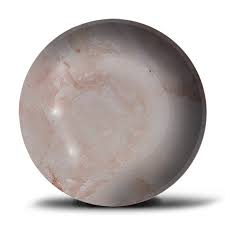
Dolomite is a natural carbonate mineral appreciated for its soft colors, attractive crystal forms and importance in mineral collections. It may occur in colorless, white, grey, pink, reddish-white, brownish-white and occasionally green shades. Natural Dolomite is commonly found as rhombohedral crystals, granular masses and compact material and may display a vitreous, pearly, waxy or resinous lustre.
Mineralogically, Dolomite has the chemical formula CaMg(CO₃)₂ and belongs to the Dolomite Group. It was named in 1791 by Nicolas Théodore de Saussure in honour of French geologist and mineralogist Déodat Gratet de Dolomieu. Dolomite has a Mohs hardness of approximately 3.5 to 4, specific gravity around 2.84 to 2.86 and a trigonal crystal system.
Dolomite Stone Benefits
In modern crystal traditions, Dolomite is often associated with emotional balance, patience, calmness, stability and a more positive outlook. Some people use Dolomite during meditation or personal reflection when they want to encourage peaceful thinking, emotional understanding and greater harmony in relationships.
Dolomite is also traditionally linked with grounding and balancing practices. Pink Dolomite is sometimes associated with compassion and emotional openness, while white Dolomite may be used symbolically for clarity and inner peace. These spiritual and metaphysical benefits belong to crystal traditions and are not scientifically established physical or psychological treatments.
Dolomite Gemological Properties
Natural Dolomite is a calcium magnesium carbonate mineral rather than a variety of Quartz or Calcite. Its important mineralogical properties include:
- Mineral name – Dolomite
- Chemical formula – CaMg(CO₃)₂
- Mineral group – Dolomite Group
- Color – Colorless, white, grey, pink, reddish-white, brownish-white and occasionally green
- Mohs hardness – 3.5 to 4
- Specific gravity – Approximately 2.84–2.86
- Crystal system – Trigonal
- Cleavage – Perfect rhombohedral cleavage
- Transparency – Transparent to translucent
- Lustre – Vitreous, pearly, waxy to resinous
- Streak – White
- Optical character – Uniaxial negative
- Refractive indices – Approximately 1.500–1.503 and 1.679–1.681
Mindat confirms Dolomite’s formula, hardness, density, trigonal crystal system and perfect cleavage.
Dolomite Mineral vs Dolostone
The name Dolomite can create confusion because it has historically been used both for the mineral and for a sedimentary rock. In modern geological terminology, Dolomite refers to the mineral CaMg(CO₃)₂, while the rock composed predominantly of this mineral is more clearly called Dolostone.
This distinction is useful when buying mineral specimens because a polished piece sold as “Dolomite stone” may be a massive Dolomite-rich rock rather than a single transparent Dolomite crystal.
Dolomite Color and Appearance
Dolomite commonly occurs in white, cream, grey and colorless forms, while pink and reddish varieties are particularly attractive for decorative and collectible use. Brownish shades can occur because of impurities, and green material is comparatively uncommon. Iron, manganese and other elements may be present as impurities and can influence coloration.
Well-formed Dolomite crystals often have distinctive rhombohedral shapes and curved crystal faces. Pink Dolomite specimens can be especially attractive when associated with Quartz, Calcite or other minerals.
Dolomite Healing and Metaphysical Properties
In crystal-healing traditions, Dolomite is used symbolically for calmness, emotional stability, self-confidence and maintaining balance during periods of change. It may also be kept in meditation spaces or homes as a decorative mineral associated with peaceful and grounding intentions.
Dolomite contains calcium and magnesium as part of its mineral structure, but wearing or holding Dolomite does not provide nutritional calcium or magnesium and should not be considered a treatment for mineral deficiency, bone disease or other health conditions. Medical concerns should always be managed through qualified healthcare.
How to Identify Natural Dolomite
Natural Dolomite can resemble Calcite because both are carbonate minerals and may share similar colors and crystal shapes. Dolomite is generally slightly harder than Calcite and has a Mohs hardness of about 3.5–4. It also has perfect rhombohedral cleavage and a specific gravity around 2.85.
Professional mineral identification may use optical properties, chemical testing or other laboratory methods. Appearance alone is not always reliable because Dolomite, Calcite, Magnesite and other pale carbonate minerals can look very similar.
Dolomite Jewelry and Decorative Uses
Dolomite can be polished into cabochons, beads, carvings, ornamental objects and decorative mineral pieces. Transparent crystals are also valued by mineral collectors. However, its low hardness and perfect cleavage mean it is less durable than gemstones such as Quartz, Topaz or Sapphire.
For jewelry, pendants, earrings and protected decorative pieces are generally more practical than exposed daily-wear rings. Strong impact can cause scratching, chipping or cleavage fractures.
Buying Natural Dolomite
When buying Natural Dolomite, consider color, crystal form, transparency, surface condition, polish and overall appearance. Pink Dolomite may be valued for attractive pastel coloration, while well-formed transparent or translucent crystals may appeal strongly to mineral collectors.
Buy from a reliable gemstone or mineral dealer and ask for accurate identification when purchasing higher-value specimens. Natural matrix, small inclusions and minor surface features may be normal and should not automatically be considered defects.
Dolomite Care and Cleaning
Dolomite requires gentle care because its Mohs hardness is only about 3.5 to 4 and it has perfect cleavage. Clean the stone with lukewarm water, mild soap and a soft cloth. Avoid abrasive powders, ultrasonic cleaners, steam cleaning, harsh household chemicals and strong acids.
Store Dolomite separately from harder gemstones because Quartz, Topaz, Sapphire and Diamond can easily scratch its surface. Avoid dropping the stone or exposing thin crystals to pressure because Dolomite is brittle.
Frequently Asked Questions
What is Dolomite?
Dolomite is a natural calcium magnesium carbonate mineral with the chemical formula CaMg(CO₃)₂. It belongs to the Dolomite Group.
What colors does Dolomite occur in?
Dolomite can be colorless, white, grey, pink, reddish-white, brownish-white and occasionally green.
What is the hardness of Dolomite?
Dolomite has a Mohs hardness of approximately 3.5 to 4, making it relatively soft compared with many jewelry gemstones.
What are the traditional benefits of Dolomite?
In crystal traditions, Dolomite is associated with calmness, emotional balance, grounding, patience and harmony. These are traditional beliefs rather than scientifically proven medical effects.
Is Dolomite suitable for jewelry?
Yes, Dolomite can be used for cabochons, beads, pendants and decorative jewelry, but careful handling is required because it is relatively soft and has perfect cleavage.


