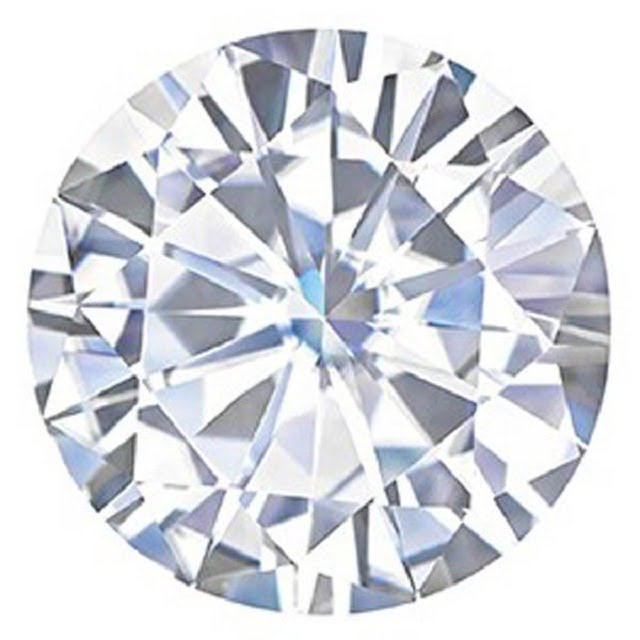
Moissanite is an extraordinary marble which was revealed by Henri Moissan. This was discovered by Henri Moissan, a noble prize winning chemist, so named as Moissanite. Firstly, it was identified as crystals as diamond, but later it was identified as silicon carbide. This stone is formed by the covalent bonding similar to the diamond, so it can withstand even high pressure of 52.7 gigapascals. Diamonds are too expensive to be used in the large ornaments, so Moissanite is used in place of diamonds to give beautiful appearance to the ornaments. It has the same optical properties as diamond.
Mineralogically, Moissanite is not a marble but naturally occurring silicon carbide with the chemical formula SiC. French chemist Henri Moissan discovered tiny natural crystals in material from the Canyon Diablo meteorite in Arizona in 1893. He initially believed the crystals were Diamond before identifying them as silicon carbide. The mineral was named Moissanite in his honour in 1905; Moissan later received the 1906 Nobel Prize in Chemistry for his work on fluorine and high-temperature chemistry.
Moissanite also does not have the same optical properties as Diamond. It resembles Diamond visually, but its refractive index, dispersion, birefringence, density and composition are different. GIA records synthetic gem Moissanite with refractive indices around 2.648–2.691, dispersion 0.104, Mohs hardness about 9.25 and specific gravity around 3.22. Its unusually high dispersion gives it stronger rainbow “fire” than Diamond.
Natural vs Lab-Created Moissanite
Natural occurring Moissanite is extremely rare and is found only in microscopic crystal. Natural source of silicon carbide is also very rare and only specific atomic arrangement is used for the making of jewelry. It is sourced from Arizona.
The Arizona reference relates mainly to the historic discovery of natural Moissanite in the Canyon Diablo meteorite rather than to a commercial source of natural jewelry gemstones. Natural Moissanite occurs as extremely rare tiny crystals in meteorites, kimberlites and a few unusual terrestrial environments. Mindat records Canyon Diablo, Arizona, as its type locality.
GIA states that although natural Moissanite exists, it is exceptionally rare and natural gem-quality material has not been found for normal jewelry production. As a result, essentially all faceted Moissanite sold for modern jewelry is laboratory-created silicon carbide.
This distinction is especially important for this product because the existing content later mentions Charles & Colvard. Charles & Colvard states that its Forever One™ Moissanite is lab-created and that natural Moissanite is too rare to supply fine jewelry. Therefore, if this specific product uses Charles & Colvard material, it should be described as Certified Lab-Created Moissanite rather than Certified Natural Moissanite.
Moissanite Gemological Properties
Color: Moissanite is clear and colorless like fine diamond.
Modern gem-quality Moissanite is commonly sold in colorless and near-colorless grades, although yellowish, greenish, blue, black and other varieties also exist. Natural Moissanite itself has been documented in green, black, blue, colorless, green-yellow and yellow shades.
- Material – Moissanite
- Chemical formula – SiC
- Chemical name – Silicon Carbide
- Common gem origin – Laboratory-created
- Natural occurrence – Extremely rare
- Mohs hardness – Approximately 9.25–9.5
- Specific gravity – Approximately 3.21–3.22
- Refractive index – Approximately 2.648–2.691
- Dispersion – Approximately 0.104
- Lustre – Adamantine to vitreous
- Transparency – Transparent in gem material
- Cleavage – Poor to indistinct
- Optical property – Doubly refractive in common gem polytypes
- Common crystal structures – Hexagonal/rhombohedral polytypes
Mindat gives natural Moissanite hardness around 9.5, density approximately 3.218–3.22 and primarily hexagonal or rhombohedral polytypes. GIA testing of synthetic jewelry Moissanite records hardness around 9.25 and strong double refraction.
Special Properties and Uses
Moissanite is hexagonal in shape. It is found rarely in iron nickel meteorites and ultra-mafic igneous rock. It looks like a monochrome diamond, but also found primarily in washy green color. It has a very tough pebble, so it is widely use in place of diamond.
This description is broadly connected with natural Moissanite but requires clarification. Moissanite can occur in meteorites and rare terrestrial geological environments, and numerous structural polytypes of SiC are known. Most natural grains belong to hexagonal or rhombohedral polytypes rather than one universal crystal form.
For jewelry, Moissanite is valued mainly because of its exceptional hardness, durability, brilliance and strong fire. Its hardness places it immediately below Diamond in scratch resistance among commonly used gemstones, making high-quality lab-created Moissanite suitable for engagement rings, earrings, pendants and other frequently worn jewelry.
Moissanite vs Diamond
Moissanite is widely selected as an alternative to Diamond, but the two should not be represented as chemically or optically identical. Diamond consists of carbon, while Moissanite consists of silicon carbide. Diamond is singly refractive, whereas common gem Moissanite is doubly refractive and can show doubling of facet junctions when examined from suitable directions.
Moissanite also has more than twice the dispersion or “fire” of Diamond and slightly greater brilliance according to GIA. This can create noticeably stronger rainbow flashes, particularly in larger stones. Diamond remains harder at Mohs 10, while Moissanite is approximately 9.25–9.5, which is still excellent for everyday jewelry.
How to Identify Moissanite
A trained gemologist can distinguish Moissanite from Diamond using its optical and physical characteristics. Strong double refraction may make pavilion facet junctions appear doubled under magnification, while its intense dispersion can create more obvious rainbow flashes. Older thermal Diamond testers can sometimes react to Moissanite similarly to Diamond because both conduct heat efficiently, so modern multi-testers or professional laboratory testing are more reliable.
Moissanite should also not be confused with Cubic Zirconia. CZ is zirconium dioxide and has lower hardness, different optical properties and a different crystal structure.
Healing Properties of Moissanite
Natural Moissanite is an excellent rumination stone. It provides composure and strengthens the inner self of the wearer. It provides radiance in all the walks of life. This stone helps to remove darkness form the inner self, and fills natural and spiritual awakening in the life. It persuades suspicion and abolishes annoyance.
In contemporary crystal practices, Moissanite may be used symbolically for clarity, confidence, inner strength, personal growth and spiritual reflection. These metaphysical associations are matters of personal or spiritual belief and are not scientifically established psychological or medical effects.
Because virtually all jewelry-sized Moissanite is laboratory-created, metaphysical descriptions should also avoid implying that a Charles & Colvard or other commercial jewelry stone is a naturally mined crystal.
Moissanite Benefits
Moissanite is used to access past life information and removes blockage or resistance to spiritual growth. It enhances telepathy especially in the initial practice. It blocks geopathic stress.
It can be used in jewelry, as a pendant or earrings.
Claims involving telepathy, past-life access, geopathic-stress protection or removal of spiritual blockages belong to metaphysical traditions and have not been scientifically demonstrated. Practical benefits of Moissanite are much easier to establish: it offers excellent hardness, strong brilliance, high dispersion and good durability at a price that can be significantly lower than a comparable Diamond.
Why Moissanite from Astrokapoor?
We carry only the top and natural Moissanite stone. We do not carry any older Moissanite gemstone. We carry only top quality “Charles and Clovard” stone. We do not have any imperfect stone. All the stones are lab tested and certified.
This section needs an important product-description correction. The correct brand name is Charles & Colvard, and its current Forever One™ Moissanite is explicitly described by the manufacturer as lab-created, not naturally mined. Charles & Colvard says it has produced lab-grown Moissanite commercially since the 1990s and currently markets Forever One™ as its premium created Moissanite.
Therefore, if AstroKapoor is supplying genuine Charles & Colvard material, an accurate statement would be that the product is premium certified lab-created Moissanite. The certificate or product documentation should also identify the manufacturer, cut, dimensions, color and clarity where applicable. Charles & Colvard notes that Forever One stones of qualifying sizes also carry its signature girdle engraving.
Moissanite Quality and Value
Quality in Moissanite is influenced by cut, color, clarity, symmetry, size and manufacturing quality. A well-cut stone can display exceptional brilliance and fire, while poorly proportioned cutting can reduce light performance even when the raw material is high quality.
Colorless and near-colorless Moissanite are especially popular for Diamond-style jewelry. Buyers should examine the stone in several lighting conditions because Moissanite can produce stronger spectral flashes than Diamond and some material may show subtle yellow, grey or green tones depending on quality and viewing angle.
Moissanite Jewelry and Care
Moissanite’s hardness of approximately 9.25–9.5 makes it highly suitable for rings, engagement rings, pendants, earrings, bracelets and necklaces. Although very resistant to scratching, jewelry settings and metal prongs can still become damaged, so normal care remains important.
Clean Moissanite using lukewarm water, mild soap and a soft jewelry brush, then rinse and dry with a lint-free cloth. Avoid unnecessary exposure to strong household chemicals, and periodically inspect frequently worn rings to ensure the setting and prongs remain secure.
Wholesale Prices of Moissanite: Visit Astrokapoor office for buying certified, natural stone in a wholesale price. We provide certified natural gemstone.
For accuracy, if the product is Charles & Colvard or another commercial jewelry Moissanite, “certified lab-created Moissanite” should replace “certified natural gemstone.” Natural Moissanite and commercial lab-created Moissanite are both SiC, but their origin must be clearly disclosed to buyers.
Frequently Asked Questions
Is Moissanite a natural gemstone?
Natural Moissanite does exist, but it is extraordinarily rare and usually occurs as tiny crystals. Virtually all jewelry-quality Moissanite available commercially is laboratory-created.
Is Charles & Colvard Moissanite natural?
No. Charles & Colvard’s Forever One™ Moissanite is lab-created silicon carbide and should be described as lab-created rather than naturally mined.
Is Moissanite the same as Diamond?
No. Diamond is carbon, while Moissanite is silicon carbide. They also differ in hardness, dispersion, refractive properties and crystal structure.
What is the hardness of Moissanite?
Gem-quality Moissanite is approximately 9.25–9.5 on the Mohs scale, making it one of the hardest and most durable gemstones used in jewelry.
Is Moissanite suitable for everyday jewelry?
Yes. Its high hardness and durability make Moissanite suitable for engagement rings, earrings, pendants and other frequently worn jewelry when it is properly set and cared for.


