
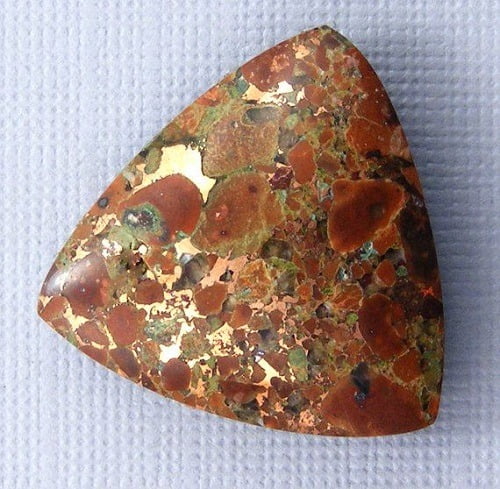
Copper is considered a mineral of energy and mental agility. In other term, copper is believed to be the metal of the God Hermes, who increases the mental agility, and quick reasons. Copper is a good conductor of energy, from electricity to the mystery of subtle energies emanating from higher planes, etc. Thus, copper enhances and transmit thoughts, even over long distances.
Copper though a necessarily micronutrient can cause copper toxicity in large amounts, so it is essential to use minute quantity of copper.
Copper is used in traditional folk remedy and crystal healing bring in additional energies for all types of healing, treatment of arthritis, relieving pain of broken bones, sexual instability, and low energy.
Natural Native Copper is elemental copper occurring naturally in metallic form rather than being chemically combined with another element in an ore mineral.
Its chemical formula is simply Cu. Fresh surfaces have the familiar copper-red color, while exposure to air can gradually produce darker brown, black or green alteration and tarnish.
Native Copper is recognized as a valid mineral species and belongs to the Copper Group. It was also one of the earliest metals worked by humans because natural metallic pieces could be shaped before advanced smelting technology developed.
Native Copper Meaning
Native Copper meaning in modern metaphysical traditions is associated with energy flow, mental clarity, motivation and communication.
Its excellent real-world electrical conductivity has also influenced symbolic crystal traditions in which Copper is described as a conductor of spiritual or metaphysical energy.
The electrical conductivity of copper is scientifically measurable, but claims about transmitting thoughts or subtle spiritual energies have not been scientifically established.
Native Copper Metaphysical Properties
Copper is traditionally associated with vitality, mental agility and the movement of energy.
Some metaphysical practitioners use Native Copper during meditation or combine it with other crystals because they believe Copper amplifies or directs their energetic properties.
Copper has also been symbolically connected with communication, creativity, confidence and personal motivation.
These uses belong to traditional spiritual or crystal-healing systems and are separate from copper’s scientifically demonstrated physical conductivity.
Traditional Healing Associations
Copper is used in traditional folk remedy and crystal healing bring in additional energies for all types of healing, treatment of arthritis, relieving pain of broken bones, sexual instability, and low energy.
Traditional Copper healing practices sometimes associate the metal with reducing discomfort, improving vitality and supporting physical energy.
However, wearing or carrying Native Copper has not been established as a medical treatment for arthritis, broken bones, sexual dysfunction, fatigue or other health conditions.
Copper should not replace professional diagnosis, medication or medical treatment.
Copper is an essential dietary micronutrient, but this does not mean that wearing Native Copper provides nutritional Copper to the body. Excess Copper exposure or intake can also be harmful. The NIH notes that excessive Copper intake can cause symptoms such as abdominal pain, nausea, vomiting and, in serious cases, liver damage.
Native Copper Mineral Properties
Native Copper is a native-element mineral consisting essentially of elemental Copper.
Typical mineralogical characteristics include:
- Chemical formula – Cu
- Mineral group – Copper Group
- Color – Copper-red
- Tarnish – Brown, black or green with exposure
- Streak – Copper-red
- Mohs hardness – Approximately 2.5 to 3
- Specific gravity – Approximately 8.94 to 8.95
- Crystal system – Isometric
- Lustre – Metallic
- Transparency – Opaque
- Cleavage – None observed
- Fracture – Hackly
- Tenacity – Malleable
- Common forms – Massive, wires, branching, dendritic and crystal forms
Mindat records Native Copper with Mohs hardness 2.5–3, specific gravity around 8.94–8.95 and an isometric crystal system.
Native Copper Crystal Forms
Native Copper can develop in several visually interesting shapes.
It may occur as branching or tree-like masses, fine wires, irregular metallic masses and occasionally well-developed crystals.
Documented crystal forms include cubes, dodecahedra and more complex combinations. Native Copper can also form distinctive arborescent or dendritic specimens that are especially attractive to mineral collectors.
Because Copper is malleable rather than brittle, it tends to bend or deform instead of breaking like many common silicate minerals.
Native Copper Uses
Native Copper was the only source of copper until the turn of the century, when extraction methods were improved. The Native Copper, is the main source of copper today. Even though, Native Copper is sometimes mined on its own for the copper content. Copper is the second as the most-used metal in the world.
The properties of conductivity, malleability, resistance, and beauty make it popular. The main uses of copper are in the electrical equipment. Due to the greatness of copper’s conductivity, it offers the lowest electrical resistance after silver. Copper is very ductile and can be changed into very thin wires, to serve as a primary electrical function. It is used manufacturing of electrical machinery such as motors, electromagnets, generators and communication devices.
For factual clarity, Native Copper is not the principal source of Copper in the modern mining industry. Most commercial Copper is extracted from Copper-bearing ore minerals, including sulfides such as Chalcopyrite and Chalcocite.
USGS notes that Native Copper is one of the relatively few metals that can occur naturally in a pure metallic state.
Copper remains one of the world’s most important industrial metals because of its combination of:
- High electrical conductivity
- High thermal conductivity
- Ductility
- Malleability
- Corrosion resistance
- Ability to form useful alloys
USGS states that electrical applications—including power transmission, building wiring, telecommunications and electronics—account for a major share of Copper consumption.
Electrical and Industrial Importance
Copper’s exceptional conductivity makes it particularly important for electrical wiring, generators, motors, transformers and telecommunications equipment.
It is also widely used in construction, transportation, industrial machinery, electronics, renewable-energy systems and plumbing.
Rather than being the “second most-used metal,” USGS describes Copper as ranking after iron and aluminium in terms of quantities consumed among major industrial metals.
Its ability to be drawn into thin wires without breaking is one of the reasons Copper remains fundamental to electrical infrastructure.
Native Copper Origin
Arizona also has several famous copper localities, specifically Ajo, Pima Co.; Morenci, Greenlee Co.; and Pinal Co. Bisbee, Cochise Co. is a very famous locality. It has one of the world’s largest copper mines, although mostly ore came out of this mine and Native Copper was comparatively scarce.
Arizona is an important Copper-producing region and contains numerous documented Native Copper occurrences.
Mindat records Native Copper specimens from several Arizona localities, including:
- New Cornelia Mine at Ajo, Pima County
- Morenci area, Greenlee County
- Ray Mine in Pinal County
- Bisbee, Cochise County
Associated minerals documented with Arizona Native Copper include Cuprite, Malachite, Calcite, Chrysocolla and Quartz.
Other Important Native Copper Localities
Native Copper occurs in many geological regions worldwide.
One of the most historically famous Native Copper regions is the Keweenaw Peninsula of Michigan, USA, where exceptionally large masses and attractive mineral specimens have been found.
Native Copper is also documented from locations in Australia and numerous other Copper-rich geological districts around the world.
Locality can be important to mineral collectors, particularly when a specimen has reliable mine and region information.
How to Identify Native Copper
Natural Native Copper can often be recognized by a combination of metallic color, density and malleability.
Typical identifying features include:
- Natural copper-red metallic color
- Copper-red streak
- Heavy feel for its size
- Metallic lustre
- Mohs hardness around 2.5–3
- Malleable behavior
- No observable cleavage
- Hackly fracture
- Green, brown or black surface tarnish on older pieces
Its unusually high specific gravity makes genuine Copper feel considerably heavier than many rocks of similar size.
Freshly exposed Copper may appear bright reddish metallic, while oxidation can gradually alter its surface appearance.
Native Copper Tarnish and Patina
Native Copper does not always retain a bright polished Copper color.
Exposure to oxygen, moisture and environmental compounds can produce darker surfaces and green secondary Copper minerals or corrosion products.
This natural weathering can form attractive patinas on old specimens.
Collectors should avoid aggressively polishing historically significant or naturally crystallized specimens because removing the natural surface may reduce their mineralogical or collectible character.
Native Copper Care and Safety
Native Copper specimens should normally be kept dry and handled gently if preserving their natural surface is important.
Use a soft dry cloth for light cleaning. Avoid strong acids, aggressive polishing compounds and household chemicals unless professional specimen restoration is intended.
Copper itself is an essential trace element, but excessive exposure or ingestion can be harmful.
Do not grind, drill or mechanically process mineral specimens without appropriate dust control, especially when the specimen contains other associated minerals whose complete composition is unknown.
Native Copper should also not be placed directly into drinking water for homemade mineral elixirs.
Native Copper for Collectors
Native Copper is particularly attractive to collectors because individual specimens can develop unusual natural shapes.
Branching dendrites, wires, arborescent masses and well-defined metallic crystals can command greater collector interest than ordinary massive Copper.
Important factors when selecting a specimen include:
- Natural crystal form
- Branching structure
- Size
- Condition
- Visible Copper color
- Attractive natural patina
- Associated minerals
- Verified locality
- Minimal repair or artificial modification
A specimen with documented mine provenance can be especially desirable for serious mineral collections.
Frequently Asked Questions
What is Native Copper?
Native Copper is naturally occurring elemental Copper with the chemical formula Cu. Unlike most Copper ores, the Copper is present in metallic form rather than being chemically combined with sulfur, oxygen or other elements.
What is the hardness of Native Copper?
Native Copper has a Mohs hardness of approximately 2.5 to 3. It is relatively soft, highly malleable and can deform rather than fracture like many brittle minerals.
Where is Native Copper found?
Native Copper occurs worldwide. Important documented localities include Michigan and Arizona in the United States, with Arizona examples occurring around Ajo, Morenci, Pinal County and Bisbee.
What are the traditional benefits of Native Copper?
In metaphysical traditions, Native Copper is associated with energy, mental clarity, communication and vitality. These are traditional beliefs and should not be confused with scientifically established medical benefits.
Is Native Copper the main source of Copper today?
No. Although Native Copper was historically important, modern commercial Copper production mainly comes from Copper-bearing ore minerals. Native Copper is now particularly valued as a mineral specimen and collector material.


