
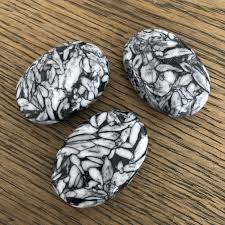
Pinolith, also commonly written as Pinolite, is a distinctive ornamental stone known for its beautiful black, grey and white natural pattern. The stone typically contains white to light-grey Magnesite crystals enclosed within a dark Dolomite-rich matrix. The contrasting Magnesite grains often resemble pine kernels, flowers or small leaves, giving every polished Pinolith specimen a unique appearance.
Mineralogically, Pinolith is not an individual mineral species with one fixed chemical formula. Mindat describes Pinolite as graphite-pigmented grey to almost black Dolomite containing white Magnesite grains that resemble pine kernels. It is therefore more accurately described as a naturally patterned multi-mineral rock or ornamental material rather than a single gemstone mineral.
Natural Pinolith is particularly associated with Austria, where historic Magnesite deposits have produced exceptional examples of this unusual material. Its elegant monochrome pattern, smooth polish and natural mineral contrast make it popular for cabochons, pendants, beads, palm stones, carvings and mineral collections.
Pinolith Meaning and Name
The name Pinolite is associated with the characteristic appearance of the white Magnesite crystals. Mindat explains that the grains resemble pine kernels, called “pinoli” in Italian, which inspired the name.
Because of its attractive white shapes against a dark background, Pinolith is sometimes compared visually with flower petals, ice flowers or abstract natural artwork. Some Austrian specimens are also referred to as “ice flower Magnesite” because of their decorative pattern.
“Pinolith” and “Pinolite” are both encountered commercially, but Pinolite is the spelling commonly used in mineralogical references. It is important to understand that Pinolite is not an IMA-approved individual mineral species; the name describes this characteristic Magnesite-Dolomite material.
Pinolith Composition and Gemological Properties
Pinolith does not have one fixed chemical formula because it contains more than one mineral. Its white crystals are mainly Magnesite, while the darker matrix commonly contains Dolomite and Graphite. Some specimens may also contain Calcite, Pyrite or other minor minerals.
Important Properties of Pinolith
- Material type – Multi-mineral ornamental rock
- Main white mineral – Magnesite
- Magnesite formula – MgCO₃
- Main dark matrix mineral – Dolomite
- Dolomite formula – CaMg(CO₃)₂
- Other possible components – Graphite, Calcite, Pyrite and minor minerals
- Typical color – White and light-grey patterns in dark grey to black matrix
- Pattern – Pine-kernel, flower-like or elongated crystal shapes
- Transparency – Generally opaque
- Lustre – Dull naturally to smooth or waxy/vitreous after polishing
- Magnesite hardness – Approximately 3.5–4.5
- Dolomite hardness – Approximately 3.5–4
- Main use – Cabochons, beads, carvings, pendants and decorative pieces
Magnesite has Mohs hardness around 3.5–4.5 and specific gravity approximately 2.98–3.02, while Dolomite has hardness around 3.5–4 and specific gravity approximately 2.84–2.86. Because Pinolith contains both minerals, it should not be assigned one exact hardness or specific-gravity figure for every specimen.
Where Is Natural Pinolith Found?
Austria is the classic source of Pinolite. The Magnesite deposit at Sunk near Hohentauern in Styria is considered a particularly important locality, and Mindat describes it as an excellent, world-class occurrence for Pinolite material.
Other documented Austrian occurrences include deposits in Lower Austria and several locations across Styria. Historically, Austrian material is the best-known source of the classic white Magnesite-in-dark-Dolomite appearance associated with the Pinolite trade name.
Pinolitic Magnesite rock is also scientifically documented at Quartz Creek in British Columbia, Canada. Research published in Geoscience Canada describes elongated white Magnesite crystals occurring in a contrasting dark matrix containing Dolomite, Chlorite, organic material, clay minerals and Pyrite. Some crystals in this Canadian occurrence reach up to about 30 cm.
How Does Pinolith Form?
Pinolith forms through geological processes involving magnesium-rich carbonate rocks and mineral-bearing fluids. In classic material, Magnesite develops as distinctive white crystals surrounded by darker carbonate-rich rock.
Research into Canadian pinolitic Magnesite suggests that magnesium-rich metasomatic fluids replaced pre-existing sedimentary Dolomite. Repeated fluid movement and fracturing allowed elongated Magnesite crystals to grow, producing the unusual contrasting patterns seen in polished sections.
This natural geological process is responsible for Pinolith’s individual patterns. Because crystal size, orientation and matrix composition vary from one specimen to another, two pieces rarely display exactly the same design.
Pinolith Metaphysical Properties
In modern crystal traditions, Pinolith is associated with calmness, emotional balance, relaxation and inner reflection. Its contrasting black-and-white appearance is often symbolically connected with balance, while the soft white Magnesite patterns are associated with peaceful meditation and a relaxed state of mind.
Some crystal practitioners use Pinolith during meditation to encourage patience, emotional awareness, self-reflection and a feeling of stability. It may also be kept in meditation rooms or personal spaces as a symbolic grounding stone.
These metaphysical properties are based on crystal-healing traditions and personal beliefs rather than scientifically established effects of Magnesite, Dolomite or Graphite.
Benefits of Pinolith Gemstone
Pinolith is traditionally associated with maintaining emotional calmness during stressful situations, encouraging positive thinking and supporting peaceful communication. It is also used symbolically by people who want to develop patience, focus and greater awareness of their emotional responses.
Its unusual natural pattern can itself make the stone useful as a meditation or mindfulness object. Looking closely at the contrasting Magnesite shapes can provide a visual focus during quiet reflection.
However, claims that Pinolith directly treats stress, anxiety, depression or other psychological conditions are not scientifically established. Persistent emotional or mental-health concerns should receive appropriate professional support.
Why Choose Pinolith?
Pinolith is attractive because it offers a natural pattern that looks very different from conventional transparent gemstones. Instead of brilliance or faceting, its beauty comes from contrasting white Magnesite crystals set against a dark Dolomite and Graphite-bearing background.
The stone can be especially appealing for buyers who prefer unusual mineral specimens, natural monochrome designs and individually patterned jewelry. Each cabochon or polished piece can display a different combination of flower-like, leaf-like or pine-kernel shapes.
Pinolith is also comparatively affordable compared with many traditional precious gemstones. However, the terms precious and semi-precious are commercial classifications and do not mean that all gemstones have the same mineralogical, astrological or healing properties.
Pinolith in Gems Therapy and Spiritual Practices
Pinolith is sometimes used in crystal practices for meditation, relaxation and symbolic emotional healing. Magnesite itself is commonly associated in metaphysical traditions with calmness and reflection, while dark-colored minerals are often symbolically linked with grounding.
These traditions do not mean that Pinolith can medically regulate the nervous system, cure anxiety, treat depression, improve blood circulation or heal physical disease. There is no reliable scientific evidence supporting such medical effects from wearing or holding Pinolith.
The stone can be used as a personal spiritual, decorative or mindfulness object, but it should not replace medication, diagnosis, counselling or other appropriate healthcare.
Pinolith Quality and Value
Pinolith quality is primarily visual. Attractive pieces generally display strong contrast between bright white or light-grey Magnesite crystals and a dark grey-to-black matrix. Clearly defined crystal shapes, balanced distribution, smooth polish and minimal damaging fractures can improve the appearance of a finished piece.
Some buyers prefer dense patterns containing many small white crystals, while others value specimens containing large elongated Magnesite shapes. Because the material is naturally patterned, there is no single “perfect” arrangement.
Austrian provenance can also be of interest to mineral collectors because Sunk, Hohentauern and other Austrian deposits are historically important Pinolite localities.
Pinolith Jewelry and Uses
Pinolith is commonly fashioned into cabochons, beads, pendants, bracelets, earrings, palm stones, spheres and ornamental carvings. Its black-and-white appearance works particularly well with silver-colored jewelry metals and simple cabochon settings.
Because its principal minerals have hardness around 3.5–4.5 and have cleavage, Pinolith is considerably softer than Quartz, Topaz or Sapphire. Pendants, earrings and beads are therefore generally more practical for regular use than exposed everyday rings.
Large polished slabs can also show the natural Pinolite pattern particularly well and are used as decorative or collector material. Mindat specifically notes that Pinolite is sometimes used as a decorative stone.
How to Care for Pinolith
Pinolith should be handled carefully because both Magnesite and Dolomite are relatively soft carbonate minerals. Avoid dropping the stone onto hard surfaces and keep it away from abrasive materials that may scratch the polish.
Clean Pinolith using a soft, slightly damp cloth or lukewarm water with a small amount of mild soap, followed by careful drying. Avoid acidic cleaners such as vinegar or lemon-based products because carbonate minerals can react with acids. Ultrasonic cleaners, steam cleaning, harsh chemicals and prolonged soaking are also best avoided.
Store Pinolith separately from harder gemstones such as Quartz, Topaz, Sapphire and Diamond. A soft pouch or lined jewelry box can help protect its polished surface.
Buying Certified Natural Pinolith
When buying Certified Pinolith, check the mineral identity, natural pattern, color contrast, polish, fractures and stated origin. Genuine classic Pinolith should show natural light-colored Magnesite crystals set within a contrasting darker carbonate matrix rather than an artificially printed or surface-painted pattern.
Certification is particularly useful when a seller makes specific claims regarding Austrian origin or mineral composition. Since Pinolith is a multi-mineral material rather than one approved mineral species, a laboratory report may identify the individual components, such as Magnesite and Dolomite, rather than simply giving one chemical formula.
For buyers seeking classic material, Austrian Pinolite—especially material associated with Styria—is particularly significant. Canadian pinolitic Magnesite is also scientifically documented, but its mineral assemblage and geological context can differ from classic Austrian examples.
Frequently Asked Questions
What is Pinolith gemstone?
Pinolith, also called Pinolite, is a naturally patterned ornamental rock composed mainly of white Magnesite crystals in a dark Dolomite-rich matrix, commonly containing Graphite.
Is Pinolith a single mineral?
No. Pinolith is not an IMA-approved individual mineral species and does not have one fixed chemical formula. It is a multi-mineral material primarily containing Magnesite and Dolomite.
Where is natural Pinolith found?
Austria is the classic and best-known source, particularly Magnesite deposits in Styria. Pinolitic Magnesite has also been scientifically documented in British Columbia, Canada.
What is the hardness of Pinolith?
Pinolith does not have one exact hardness because it contains several minerals. Magnesite is approximately 3.5–4.5 on the Mohs scale, while Dolomite is around 3.5–4.
What are the traditional benefits of Pinolith?
In crystal traditions, Pinolith is associated with calmness, meditation, emotional balance, patience and grounding. These are traditional metaphysical beliefs rather than scientifically proven medical effects.


