
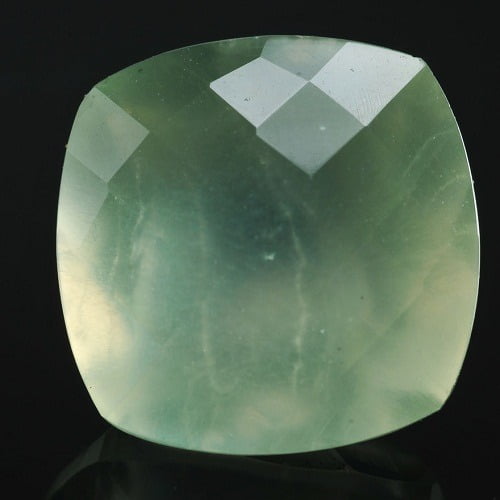
Prehnite is a stone of unconditional love. It is a transparent to translucent and the outer surface of Prehnite is shiny and soft in appearance. Prehnite is a composition of calcium aluminum silicate. Prehnite was first discovered in 1788 in the Karoo dolerites of Cradok, South Africa. It was named as Prehnite after its discoverer, Colonel Hedrick vom Prehn ( 1733 -1785 ), a Dutch mineralogist.
Natural Prehnite is an attractive mineral known particularly for its soft green, yellow-green and sometimes nearly colorless appearance. It is widely collected as polished stones, cabochons, beads and natural mineral specimens.
For mineralogical clarity, Prehnite has the chemical formula Ca₂Al₂Si₃O₁₀(OH)₂ and belongs to the orthorhombic crystal system. Mineral references credit Hendrik von Prehn with bringing early specimens from the Cape of Good Hope region of South Africa to Europe, and the mineral was named in his honor in 1788.
Prehnite Meaning and Natural Appearance
Prehnite meaning is traditionally associated with unconditional love, inner peace, harmony and spiritual awareness. Its gentle green appearance contributes to its popularity among people interested in meditation and metaphysical crystals.
Natural Prehnite commonly occurs in pale green, yellow-green, white, colorless and occasionally pale brownish shades. Gem-quality material is often translucent, while more transparent specimens may also be faceted.
Prehnite Gemstone Properties
Prehnite is a protective stone. It helps one to protect at all levels by imparting inner strength by increasing the energy of life force. Prehnite enhances the visualization process and induces deep meditation in which the higher self is contacted.
Prehnite helps you to make your home into a healing sanctuary by imparting the source of divine positive vibration. This stone teaches how to live in harmony with nature and the elemental forces. Prehnite crystals help to teach to let go the old memories that are painful and get associated with the bright incoming future. It will help you to recognize the true potential that lies within your divine self.
Prehnite metaphysical properties are commonly associated with calmness, meditation, emotional balance and personal awareness. Some crystal practitioners keep Prehnite in meditation spaces or carry a polished stone according to their personal spiritual practices.
These metaphysical properties are based on traditional crystal beliefs rather than scientifically established effects.
Prehnite and Meditation
Prehnite is traditionally regarded as a useful meditation crystal because of its association with calmness and visualization.
Its soft green color also contributes to its symbolic connection with harmony, nature and emotional balance. People may use a Prehnite Crystal during meditation, reflection or other spiritual practices according to personal preference.
Prehnite Gemstone Benefits
Prehnite is said to be the “heal healer”. A stone that is useful for the diagnosis and the root cause of the Kidney disease. Prehnite cures the thyroid gland, kidney, chest, shoulders and lungs.
Prehnite fosters a strong sense of trust in universal principle. Psychologically, Prehnite alleviates nightmares, phobias and uncovers the phobias that make them. It is also known as the good Feng Shui stone and is an excellent stone to place it in the garden. This stone teaches how to be in harmony with the nature.
Traditional Prehnite benefits are mainly associated with emotional calmness, harmony, confidence and maintaining a positive mindset.
Claims involving kidney disease, thyroid conditions, lungs, phobias or other medical and psychological conditions belong to traditional crystal-healing practices and are not scientifically established treatments. Prehnite should not replace professional medical diagnosis or healthcare.
Prehnite Chakra and Spiritual Uses
Prehnite is commonly associated with the Heart Chakra in modern crystal traditions because of its green coloration and symbolic connection with emotional harmony.
Some spiritual practices also connect Prehnite with intuition and inner awareness. It may be worn as jewelry, carried as a polished stone or placed in spaces used for meditation.
Chakra associations are spiritual traditions rather than scientifically measurable gemstone effects.
Prehnite Stone Value
Prehnite Color – It is found in the range of green colors that starts from pale green to dark green and yellow. A soft apple green color of Prehnite is the most desirable color of all. Prehnite stone jewelry is still used as a piece of beauty.
Prehnite Cut – It is often cut and polished en cabochon. But the highly transparent stone is faceted. It is often found in the tumbled bead.
Prehnite Treatment – No treatment is found in Prehnite
Prehnite Stone value can depend on color, translucency, clarity, size, cut and overall visual appearance.
Soft apple-green and attractive yellow-green stones are popular choices, while transparent material suitable for faceting is less common. Prehnite is frequently cut into cabochons because its translucent appearance and natural glow can be displayed effectively in this form.
Factors Affecting Prehnite Value
Important factors to consider when choosing Natural Prehnite include:
- Green or yellow-green color
- Color uniformity
- Transparency and translucency
- Clarity
- Cut and polish
- Carat weight
- Overall appearance
- Natural inclusions
- Gemstone identification
Each natural gemstone should be evaluated individually because color and transparency can vary considerably.
Prehnite Gemological Properties
Color – Yellow –Green, brown-yellow, gray, white and colorless
Cleavage – Good
Transparency – Transparent to translucent
Luster – Vitreous to Pearly
Hardness -6 to 6.5 on Mohs’ scale
Prehnite has a Mohs hardness of approximately 6 to 6.5, good cleavage and a vitreous to pearly lustre. Its specific gravity is generally about 2.80 to 2.95. The mineral belongs to the orthorhombic crystal system.
Because Prehnite is not as hard as Sapphire or Quartz, jewelry containing this gemstone should be treated with reasonable care to help protect its polished surface.
Prehnite Color and Clarity
Natural Prehnite is especially known for pale apple-green and yellow-green shades. Colorless, white, grey and pale brownish material can also occur.
Most gem-quality Prehnite is translucent rather than perfectly transparent. Individual stones may contain inclusions or internal features that contribute to their natural appearance.
Prehnite Jewelry and Uses
Prehnite can be fashioned into pendants, rings, earrings, bracelets, beads and cabochons. Its soft green coloration makes it suitable for both simple and decorative jewelry designs.
Cabochon cutting is particularly common, although sufficiently transparent material can also be faceted.
For collectors, natural Prehnite crystals and mineral aggregates can also be attractive display specimens.
How to Care for Prehnite Gemstone
Prehnite should be protected from hard impacts because it has good cleavage and moderate hardness.
For normal cleaning, use lukewarm water, mild soap and a soft cloth. Avoid aggressive chemical cleaners and rough handling.
Store Prehnite separately from harder gemstones such as Sapphire and Diamond to help protect its polished surface from scratches.
Frequently Asked Questions
What is Prehnite Gemstone?
Prehnite is a calcium aluminium silicate mineral generally known for its pale green to yellow-green appearance. It has a Mohs hardness of approximately 6 to 6.5 and is commonly cut into cabochons, beads and polished stones.
What are the traditional benefits of Prehnite?
In metaphysical traditions, Prehnite is associated with unconditional love, emotional balance, harmony, meditation and inner awareness. These are traditional crystal beliefs and are not scientifically established medical effects.
What color is Natural Prehnite?
Natural Prehnite commonly occurs in pale green, apple green and yellow-green shades. It can also occur in colorless, white, grey and pale brownish varieties.
How can I choose a good Prehnite Stone?
Consider color, translucency, clarity, cut, polish, carat weight and overall appearance. Attractive apple-green coloration and good translucency are popular characteristics when selecting Prehnite for jewelry.
Is Prehnite suitable for jewelry?
Yes. Prehnite can be used in pendants, rings, earrings, bracelets and beads. With a Mohs hardness of about 6 to 6.5 and good cleavage, it should be protected from scratches, strong impacts and harsh cleaning methods.


