
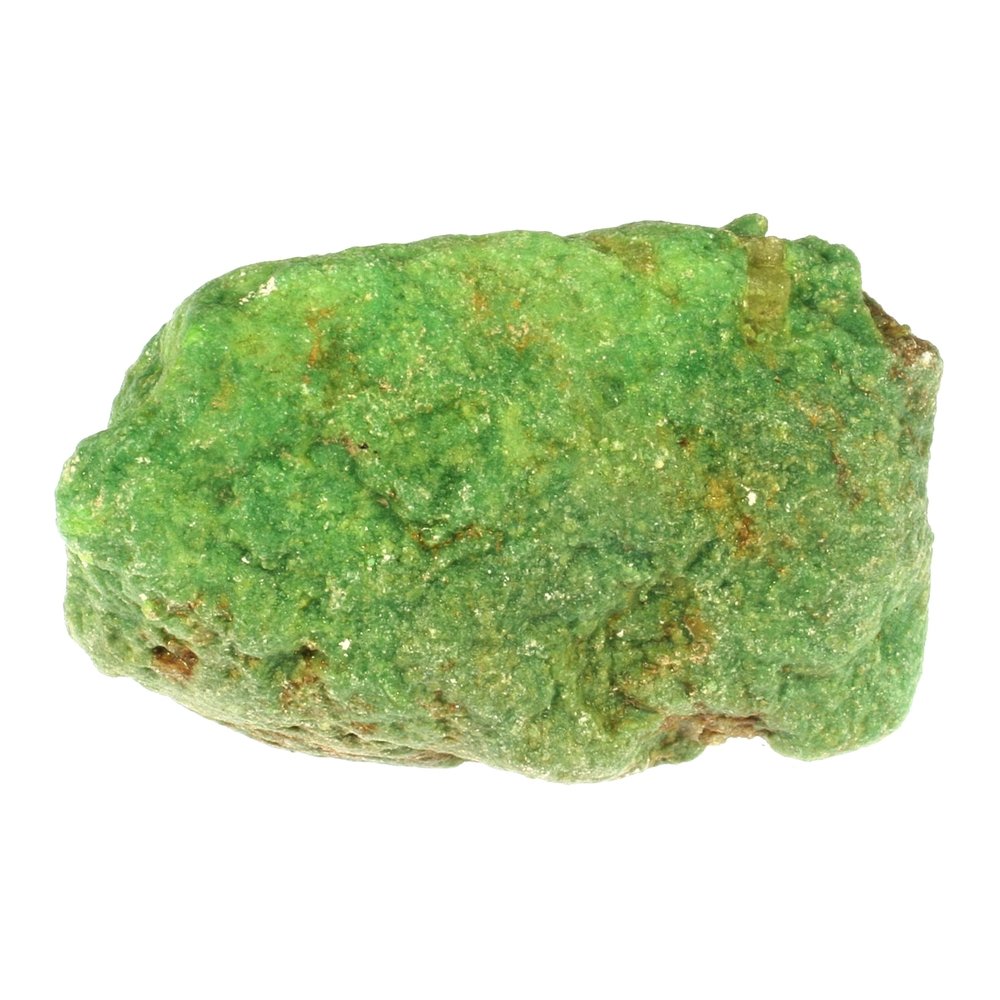
Gaspeite is an uncommon apple-green to yellowish-green stone that has drawn increasing attention from gem collectors in recent years. Its colour is unlike anything else in the mineral world — a flat, opaque lime green that no other natural stone quite matches, often marked with brown or grey host rock that makes each piece distinct.
Regarded as a double-action gemstone for its brown matrix and green hues, it is known for the confident use of personal influence to reach goals, and for recognising the spiritual within the everyday. It is said to clear away uncertainty, widen awareness beyond what the eye can see, develop a compassionate attitude and lift a negative outlook from the wearer’s mind. It is also used to stimulate the intellect, sharpen accuracy and increase knowledge. Traditionally worn for personal development or for the collective good, it is regarded as a gemstone of expression, one that draws out inner honesty, and it is associated with courage.
What Is Gaspeite? The Mineral Behind the Colour
Gaspeite is a nickel carbonate. That single fact explains everything else about it — the colour, the rarity, the price and the handling advice further down this page.
It was first described in 1966 at the Gaspé Peninsula in Quebec, Canada, which is where the name comes from. Today most gaspeite reaching the market is Australian, recovered from the nickel belts of Western Australia around Widgiemooltha and Kambalda, where it occurs in the weathered upper zones of nickel sulphide deposits.
Because it forms only where nickel ore has weathered in a very particular way, gem-quality gaspeite is genuinely scarce. It has become popular in Southwestern-style silver jewellery, where its lime green sits strikingly against turquoise and coral.
How to Tell Real Gaspeite from Dyed Magnesite
This is the most important thing to know before buying, because a large share of what is sold online as gaspeite is not gaspeite at all.
The usual substitutes are dyed magnesite and dyed howlite — cheap white stones with natural web-like veining, coloured green to imitate gaspeite. The tell-tale signs:
- Dye pooling in the veins. On a dyed stone the colour is darkest in the cracks and veining. Real gaspeite is coloured throughout its body, with the veins usually being the paler host rock.
- Colour that is too even. Genuine gaspeite varies in saturation across a single piece. Dyed material is uniformly bright.
- Colour on a cotton swab. A swab lightly dampened with acetone will pick up colour from dyed magnesite. It will not from natural gaspeite.
- Price that is too good. Real gaspeite is a rare mineral. If it is priced like turquoise chips, it is almost certainly dyed.
Always buy gaspeite with a certificate from a supplier who states the source.
Why Should I Wear Gaspeite?
This brilliant gemstone is said to help the wearer absorb new knowledge and improve both ability and judgement. Its lime green energy is described as stimulating mental activity and clarity of thought.
The various shades of green are believed to bring out the potential of the wearer in different ways, supporting the ability to learn and sustaining the energy needed to work through complex material.
Gaspeite is also associated with heightened awareness and clearer perception. It is described as increasing inventiveness, and is often reached for when someone wants to reawaken the will to finish a long-standing piece of work. By stirring the inner nature it is said to open up new directions worth exploring. It is regarded as an inspiring stone that promotes a lively, outgoing approach, translating good intentions into action and clear communication.
Benefits and Effects
Gaspeite is described as an uplifting stone that steadies a person through difficult periods.
It is also said to ease shyness and build social comfort with sincerity, and to help a person step away from relationships that were never going to last.
By fostering a sense of community it is associated with ideas and creativity directed at the common good, and with the model of service through cooperative effort. It is said to clear away misunderstanding, bringing hidden feelings to the surface where they can be resolved. It helps the wearer speak plainly, and to move beyond a narrow view towards a broader picture of the world.
The benefits most commonly associated with gaspeite are mental clarity and learning, confidence in social settings, creative momentum on unfinished work, honest communication, and a sense of connection to community.
Details
Origin – Gaspé Peninsula, Quebec, Canada and Western Australia
Colour – Apple green and yellowish green
Species – Nickel carbonate, with magnesium and iron
Hardness – 4.5 to 5 on the Mohs scale
Density – 3.71 g/cm³
Lustre – Vitreous to dull; opaque
Birthstone month – September
Ruling planet – Mercury
Associated chakra – Heart and solar plexus
Profession – Writer, theatre or film artist, painter, teacher and other professions as suggested by an astrologer
Jewellery metal – Silver, and any other metal as suggested by an astrologer
Wearing day – Wednesday
Significance – Gaspeite is said to align a person with their higher mind and with the larger pattern of their life, and to ease inner restlessness. By reducing emotional confusion it is believed to attract friendships and pleasant company. Largely connected to the heart chakra, it is associated with charm, depth and success in life, and it carries a reputation as a stone of good fortune for the person who keeps it. Its apple green energy is said to amplify the effect of other gemstones worn alongside it. The yellow-green tone is also linked to the solar plexus, the centre associated with personal power and confidence, and gaspeite is described as clearing obstructions across both centres so that a person can recognise their own desires and feelings clearly.
Is Gaspeite a Vedic Gemstone?
No. Gaspeite is not one of the nine Vedic ratnas and is not prescribed in Jyotish for any planet. The Mercury association above belongs to crystal tradition rather than Vedic astrology — the gemstone traditionally prescribed for Mercury is emerald (Panna).
That said, the Mercury pairing here is at least internally coherent: Wednesday is Mercury’s day, and Mercury governs intellect, learning and communication, which matches everything gaspeite is traditionally kept for.
Because gaspeite is not a prescribed ratna, there is no ascendant rule, no ratti weight, no trial period and no muhurat requirement — anyone can keep or wear it regardless of their birth chart. If you want a genuine Mercury remedy, a horoscope-based gemstone recommendation is the correct starting point.
Nickel Content — Safe Handling
Gaspeite is a nickel mineral, and that deserves a plain explanation rather than silence.
For wearing: nickel is the most common cause of contact allergy in jewellery worldwide. A polished, sealed gaspeite cabochon is not the same as raw nickel metal, but if you have previously reacted to costume jewellery, watch backs or belt buckles, a gaspeite piece worn directly against the skin may cause irritation. A bezel setting, a protective sealant, or wearing it as a pendant over clothing rather than as a ring are the practical solutions.
What not to do: never grind, cut, sand or polish gaspeite without proper dust protection, and never powder it. Nickel compounds are a recognised hazard in inhalable dust form. It should also never be soaked to make a drinkable crystal elixir. If you handle rough or unpolished material, wash your hands afterwards.
None of this makes gaspeite dangerous to own. It simply means it belongs in a display case or a well-made setting rather than in your mouth, your water glass or a grinding wheel without a mask.
Hardness and Everyday Wear
At 4.5 to 5 on the Mohs scale, gaspeite is soft. It will scratch against everyday dust, and as a carbonate it reacts to acids — even lemon juice or vinegar will etch the surface.
It suits pendants, earrings and brooches far better than rings worn daily. If you do want a ring, a bezel that sits slightly proud of the stone gives it the protection it needs.
Care and Cleaning
Do not use bleach or any harsh household chemical cleaner on gaspeite. Clean it with mild soapy water and a soft cloth, then rinse thoroughly with lukewarm water to remove any soap residue and dry it completely.
- Never use ultrasonic or steam cleaners
- Keep it away from vinegar, citrus, perfume and hairspray — carbonates etch on contact with acid
- Remove gaspeite jewellery before exercise, sport and heavy household work
- Store separately from harder stones, wrapped in a soft cloth
- Keep it out of prolonged direct sunlight and away from strong heat
Frequently Asked Questions
What is gaspeite?
Gaspeite is a rare apple-green nickel carbonate mineral, first identified at the Gaspé Peninsula in Quebec, Canada. Most material on the market today comes from the nickel deposits of Western Australia.
What is gaspeite good for?
In crystal tradition it is associated with mental clarity, learning, honest communication, social confidence and creative momentum, particularly on work that has stalled.
How can I tell if gaspeite is real?
Real gaspeite is coloured throughout, with natural variation in saturation. Dyed magnesite and howlite show colour pooling in the veins, look unnaturally uniform, and will often leave green on an acetone-dampened swab.
Is gaspeite safe to wear?
A polished, well-set stone is fine for most people. Because gaspeite contains nickel, anyone with a known nickel allergy should avoid direct skin contact or choose a bezel-set or sealed piece.
Can gaspeite go in water?
Brief cleaning with mild soapy water is fine. It should never be soaked for long periods, and never used to make a drinkable crystal elixir.
How hard is gaspeite?
It is 4.5 to 5 on the Mohs scale — soft, and additionally sensitive to acid because it is a carbonate. Pendants and earrings suit it better than daily-wear rings.
Which chakra is gaspeite connected to?
Primarily the heart chakra because of its green colour, with a secondary association to the solar plexus from its yellow tone.
Is gaspeite a navratna or a Vedic gemstone?
No. It is not among the nine Vedic gemstones and is not prescribed in Jyotish for any planet. It is kept as a crystal rather than as a planetary remedy.
Why is gaspeite so expensive?
It forms only where nickel ore has weathered under specific conditions, so gem-quality material is genuinely scarce. Cheap “gaspeite” is nearly always dyed magnesite.
Is gaspeite the same as turquoise or variscite?
No. It is a different mineral entirely, though it is often set alongside turquoise in Southwestern-style silver jewellery because the lime green and blue work well together.
Choosing Your Gaspeite
Every gaspeite piece differs in the depth of its green and the pattern of brown host rock running through it. Given how much dyed material circulates under this name, buy only from a supplier who states the source and provides a certificate. If you would like help choosing a piece, or want to know whether a prescribed Vedic gemstone suits your purpose better, Mr. Prashant Kapoor’s team is available for a personal consultation.


