
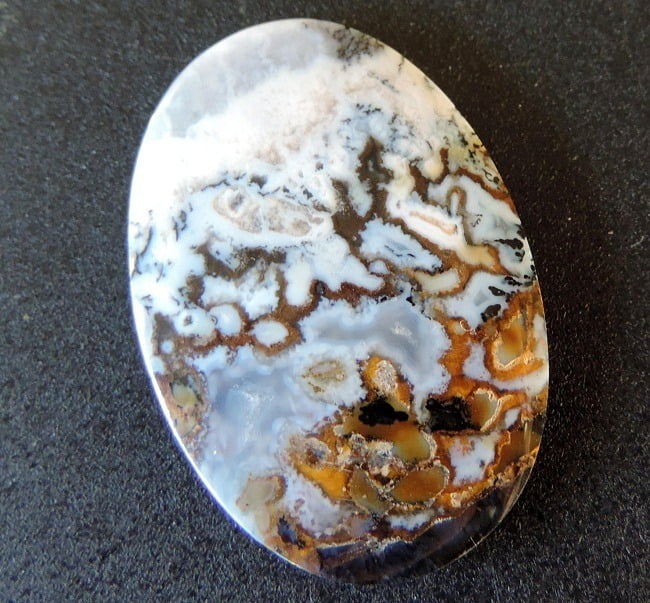
Dendritic agate is a semiprecious gemstone, which is also called as the stone of harmony. Dendritic agate has tree like appearance on the surface, so called as Dendritic Agate. It is found in clear, brown and green in color. It is often small and tumbled. It is readily available. Sometimes, it is found in colorless to white in color. It is a form of chalcedony. It is one of the rarest varieties of agate. It has 6.5 to 7 hardness on the Moh’s scale. It is free of cleavage and it can be identified by the composition of silicon dioxide and distinctive branch on the surface.
Gemologically, Natural Dendritic Agate is Chalcedony containing distinctive branching dendritic inclusions and has the basic chemical composition SiO₂. Mindat specifically classifies Dendritic Agate as a variety of Chalcedony containing dendritic inclusions. The patterns often resemble trees, moss, ferns, roots or miniature landscapes, but they are mineral formations rather than preserved vegetation.
The statement that the branches occur only “on the surface” also needs clarification. Dendrites commonly develop inside Chalcedony along microscopic fractures, interfaces and growth layers. GIA explains that minute particles of iron or manganese oxides can enter cracks while the Agate is forming and create the characteristic tree-like scenery.
Dendritic Agate should also not automatically be described as one of the rarest Agates. Commercial material is available, although exceptionally beautiful specimens with clear backgrounds, finely defined dendrites and natural landscape-like patterns can be uncommon and highly collectible.
Origin and Sources of Dendritic Agate
Origin: Dendritic Agate is found in United States, India, Iceland, Morocco and Brazil
Dendritic Chalcedony and Agate occur in several parts of the world wherever suitable silica-rich geological conditions and mineral-bearing fluids allow dendrites to develop. The United States, India, Brazil and several other regions are known sources.
India is particularly noteworthy for attractive scenic material. GIA has documented high-quality Dendritic Agate from central India and notes that Chalcedony from this region has been used in jewelry for centuries.
Origin itself does not determine quality. For decorative and collectible Dendritic Agate, the contrast of the dendrites, background translucency, natural pattern, cutting, polish and absence of distracting fractures are generally more important.
Dendritic Agate Gemological Properties
Dendritic Agate takes most of its physical properties from its Chalcedony host.
- Gem material – Dendritic Agate / Dendritic Chalcedony
- Main composition – SiO₂
- Mineral family – Quartz
- Variety – Chalcedony
- Pattern-forming material – Commonly manganese and/or iron oxides
- Color – Colorless, white, grey, brown, reddish, greenish or multicolored
- Mohs hardness – 6.5 to 7
- Specific gravity – Approximately 2.60–2.64
- Refractive index – Approximately 1.530–1.543
- Transparency – Transparent to translucent, sometimes opaque
- Lustre – Waxy naturally to vitreous when polished
- Cleavage – None
- Fracture – Uneven to conchoidal
- Structure – Fine-grained to cryptocrystalline silica aggregate
Agate generally has hardness around 6.5–7, specific gravity approximately 2.60–2.64 and refractive index around 1.530–1.543. These properties make Dendritic Agate reasonably durable for normal jewelry use.
What Creates the Tree-Like Patterns in Dendritic Agate?
The tree, fern and branch-like formations are called dendrites. They form when mineral-rich fluids move through tiny cracks or along layers in the Chalcedony and deposit manganese or iron compounds in branching patterns.
GIA research has shown that dendritic inclusions commonly found in Quartz and Chalcedony can consist of manganese oxide-hydroxide compounds. GIA also explains that the scenic patterns in Dendritic Agate can result from minute iron or manganese oxide particles entering cracks during formation.
Therefore, a pattern that looks remarkably like a tree or plant should not automatically be described as a fossil. The resemblance is created naturally by inorganic mineral growth.
Dendritic Agate vs Moss Agate
Dendritic Agate and Moss Agate can look similar, and the names sometimes overlap in commercial use. Both belong to the wider Chalcedony family, but their inclusion patterns are usually different.
Dendritic Agate is especially characterized by sharply branching, tree-like dark inclusions, commonly composed of manganese or iron oxides. Moss Agate more typically contains diffuse moss-like green inclusions, although brown or black manganese and iron-oxide dendrites can also occur in material sold as Moss Agate. Mindat notes that Moss Agate may contain green minerals such as chlorite or hornblende as well as brown-to-black iron or manganese oxide dendrites.
The distinction is therefore based mainly on appearance and trade usage rather than a completely separate chemical composition.
Dendritic Agate Metaphysical Properties
Dendritic agate is the stone of fullness and growth. It is widely used to enhance the yield of the crop and to maintain healthy plants. This creates a very soothing environment in the both inner and outer environment and encourages enjoyment. This crystal is particularly associated with plant kingdom.
Psychologically, it encourages in bringing stability in life. It clears confusion and directs towards proper path. It helps to remain connected with the root as you grow. It opens the chakras and bring higher consciousness.
Because of its natural tree-like patterns, Dendritic Agate has become strongly associated in crystal traditions with nature, growth, patience, stability and connection with the earth. Its visual resemblance to branches and landscapes also explains why it is sometimes used symbolically in gardening, agricultural and nature-focused spiritual practices.
There is no scientific evidence that keeping Dendritic Agate with crops increases agricultural yield or directly improves plant health. Chakra opening, higher consciousness and energetic grounding are also metaphysical beliefs rather than scientifically measurable properties.
Benefits of Dendritic Agate
In modern crystal traditions, Dendritic Agate is associated with patience, emotional stability, personal development, confidence and maintaining a stronger symbolic connection with nature. Some practitioners use it during meditation when focusing on gradual growth, long-term goals or a calmer state of mind.
Its unique patterns can also make each stone personally meaningful because no two natural dendritic formations are exactly alike. However, effects relating to good fortune, emotional transformation or spiritual development should be understood as traditional beliefs rather than guaranteed outcomes.
Healing and Dendritic Agate in Medical Astrology
Healing | Dendritic useful in Medical Astrology Treatment
Dendritic Agate heals the disease caused by chakra imbalances. It heals the blood circulatory system. It treats skeletal disorders. It is an excellent gemstone for the treatment of nervous system disorder. If provide relief from the pain.
These statements represent traditional crystal-healing and medical-astrology beliefs. There is no reliable scientific evidence that Dendritic Agate treats circulatory disease, skeletal disorders, neurological conditions or physical pain. Medical conditions involving the blood, bones, nerves or persistent pain require appropriate professional diagnosis and treatment.
Similarly, illnesses are not medically established as being caused by chakra imbalances. Dendritic Agate may be kept as a personal, spiritual or meditation object, but it should not replace healthcare.
Why Semi Precious Gemstone Dendritic Agate?
Semi precious gemstone has the same qualities as the precious gemstone. The semiprecious gemstone can be very well considered, if you are incapable of buying the precious gemstone. Although semi precious gemstone lack few characteristic of precious gemstone, but yet they have the quality which can act as a precious gemstone.
The terms “precious” and “semi-precious” are traditional commercial classifications rather than scientific measures of gemstone quality or effectiveness. Dendritic Agate is valuable for its natural mineral patterns, durability, individuality and decorative appeal rather than because it works in the same way as a precious gemstone.
Its relative affordability also makes naturally patterned specimens accessible for pendants, cabochons, rings, beads and mineral collections.
Dendritic Agate Quality and Value
Quality is strongly influenced by the visual appearance of the dendritic inclusions. Fine pieces may show crisp black, dark brown or reddish branching formations against a translucent white, colorless or pale-grey background. Stones in which the dendrites resemble trees, mountains or complete landscapes can be particularly attractive to collectors.
Good cutting is important because the lapidary must choose the correct orientation to expose the most interesting section of the internal pattern. A poorly positioned cut can hide an attractive dendrite, while a skilled cabochon or flat polished slice can transform the same material into a scenic gemstone.
Color contrast, pattern complexity, transparency, size, polish and overall composition are generally more useful indicators of desirability than simply labeling the variety “rare.”
Treatments and Identification
A natural dendritic pattern should appear integrated with the Chalcedony and may follow internal fractures or growth interfaces. Magnification can help distinguish naturally deposited mineral branches from painted, printed or surface-applied designs.
Agate as a broader gem material can be dyed into many colors. Gemdat documents multiple traditional dyeing methods for Agate, including treatments producing green, red and other colors. Therefore, unusually intense background colors should be accompanied by appropriate treatment disclosure when the stone is sold as natural-color material.
For expensive scenic specimens, certification can help confirm the Chalcedony identity and identify obvious treatments or imitations.
Dendritic Agate Jewelry and Care
With hardness around 6.5–7 and no cleavage, Dendritic Agate is suitable for pendants, earrings, bracelets, beads, cabochons and rings. Its patterns are generally best displayed using cabochon, flat-polished or freeform cuts rather than complex faceting.
Clean the stone using lukewarm water, mild soap and a soft cloth or brush. Avoid strong impacts, harsh household chemicals and prolonged extreme heat. Conservative cleaning is especially advisable when treatment history is unknown.
Store Dendritic Agate separately from harder gemstones such as Topaz, Sapphire and Diamond to reduce scratching.
Wholesale Prices of Dendritic Agate: Visit Astrokapoor office for buying certified, natural stone in a wholesale price. We provide certified natural gemstone.
When buying Certified Natural Dendritic Agate, consider pattern definition, background clarity, polish, treatment disclosure and overall design. Fine natural branching should be treated as the main visual feature rather than as an imperfection.
Frequently Asked Questions
What is Dendritic Agate?
Dendritic Agate is a variety of Chalcedony containing naturally formed branching mineral inclusions that resemble trees, ferns, roots or landscape scenes.
Are the tree patterns in Dendritic Agate real plants?
No. The tree-like patterns are mineral dendrites, usually formed from manganese and/or iron oxide compounds rather than fossilized plants.
What is the hardness of Dendritic Agate?
Dendritic Agate generally has a Mohs hardness of approximately 6.5 to 7 and has no cleavage, making it suitable for many jewelry applications.
What are the traditional benefits of Dendritic Agate?
In crystal traditions, Dendritic Agate is associated with growth, patience, stability, harmony, meditation and connection with nature. These are traditional beliefs rather than scientifically proven medical effects.
Is Dendritic Agate the same as Moss Agate?
Not exactly. Dendritic Agate is particularly known for sharp branching mineral patterns, while Moss Agate generally has softer moss-like inclusions. However, the two terms can overlap in some commercial material.


