
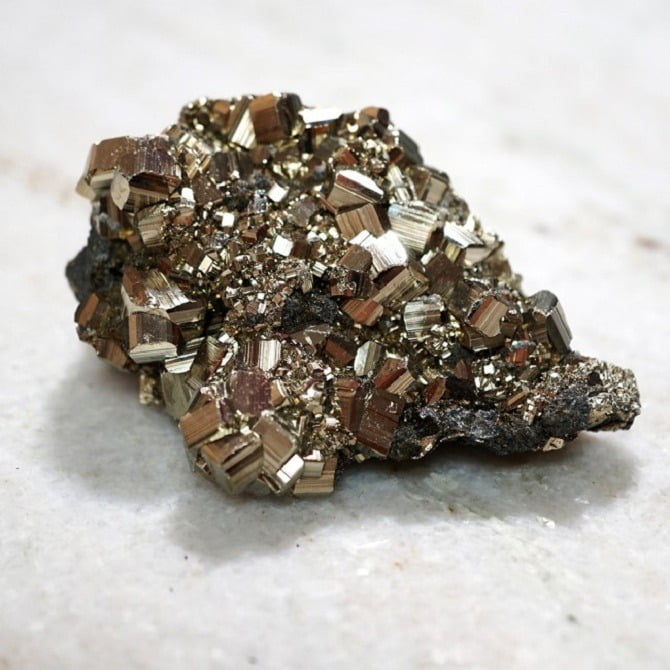
Pyrite is the mineral which is known as “Fools Gold”. Pyrite is a composition of Iron sulfide. Pyrite is pale brass yellow in color, so it resembles as gold. An, Earth element, it is associated with fire energy, symbolizes warmth and enduring presence of the Sun. Pyrite is a protective stone and it protects the wearer from the negative energy aura. Pyrite is masculine in nature, and is a stone of protection. Pyrite is also found in Rainbow shade, it is called as Rainbow Pyrite. Rainbow Pyrite is the trade name for iridescent form of ‘pyrite druzy’. Druzy is the term used to denote encrustations and clusters of minute of crystal. Along with the ‘druzy’, it is also closely related to marcascite. But marcascites are not suitable for jewelry. Pyrite is also known as ‘Iron Pyrite’, due to huge content of iron. The word pyrite is derived from the Greek word ‘Pyr’, which denotes fire. It also produces spark, when struck by steel or flint.
Mineralogically, Pyrite is iron disulfide with the chemical formula FeS₂. Its pale brass-yellow metallic appearance frequently caused it to be mistaken for Gold, giving rise to the famous name “Fool’s Gold.” The name Pyrite comes from the Greek word related to fire because the mineral can produce sparks when struck against metal or another hard material. Pyrite has an isometric crystal structure, while Marcasite has the same FeS₂ composition but an orthorhombic structure, making the two minerals dimorphs rather than the same mineral.
Pyrite is highly found in sedimentary deposits in metamorphic rocks. It is formed as brasses, slates, grains and globes. Traditionally, Pyrite is known as stone of luck. It attracts abundance and destroys negative energies. This quality renders pyrite to be used in grid works and rituals. Pyrite can enhance one’s will during the challenging time. If meditating with Pyrite, it helps to get associated to the higher spiritual soul. Pyrite encourages greater frequencies in moment of inspiration.
Pyrite is actually a very common natural sulfide mineral and occurs in a wide variety of geological environments, including sedimentary rocks, metamorphic rocks, hydrothermal veins and igneous-related deposits. It can form impressive cubes, pyritohedrons, octahedrons, granular masses, nodules and fine crystal aggregates.
Rainbow Pyrite Meaning and Appearance
Rainbow pyrite is also known as the stone of manifestation. In ancient era, pyrite was used as mirrors by the Native Americans. Rainbow Pyrite was used as an amulet by the talisman in the long journey.
Rainbow Pyrite is a trade name for naturally iridescent Pyrite drusy made up of numerous tiny crystals. GIA reports notable natural Rainbow Pyrite material from the Volga River region of Russia. Its surface can display gold, copper, green, blue, pink and other iridescent shades, with the color effect resulting from light interacting with the crystal surface.
Rainbow Pyrite should not be confused with every artificially coated metallic drusy material. When natural origin and treatment status are important, buyers should request reliable identification or certification.
Pyrite Origin and Sources
Pyrite is found in many localities around the world, but mainly found in Germany, Peru, Mexico, Spain, Romania, USA and South Africa.
Pyrite is extremely widespread and occurs in thousands of mineral localities worldwide. Peru and Spain are particularly famous among mineral collectors for well-formed Pyrite crystals, but excellent specimens also occur in many other countries. Geographic origin alone does not determine quality; crystal form, metallic lustre, surface condition, size and overall appearance are important for collectible material.
Pyrite Gemological Properties
Natural Pyrite has several properties that make it relatively easy to distinguish from real Gold:
- Mineral – Pyrite
- Chemical formula – FeS₂
- Mineral group – Pyrite Group
- Color – Pale brass-yellow
- Streak – Greenish-black
- Mohs hardness – 6 to 6.5
- Specific gravity – Approximately 4.8–5.0
- Crystal system – Isometric
- Transparency – Opaque
- Lustre – Metallic
- Cleavage – Poor to indistinct
- Tenacity – Brittle
- Fracture – Uneven to conchoidal
Mindat reports Pyrite at Mohs hardness 6–6.5 with specific gravity about 4.8–5.0, metallic lustre, greenish-black streak and an isometric crystal system.
Pyrite vs Gold
Although Pyrite resembles Gold in color, the two are very different materials. Pyrite is harder, brittle and commonly forms sharp geometric crystals, while natural Gold is much softer, highly malleable and substantially denser. Pyrite also leaves a dark greenish-black streak, which is quite different from Gold’s yellow streak. These properties explain why Pyrite can be recognized as “Fool’s Gold” despite its attractive metallic appearance.
Metaphysical and Crystal Healing Properties
Pyrite promotes good physical health. It promotes emotional well being. This stone is helpful in all types of infections and purify the system of the body. It increases vitality during the time of stress. Pyrite is also used for balancing one’s energetic field. It is a great gift for people who are in convalescence. It increases oxygen supplies to the blood. It also strengthens the respiratory and circulatory system. It is beneficial for lungs and alleviates asthma. Pyrite strengthens the bones, and also repair damage DNA.
In modern crystal traditions, Pyrite is more appropriately associated with confidence, motivation, protection, determination, prosperity and abundance. Its bright golden metallic appearance contributes to its symbolic relationship with wealth and success. Claims that Pyrite treats infections, asthma, blood circulation, DNA damage, bones or respiratory conditions are not scientifically established medical effects and should not replace professional healthcare.
Pyrite Chakra Healing
Pyrite stimulates the third eye chakra or solar plexus. This chakra is associated with immune system. The strong Solar plexus helps to protect form the disease and infections.
Pyrite is commonly connected with the Solar Plexus Chakra in contemporary crystal practices and is used symbolically for confidence, willpower, personal strength and motivation. Some traditions may also connect it with additional chakras. Chakra practices are spiritual traditions and there is no scientific evidence that strengthening a chakra prevents infection or changes immune-system function.
Pyrite Stone for Prosperity and Positive Energy
Pyrite is traditionally known as a stone of luck and abundance. Its gold-like metallic appearance has made it popular in meditation spaces, offices and homes where it may be used as a symbolic reminder of confidence, financial discipline and personal goals. Some people also keep Pyrite on a work desk when focusing on business, creativity or motivation.
These prosperity and protective associations belong to Feng Shui, crystal-healing and metaphysical traditions. Financial or professional success depends on practical decisions, skills, planning and circumstances rather than possession of the gemstone.
How to Buy Certified Natural Pyrite
When buying Natural Pyrite, consider metallic brightness, crystal shape, surface condition, size and absence of severe oxidation or crumbling. Well-formed cubic or pyritohedral crystals can be particularly attractive to mineral collectors, while polished Pyrite and drusy material may be selected for jewelry and decorative objects.
For Rainbow Pyrite, evaluate the brightness and range of iridescent colors as well as the condition of the tiny drusy crystals. Certification or reliable seller disclosure is helpful when distinguishing naturally iridescent Pyrite from coated or otherwise modified material.
Pyrite Gemstone Jewelry and Care
Pyrite gemstone jewelry is quite delicate when compared to common gemstone. The durability of the gemstone depends upon the crystal durability. It should be cleaned with the plain water and soap. This gemstone should be removed while doing harsh work. Rainbow pyrite should be cleaned only with plain water. Soft cloth should be used for cleaning. Soft tooth brush can also be used, but hard brush should be avoided. Do not use any harsh soap or chemical.
Pyrite is reasonably hard but brittle, and moisture deserves particular attention. Pyrite can oxidize when exposed to oxygen and excessive humidity, and conservation authorities note that prolonged high humidity can eventually damage susceptible specimens. Therefore, avoid prolonged soaking, dry Pyrite thoroughly after cleaning and store valuable mineral specimens in a reasonably dry environment.
For delicate Rainbow Pyrite drusy, use an especially gentle dry or barely damp soft brush rather than aggressive scrubbing. Avoid steam cleaners, ultrasonic cleaning, acids and strong household chemicals. Direct-contact gemstone elixirs are also not recommended because Pyrite is an iron sulfide mineral that can alter through oxidation.
We provide natural, certified Pyrite stone in a wholesale price. You can also buy pyrite online from our astrostore.
Frequently Asked Questions
What is Pyrite?
Pyrite is a natural iron disulfide mineral with the chemical formula FeS₂. Its brass-yellow metallic appearance gives it the popular nickname “Fool’s Gold.”
How can Pyrite be distinguished from real Gold?
Pyrite is harder and brittle, has a greenish-black streak and commonly forms geometric crystals. Gold is much softer, malleable and considerably denser.
What is Rainbow Pyrite?
Rainbow Pyrite is the trade name for naturally iridescent Pyrite drusy composed of many tiny crystals that can display gold, green, blue, pink and copper-colored reflections.
What are the traditional benefits of Pyrite?
In metaphysical traditions, Pyrite is associated with confidence, motivation, protection, abundance, prosperity and personal strength. These are traditional beliefs rather than scientifically proven medical benefits.
Can Pyrite be used in jewelry?
Yes. Pyrite is used in pendants, earrings, beads, rings and decorative jewelry, but it is brittle and should be protected from strong impacts, harsh chemicals and prolonged moisture.


