
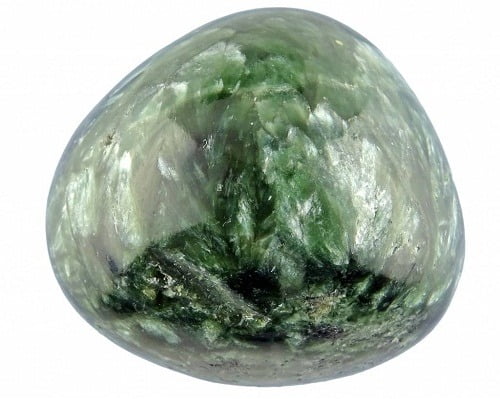
Seraphinite is the name given to a variety of clinochlore belonging to the chlorite group. This name has been derived from the Greek word “seraphim”, which refers to a celestial being with three pairs of wings, and this could be due to the silvery feather-like chatoyant fibres that are present on seraphinite. These fibres have evolved due to the deposition of mica. Seraphinite is a typically dark-green to grey in color, with a contrasting silvery color that shimmers on the stone. It is a soft stone and lacks hardness, so called as a jewelry stone.
Natural Seraphinite is an attractive green ornamental gemstone recognized for its silvery, feather-like patterns. These radiating markings can appear like angel wings when the polished stone is moved under light, which inspired its commercial name.
Mineralogically, Seraphinite is a variety of Clinochlore, a mineral belonging to the Chlorite group. Mindat describes Seraphinite specifically as Clinochlore with a radiating or plumose structure used for decorative stones and carvings.
The shimmering feather effect is therefore best understood as being related to the radiating, fibrous or platy structure of the Clinochlore material. It should not automatically be described as a separate deposit of mica in every specimen.
Seraphinite Meaning
The name Seraphinite is associated with “Seraphim,” referring to angelic beings, because its bright silvery patterns resemble feathered wings.
In modern crystal traditions, Seraphinite meaning is associated with spiritual awareness, emotional balance, personal growth and meditation.
Its deep green coloration is commonly linked with the Heart Chakra, while its silver feather-like patterns contribute to its modern association with angelic or higher spiritual practices.
These metaphysical meanings are traditional beliefs rather than scientifically measurable gemstone properties.
Seraphinite Healing Properties
If placed on the third eye or meditated with, Seraphinite is a stone of spiritual enlightenment and is an excellent for accessing self-healing. It is one of the crystals for making an angelic connection, and for opening the third eye chakra and higher crown chakras. This tone promotes living from the heart and has a gently cleansing effect on the heart chakra, heals any afflictions to the heart chakras.
It has a beautiful feathery wings, whisk one to a high spiritual vibration and it is excellent for making a journeys out of the body, protecting the physical body while one is gone. It also assists on reviewing the progress of life and identifying the changes needed to put one on the path of peace and fulfillment.
In metaphysical traditions, Seraphinite is primarily associated with meditation, emotional reflection, compassion and developing a sense of inner peace.
Its green coloration has contributed particularly to its traditional connection with the Heart Chakra, while its unusual silvery patterns are sometimes linked with the Third Eye and Crown Chakras.
Claims involving angelic communication, out-of-body journeys or energetic protection belong to spiritual belief systems and are not scientifically established effects.
Emotional and Spiritual Associations
Seraphinite may be used during meditation as a symbolic stone for reviewing personal goals and reflecting on changes in life.
Crystal practitioners traditionally associate it with:
- Emotional balance
- Compassion
- Personal reflection
- Spiritual awareness
- Meditation
- Acceptance of change
Individual experiences with crystals vary, and these traditional associations should be considered separately from scientifically established health or psychological treatments.
Seraphinite Color
Seraphinite is found in the dark-green to gray, with silvery inclusions on the body surface. These silvery mica are distributed throughout the stone.
Natural Seraphinite is best known for a dark forest-green to greenish-grey body color crossed by lighter silver, grey-green or whitish radiating patterns.
The most desirable polished material often shows strong contrast between the dark green background and bright feathery markings.
The silver appearance should not automatically be interpreted as metallic silver or as a separate mica mineral. The characteristic pattern is principally associated with the radiating or plumose Clinochlore structure.
Seraphinite Clarity and Lustre
Seraphinite is translucent to opaque and the translucence appaerance is present on the silver fibres exhibiting chatoyancy. The lustre of seraphinite is pearly, vitreous, greasy or dull.
Gemological references describe Clinochlore and Seraphinite as transparent to translucent in thinner material, while ornamental pieces are commonly translucent to opaque.
Its lustre may range from pearly and greasy to dull, with polished surfaces displaying attractive reflective feather-like structures. Gemdat reports refractive indices of approximately 1.571–1.597 for Clinochlore.
Seraphinite Cut and Shape
Seraphinite is typically cut en cabochon. The fancy cut or carved into spheres or other shapes.
Cabochon cutting is particularly suitable for Seraphinite because a broad polished surface displays its radiating silver patterns effectively.
Common forms include:
- Oval cabochons
- Pear-shaped cabochons
- Pendants
- Beads
- Spheres
- Freeform polished stones
- Carvings
- Collector slabs
Seraphinite is considerably softer than many popular jewelry gemstones, so faceting is less common and protective jewelry designs are preferable.
Seraphinite Gemological Properties
Seraphinite is a dense fine-grained variety of Clinochlore rather than an independent mineral species.
Typical properties include:
- Mineral – Clinochlore
- Mineral group – Chlorite group
- Variety – Seraphinite
- Chemical formula – (Mg,Fe²⁺)₅Al(Si₃Al)O₁₀(OH)₈
- Color – Dark green to grey
- Mohs hardness – Approximately 2 to 2.5
- Specific gravity – Approximately 2.60 to 3.02
- Refractive index – Approximately 1.571 to 1.597
- Crystal system – Monoclinic
- Cleavage – Perfect
- Transparency – Transparent to translucent as a mineral; commonly translucent to opaque in ornamental material
- Lustre – Pearly, greasy or dull
- Pattern – Radiating, plumose or feather-like
Gemdat records Clinochlore hardness at only 2–2.5 with perfect cleavage, making Seraphinite quite soft compared with Quartz, Topaz, Sapphire or Diamond.
Why Is Seraphinite So Soft?
Seraphinite’s softness is related to the layered crystal structure of Clinochlore.
With a Mohs hardness of only about 2 to 2.5 and perfect cleavage, it can be scratched relatively easily and may be damaged by impact.
This does not prevent its use in jewelry, but it makes pendants, earrings and protected decorative pieces more practical than rings intended for everyday wear.
Where Is Natural Seraphinite Found?
Natural Seraphinite is especially associated with Russia.
Mindat documents Seraphinite from the Korshunovskoye iron deposit near Zheleznogorsk-Ilimsky in the Nizhneilimsky District of Irkutsk Oblast, Russia. The locality contains confirmed Clinochlore variety Seraphinite material exhibiting characteristic green and silvery radiating structures.
Russian material is particularly well known in the gemstone and mineral trade because of its dramatic feather-like patterns.
Collectors looking for high-quality Seraphinite should consider locality information together with pattern, color, polish and condition.
Seraphinite Treatment
Seraphinite is sometimes polymer impregnated that improves its durability. However, untreated gemstones are available everywhere and all reputable gemstone traders declare any treatments or enhancements.
Because Seraphinite is naturally soft and has perfect cleavage, stabilization or impregnation may sometimes be discussed in the commercial gemstone market.
Gemstone impregnation generally involves introducing substances such as polymer, wax or plastic into porous material to increase stability or improve its appearance. Such treatments should be disclosed when known.
Treatment should not be assumed for every Seraphinite specimen. When purchasing a valuable stone represented as natural and untreated, buyers should request reliable treatment information from the seller or laboratory.
How to Identify Natural Seraphinite
Natural Seraphinite is primarily recognized through its distinctive appearance.
Useful characteristics include:
- Deep forest-green body color
- Silver to pale-green feather-like patterns
- Radiating or plumose structures
- Pearly to silky reflective areas
- Relatively soft surface
- Natural variation between individual pieces
- Russian locality information for classic material
The wing-like patterns should occur naturally within the mineral structure rather than appearing printed or painted on the surface.
For valuable specimens, mineralogical testing can confirm that the material is Clinochlore.
Seraphinite Metaphysical Properties
Seraphinite is a stone of spiritual alignment and spiritual connection. This is the most important stone discovered for connecting and communicating with the higher energy of the soul. It facilitates and raises conscious awareness on the higher planes. This is an excellent semi-precious gemstone for self-healing and promotes living from the heart. It cleanses the aura and strengthens, activates and balances all the chakras of the body. It imbalances the cause of old patterns of disease, thus creates a space for new patterns of well-being to form.
In modern metaphysical practices, Seraphinite is associated especially with the Heart, Third Eye and Crown Chakras.
Its traditional spiritual uses include meditation, compassion, emotional awareness and symbolic connection with higher consciousness.
Aura cleansing, chakra balancing and communication with spiritual energies are metaphysical concepts rather than scientifically demonstrated gemstone effects.
Physical Healing Claims and Safety
Seraphinite is excellent for healing the nerve brain cells. It activates and energizes the brain and the spinal cord and links it to the etheric body. Seraphinite eases the muscles tensions gripped upto the neck, overcomes chills, and helps in the improvement of weight loss.
Claims that Seraphinite can regenerate brain cells, treat the spinal cord, cause weight loss, relieve chills or treat muscular disorders are not supported by established medical evidence.
Seraphinite should not replace professional diagnosis or treatment for neurological, spinal, muscular, metabolic or other health conditions.
Its safest role is as an ornamental gemstone, collector mineral or personal object used in meditation and traditional spiritual practices.
Seraphinite Jewelry and Care
Seraphinite requires more careful handling than many common gemstones because of its low hardness and perfect cleavage.
Pendants, earrings, brooches and protected cabochons are generally better choices than exposed everyday rings.
Clean Seraphinite gently using a soft, slightly damp cloth. Avoid:
- Ultrasonic cleaners
- Steam cleaning
- Abrasive brushes
- Harsh detergents
- Acids and strong chemicals
- Extended soaking
- High heat
- Strong impacts
If a stone has been polymer or wax impregnated, heat and chemical exposure can potentially damage the treatment. GIA notes that impregnated gem materials can be sensitive to heat and chemicals.
Store Seraphinite separately in a soft pouch or lined jewelry box because harder gemstones such as Quartz, Topaz, Sapphire and Diamond can easily scratch it.
Frequently Asked Questions
What is Seraphinite?
Seraphinite is a green to grey ornamental variety of Clinochlore from the Chlorite mineral group. It is known for distinctive silvery, feather-like radiating patterns.
Where is natural Seraphinite found?
One of the best-documented sources of Seraphinite is the Korshunovskoye iron deposit in Irkutsk Oblast, Russia.
What is the hardness of Seraphinite?
Seraphinite or Clinochlore has a Mohs hardness of approximately 2 to 2.5. It is quite soft and also has perfect cleavage, so jewelry requires careful handling.
What are the traditional benefits of Seraphinite?
In metaphysical traditions, Seraphinite is associated with meditation, compassion, emotional balance and spiritual awareness. These are traditional beliefs rather than scientifically proven medical benefits.
Can Seraphinite be used in jewelry?
Yes. Seraphinite is commonly polished into cabochons, pendants, earrings and beads. Because it is soft and has perfect cleavage, protected settings and gentle care are recommended.


