
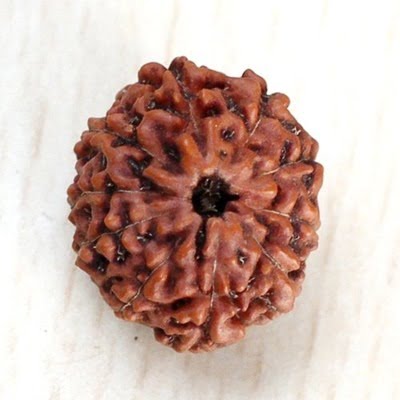
16 Mukhi Indonesian Rudraksha, also known as Sixteen Mukhi Rudraksha or Solah Mukhi Rudraksha, is a distinctive spiritual bead featuring sixteen naturally formed mukhi lines or faces.
In traditional Rudraksha practices, 16 Mukhi Rudraksha is primarily associated with Lord Mahamrityunjaya or Mahakaal Shiva, a powerful form of Lord Shiva. Because of this association, it is traditionally regarded as a Rudraksha connected with courage, protection, fearlessness, spiritual strength and confidence.
Some traditions also associate Sixteen Mukhi Rudraksha with Lord Rama and qualities such as truth, dharma, courage and responsible leadership.
The Indonesian variety offers a compact form of Rudraksha suitable for pendants, bracelets and personal spiritual use.
What Is a 16 Mukhi Rudraksha?
A 16 Mukhi Rudraksha is a naturally formed Rudraksha bead with sixteen distinct longitudinal mukhi divisions.
The word Mukhi means “face.” These natural grooves run along the surface of a Rudraksha and are used traditionally to classify different types.
Sixteen Mukhi Rudraksha is traditionally associated with:
- Lord Mahamrityunjaya Shiva
- Mahakaal
- Courage
- Fearlessness
- Protection
- Confidence
- Clear decision-making
- Spiritual strength
- Leadership
- Meditation
- Positive personal development
These are traditional religious and metaphysical associations rather than scientifically guaranteed effects.
Which God Is Associated With 16 Mukhi Rudraksha?
The deity most strongly associated with Sixteen Mukhi Rudraksha is Lord Mahamrityunjaya Shiva, also described in some traditions as Mahakaal Shiva.
Mahamrityunjaya represents the powerful and protective aspect of Lord Shiva.
For this reason, 16 Mukhi Rudraksha is traditionally used in spiritual practices focused on:
- Courage
- Protection
- Overcoming fear
- Confidence
- Spiritual awareness
- Strength during difficult periods
- Shiva worship
Some traditions additionally connect this bead with Lord Rama.
16 Mukhi Rudraksha Benefits
According to Hindu spiritual and Rudraksha traditions, 16 Mukhi Rudraksha benefits are primarily associated with courage, protection, fearlessness and personal strength.
Traditional benefits include:
- Encouraging courage
- Supporting confidence
- Promoting fearlessness
- Supporting clear thinking
- Encouraging logical decision-making
- Supporting leadership qualities
- Encouraging perseverance
- Supporting meditation
- Strengthening devotion to Lord Shiva
- Encouraging personal discipline
- Supporting spiritual development
- Promoting positive intentions
These benefits are based on religious and spiritual traditions and should not be interpreted as medical guarantees.
16 Mukhi Rudraksha for Protection
Protection is one of the most prominent traditional themes surrounding Sixteen Mukhi Rudraksha.
Because it is associated with Mahamrityunjaya Shiva, devotees may wear the bead as a symbol of divine protection and courage.
Traditional descriptions connect it with protection-related intentions concerning:
- Personal security
- Courage during uncertain situations
- Confidence
- Family well-being
- Freedom from fear
- Spiritual protection
However, a Rudraksha should never be described as guaranteeing protection from fire, theft, accidents or physical harm.
It should be understood as a spiritual symbol rather than a replacement for real-world safety measures.
16 Mukhi Rudraksha for Fearlessness and Courage
Lord Mahakaal and Mahamrityunjaya Shiva are symbolically associated with overcoming fear.
For this reason, Sixteen Mukhi Rudraksha may appeal to people who want to develop greater:
- Courage
- Confidence
- Determination
- Resilience
- Leadership
- Self-discipline
People may wear the bead or use it during meditation while setting intentions around these qualities.
16 Mukhi Rudraksha for Success and Victory
Traditional descriptions also connect 16 Mukhi Rudraksha with victory and success in important endeavours.
Rather than promising guaranteed success, the bead can be presented as a spiritual symbol encouraging qualities that support achievement, such as:
- Clear thinking
- Perseverance
- Courage
- Discipline
- Responsible decisions
- Confidence
- Focus
This makes it particularly relevant to professionals and people in leadership roles.
16 Mukhi Rudraksha for Leaders and Professionals
Sixteen Mukhi Rudraksha is traditionally considered meaningful for people who regularly make important decisions.
It may appeal to:
- Entrepreneurs
- Business owners
- Managers
- Politicians
- Public administrators
- Executives
- Lawyers
- Consultants
- Team leaders
- Professionals in positions of responsibility
The bead can be worn as a spiritual reminder to approach challenges with courage, clarity and discipline.
16 Mukhi Rudraksha for Court Cases
Some traditional Rudraksha literature associates 16 Mukhi Rudraksha with victory in disputes and court-related matters.
This should be carefully worded.
A suitable interpretation is that people involved in difficult disputes may wear the bead as a spiritual symbol of courage, clear judgement and perseverance.
It should never be claimed that wearing Rudraksha guarantees a favourable legal judgment or replaces professional legal advice.
16 Mukhi Rudraksha and Mahamrityunjaya Mantra
The strong connection between Sixteen Mukhi Rudraksha and Mahamrityunjaya Shiva makes the Mahamrityunjaya Mantra especially relevant to this bead.
Traditional sources commonly recommend Mahamrityunjaya mantra practice with 16 Mukhi Rudraksha.
The mantra begins:
Om Tryambakam Yajamahe…
Devotees may chant it during meditation, Shiva worship or the energisation of the Rudraksha according to their spiritual tradition.
16 Mukhi Rudraksha Mantra
A commonly associated Beej Mantra is:
Om Hreem Hoom Namah
Another traditional mantra used by AstroKapoor is:
Om Haum Joom Sah
The Mahamrityunjaya Mantra and Om Namah Shivaya are also used in different Sixteen Mukhi traditions.
Mantra practices vary by teacher and lineage, so there is no need to present only one version as universally correct.
How Many Times Should the Mantra Be Chanted?
Different traditions recommend different repetition counts.
Common practices include:
- 9 times
- 11 times
- 16 times
- 21 times
- 108 times
Some contemporary traditions recommend 11, 16, 33 or 108 repetitions for Sixteen Mukhi Rudraksha.
AstroKapoor may retain its own practice of chanting the mantra nine times before wearing while clearly identifying it as the method followed by AstroKapoor.
Which Planet Rules 16 Mukhi Rudraksha?
The planetary association of Sixteen Mukhi Rudraksha differs between Rudraksha traditions.
Several contemporary systems associate it with the Moon or Chandra, while other established Rudraksha traditions associate it with Rahu or Ketu.
Therefore, the most accurate wording for this product is:
Traditional planetary association followed by AstroKapoor: Moon / Chandra
This avoids presenting a variable spiritual tradition as an objective scientific fact.
16 Mukhi Rudraksha and Moon
In the astrological tradition that connects Sixteen Mukhi Rudraksha with the Moon, Chandra symbolically represents:
- Mind
- Emotions
- Inner peace
- Sensitivity
- Intuition
- Adaptability
The Rudraksha may therefore be used in spiritual practices focused on calm decision-making, emotional awareness and clarity.
Anyone using it specifically as an astrological remedy should consider personalised horoscope guidance.
16 Mukhi Rudraksha for Meditation
Sixteen Mukhi Rudraksha can also be incorporated into meditation and Shiva-focused spiritual practices.
It may be worn or held during meditation focused on:
- Courage
- Fearlessness
- Confidence
- Spiritual awareness
- Discipline
- Personal growth
- Clear thinking
- Devotion to Shiva
The bead serves as a symbolic focus rather than a medical treatment.
Indonesian 16 Mukhi Rudraksha
Rudraksha-related Elaeocarpus trees are genuinely found in Indonesia.
Botanical references document Elaeocarpus ganitrus—also treated taxonomically under Elaeocarpus angustifolius in some references—as occurring from India and Nepal through Southeast Asia, including Indonesia. Indonesian vernacular names include genitri, jenitri and ganitri.
Therefore, Indonesian Rudraksha should not automatically be dismissed as fake or merely described as “Bhadraksha.”
Indonesian vs Nepali 16 Mukhi Rudraksha
Nepali and Indonesian Rudraksha can differ in appearance.
Common differences may include:
Indonesian Rudraksha
- Often relatively smaller
- Usually finer surface texture
- Suitable for compact pendants and malas
- Mukhi grooves may appear subtler
Nepali Rudraksha
- Often larger
- More pronounced surface texture
- Mukhi lines can appear deeper
- Large high-mukhi specimens may be particularly scarce
Geographic origin alone does not scientifically prove that one Rudraksha possesses more spiritual “power” than another.
The most important buying factors are authenticity, natural mukhi structure, condition and accurate origin disclosure.
Is Indonesian 16 Mukhi Rudraksha Genuine?
Yes. Genuine Rudraksha material occurs in Indonesia. Botanical research from Indonesia specifically documents Elaeocarpus ganitrus and describes its hard seeds with naturally varying numbers of mukhi grooves.
However, authenticity must still be established for each individual bead.
Being sold as Indonesian does not automatically prove that a specific 16 Mukhi bead is natural.
How to Identify Original 16 Mukhi Rudraksha
A genuine Sixteen Mukhi Rudraksha should have sixteen naturally formed mukhi divisions.
Buyers should examine:
- Number of natural mukhi lines
- Continuity of grooves
- Natural surface appearance
- Signs of artificial carving
- Glued or reconstructed areas
- Overall structural integrity
For expensive high-mukhi Rudraksha, X-ray examination can provide additional evidence by revealing internal compartments. Rudraksha specialists commonly recommend X-ray analysis instead of relying on folklore-based water tests.
Is the Rudraksha Thermometer Test Reliable?
No. The existing thermometer test should be removed from the AstroKapoor page.
A one- or two-degree temperature change after putting a Rudraksha bead in water is not a recognised authentication standard.
Similarly, floating, sinking, milk and copper-coin tests are not reliable proof of authenticity. Current Rudraksha authenticity guidance specifically describes such tests as unscientific and recommends structural examination and X-ray analysis instead.
For a premium Sixteen Mukhi Rudraksha, proper certification is significantly more useful.
Certified 16 Mukhi Indonesian Rudraksha
If this product genuinely includes laboratory certification, make that one of the main trust signals on the page.
Useful certification information may include:
- Photograph of the exact bead
- Mukhi count
- Dimensions
- Weight
- Natural formation observations
- X-ray image
- Signs of modification or absence of modification
- Report or certificate number
Only use the word Certified if the actual bead supplied to the customer includes verifiable certification.
Energized 16 Mukhi Rudraksha
According to AstroKapoor’s stated tradition, each Rudraksha is energized before dispatch through a Pran Pratishtha ceremony performed by designated Pandits.
This is useful information and should be explained clearly rather than simply describing the bead as “energized.”
The process may include:
- Selection of an auspicious time
- Sankalp using the client’s details
- Ritual purification
- Worship of Lord Shiva
- Incense and flower offerings
- Panchamrit offerings
- Beej Mantra chanting
- Pran Pratishtha
These practices belong to religious tradition and should be presented as such.
Pooja of 16 Mukhi Rudraksha
According to the spiritual procedure followed by AstroKapoor:
Step 1 – Select an Auspicious Time
An auspicious day and Nakshatra may be selected according to the ritual tradition.
Step 2 – Prepare the Worship Space
A clean and peaceful area is prepared for the pooja.
Step 3 – Ritual Purification
The Rudraksha is ritually cleaned according to tradition.
Step 4 – Worship Lord Shiva
The Rudraksha is respectfully placed near an image or representation of Lord Shiva.
Step 5 – Offerings
Incense, flowers, fruits, sweets and Panchamrit may be offered.
Step 6 – Sankalp
The client’s name and birth details may be included during the spiritual intention or Sankalp.
Step 7 – Mantra Chanting
The appropriate Rudraksha or Mahamrityunjaya mantra is repeated according to the ritual.
Step 8 – Pran Pratishtha
After the final prayers, the energized Rudraksha is prepared for the wearer.
How to Wear 16 Mukhi Rudraksha
Sixteen Mukhi Rudraksha may traditionally be:
- Worn around the neck
- Worn as a pendant
- Incorporated into a bracelet
- Kept respectfully in a puja room
A simple wearing procedure may include:
- Bathe and wear clean clothes.
- Sit in a clean prayer space.
- Offer prayers to Lord Shiva.
- Hold the Rudraksha respectfully.
- Chant Om Hreem Hoom Namah, Om Haum Joom Sah or the Mahamrityunjaya Mantra.
- Wear the bead with a positive spiritual intention.
Exact practices may vary according to spiritual lineage.
Which Day Should 16 Mukhi Rudraksha Be Worn?
Monday is frequently recommended for Sixteen Mukhi Rudraksha because of its connection with Lord Shiva and, in some traditions, the Moon.
However, a personalised day may be selected during formal Pran Pratishtha or according to an astrologer’s recommendation.
Can Men and Women Wear 16 Mukhi Rudraksha?
Both men and women may wear Rudraksha according to their personal spiritual tradition.
There is no need to impose separate universal wearing rules for men and women unless AstroKapoor follows a specific religious tradition that requires them.
The bead may be worn:
- Around the neck
- As a pendant
- As a bracelet
- According to personalised spiritual guidance
16 Mukhi Rudraksha for Family and Home
The traditional protection symbolism of Sixteen Mukhi Rudraksha also makes it relevant to people interested in keeping the bead in their prayer area.
It may be kept respectfully in a puja room as a symbol of:
- Shiva’s blessings
- Courage
- Family harmony
- Spiritual protection
- Positive intentions
It should not be claimed that simply keeping a Rudraksha in the home guarantees prevention of theft, fires or accidents.
16 Mukhi Rudraksha and Swadhisthana Chakra
Some modern metaphysical traditions connect Sixteen Mukhi Rudraksha with chakra practices, although chakra associations vary significantly across sources.
If AstroKapoor follows a tradition connecting it with the Swadhisthana Chakra, this may be described as a traditional metaphysical association rather than a physiological effect.
The Swadhisthana or Sacral Chakra is symbolically associated with:
- Creativity
- Emotions
- Relationships
- Adaptability
- Personal expression
Can 16 Mukhi Rudraksha Cure Diseases?
A Sixteen Mukhi Rudraksha should not be promoted as a cure for tuberculosis, leprosy, kidney disorders, urinary disorders, back pain, depression or other medical conditions.
Scientific research has studied extracts from Elaeocarpus ganitrus in laboratory and animal experiments, including antifungal and metabolic studies. Such research does not establish that wearing an intact Rudraksha bead treats disease in humans.
Anyone experiencing physical or mental-health symptoms should obtain appropriate professional healthcare.
Who May Consider 16 Mukhi Rudraksha?
A 16 Mukhi Indonesian Rudraksha may appeal to:
- Devotees of Lord Shiva
- Mahamrityunjaya worshippers
- Spiritual practitioners
- Business owners
- Entrepreneurs
- Managers
- Politicians
- Leaders
- Public administrators
- Professionals
- Meditation practitioners
- Rudraksha collectors
- People interested in traditional Moon-related practices
For a specific astrological remedy, personalised horoscope advice is recommended.
How to Care for 16 Mukhi Rudraksha
Rudraksha is natural organic seed material rather than a mineral gemstone. Scientific botanical literature identifies Rudraksha as the hard endocarp associated with Elaeocarpus ganitrus.
For regular care:
- Keep the bead clean.
- Avoid harsh cleaning chemicals.
- Do not apply perfume directly to it.
- Avoid scratching or carving the bead.
- Avoid prolonged unnecessary soaking.
- Protect it from excessive force.
- Store it in a clean and dry location.
- Inspect its thread or mounting regularly.
Why Choose a 16 Mukhi Indonesian Rudraksha?
16 Mukhi Indonesian Rudraksha combines the traditional symbolism of Lord Mahamrityunjaya Shiva, courage, protection, confidence and spiritual strength with the distinctive structure of a high-mukhi Rudraksha.
It may be especially meaningful for people interested in:
- Mahakaal Shiva
- Mahamrityunjaya worship
- Courage and fearlessness
- Leadership
- Meditation
- Spiritual growth
- Certified Rudraksha
- Indonesian Rudraksha
- Rare Mukhi collections
For premium beads, authenticity and certification should be given greater importance than unreliable home tests.
Frequently Asked Questions About 16 Mukhi Rudraksha
What is 16 Mukhi Rudraksha?
A 16 Mukhi Rudraksha is a Rudraksha bead with sixteen naturally formed mukhi divisions. It is traditionally associated with Mahamrityunjaya or Mahakaal Shiva.
Which God is associated with 16 Mukhi Rudraksha?
Lord Mahamrityunjaya Shiva or Mahakaal is the principal deity most commonly associated with Sixteen Mukhi Rudraksha. Some traditions also connect it with Lord Rama.
What are 16 Mukhi Rudraksha benefits?
Traditional benefits include courage, fearlessness, protection, confidence, decision-making, leadership and spiritual growth. These are religious beliefs rather than scientifically guaranteed outcomes.
Which planet rules 16 Mukhi Rudraksha?
There is no completely uniform tradition. Several systems associate Sixteen Mukhi Rudraksha with the Moon, while other sources connect it with Rahu or Ketu. AstroKapoor may state Moon as the planetary association followed in its own tradition.
What is the mantra for 16 Mukhi Rudraksha?
Commonly used mantras include:
Om Hreem Hoom Namah
Om Haum Joom Sah
The Mahamrityunjaya Mantra and Om Namah Shivaya may also be used according to spiritual tradition.
Is 16 Mukhi Rudraksha associated with Mahamrityunjaya Shiva?
Yes. This is one of the strongest and most consistent traditional associations of Sixteen Mukhi Rudraksha.
Is Indonesian 16 Mukhi Rudraksha genuine?
Genuine Rudraksha-producing Elaeocarpus trees occur in Indonesia, including Java. The authenticity of an individual bead should still be checked separately.
How do I identify an original 16 Mukhi Rudraksha?
Look for sixteen naturally formed mukhi lines and signs of an unaltered structure. For valuable beads, professional examination and X-ray analysis provide stronger authentication than home tests.
Is the water or thermometer test reliable?
No. Floating, sinking, milk, copper-coin and thermometer tests are not reliable proof that a Rudraksha is genuine.
Which day is good for wearing 16 Mukhi Rudraksha?
Monday is commonly recommended because of the bead’s association with Lord Shiva and, in some traditions, the Moon.
Can 16 Mukhi Rudraksha be kept in a puja room?
Yes. It may be worn or respectfully kept in a place of worship according to personal spiritual tradition.
Can 16 Mukhi Rudraksha cure diseases?
There is no established clinical evidence that wearing a Sixteen Mukhi Rudraksha cures diseases. Studies of Elaeocarpus ganitrus extracts should not be interpreted as evidence for therapeutic effects from wearing the bead.


