
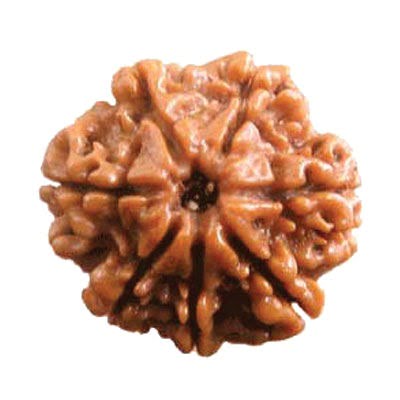
The 7 Mukhi Indonesian Rudraksha, also known as Seven Mukhi Rudraksha, Saat Mukhi Rudraksha or Sapta Mukhi Rudraksha, is a sacred Rudraksha bead identified by seven naturally formed faces or mukhis.
This Indonesian or Java-origin 7 Mukhi Rudraksha is widely used for spiritual practice, meditation, mantra chanting and traditional astrological purposes.
In contemporary Rudraksha traditions, 7 Mukhi Rudraksha is strongly associated with Goddess Mahalakshmi, prosperity, stability and the planet Saturn or Shani. The Shiva Purana describes the seven-faced Rudraksha as Ananga and traditionally associates wearing it with improvement in material circumstances.
What Is 7 Mukhi Rudraksha?
A 7 Mukhi Rudraksha is a natural Rudraksha bead with seven distinct mukhi lines running longitudinally across its surface.
For proper identification, the seven grooves should be naturally formed rather than artificially carved or altered. Rudraksha testing laboratories examine the external surface as well as internal structure when authenticating higher-value beads. A GJSPC laboratory report for a certified seven-faced Rudraksha, for example, identifies seven natural grooves and records X-ray examination as part of testing.
The number seven also holds considerable spiritual symbolism in Indian traditions and is associated in different Rudraksha traditions with the Saptarishi, Sapta Matrika and other sacred groups of seven.
7 Mukhi Rudraksha Meaning
Seven Mukhi Rudraksha is traditionally regarded as a bead connected with prosperity, stability, spiritual discipline and material balance.
The Shiva Purana refers to the seven-faced Rudraksha as Ananga and states that, according to its religious tradition, wearing it may elevate even a poor person to a position of prosperity.
Modern Rudraksha traditions additionally connect Seven Mukhi with Goddess Mahalakshmi, the goddess associated with prosperity and abundance.
Therefore, people commonly choose a 7 Mukhi Rudraksha with spiritual intentions related to financial stability, confidence, patience, discipline, career progress and peaceful living.
These should be understood as traditional religious and astrological beliefs rather than guaranteed results.
7 Mukhi Rudraksha and Goddess Mahalakshmi
Goddess Mahalakshmi is the most commonly stated presiding deity of 7 Mukhi Rudraksha in contemporary Rudraksha traditions.
Mahalakshmi represents prosperity, abundance, auspiciousness and well-being. For this reason, Seven Mukhi Rudraksha is particularly popular among people seeking a sacred bead connected with material stability and positive professional growth.
It may be worn or kept in a place of worship during Lakshmi prayer, Shiva worship, meditation and other personal spiritual practices.
7 Mukhi Rudraksha in the Shiva Purana
The Shiva Purana provides an important textual reference for Seven Mukhi Rudraksha.
In Vidyeshvara Samhita, Chapter 25, the seven-faced Rudraksha is called Ananga. The text traditionally connects wearing this Rudraksha with improvement in a person’s material circumstances.
This is useful to mention because it provides a stronger scriptural foundation than simply making modern claims about wealth or success.
The spiritual interpretation should nevertheless remain distinct from a promise that wearing a Rudraksha automatically produces financial wealth.
7 Mukhi Rudraksha Benefits
Traditional 7 Mukhi Rudraksha benefits are commonly associated with prosperity, stability, patience, confidence, spiritual awareness and disciplined action.
Modern Rudraksha traditions also connect Seven Mukhi with business progress, career stability, relief from difficult Saturn-related periods and the blessings of Mahalakshmi.
A person may therefore wear this Rudraksha while focusing on intentions related to financial discipline, professional development, confidence, inner stability, patience, meditation and spiritual progress.
These benefits belong to spiritual and astrological traditions and should not be regarded as guaranteed financial, psychological or medical outcomes.
Which Planet Rules 7 Mukhi Rudraksha?
Saturn or Shani is the most common planetary association found for 7 Mukhi Rudraksha in current Rudraksha and Jyotish traditions.
Saturn traditionally represents discipline, responsibility, patience, perseverance, karma and long-term development.
Some other traditions associate 7 Mukhi Rudraksha with Venus or Shukra. For example, the Geological Institute of India lists Venus while also describing the bead in relation to Saturn’s malefic effects.
For a clearer and more accurate product page, I recommend describing it as:
Ruling Deity: Goddess Mahalakshmi
Primary Planetary Association: Saturn / Shani
Alternate Tradition: Venus / Shukra in some systems
If a person wants to wear the bead specifically as a planetary remedy, horoscope-based guidance is preferable.
7 Mukhi Rudraksha for Saturn and Shani Dosha
Seven Mukhi Rudraksha is widely used in modern astrological traditions as a Shani-associated Rudraksha.
It may be recommended within these traditions during periods connected with Saturn, including Shani-related challenges, Sade Sati or other difficult Saturn influences.
People may use the bead with intentions involving greater patience, discipline, responsibility and stability during challenging periods.
However, one Rudraksha should not be marketed as something that automatically removes every negative effect of Saturn. Astrological interpretation depends on the complete horoscope.
7 Mukhi Rudraksha for Wealth and Prosperity
Wealth and prosperity are among the most common search themes surrounding 7 Mukhi Rudraksha.
The association comes from both the Mahalakshmi tradition and the Shiva Purana’s description of the seven-faced bead as Ananga with a traditional connection to improved material circumstances.
A Seven Mukhi Rudraksha may therefore be worn as a spiritual symbol while focusing on financial stability, responsible decision-making, business development and professional progress.
It would be better, however, to avoid promising that simply wearing the bead will generate money, eliminate debt or guarantee business profits.
7 Mukhi Rudraksha for Business and Career
Business owners, professionals and people working in responsible positions frequently search for 7 Mukhi Rudraksha because of its traditional association with Mahalakshmi and Saturn.
Mahalakshmi represents prosperity, while Saturn symbolizes discipline, patience and long-term effort.
This combination makes Seven Mukhi Rudraksha spiritually relevant for intentions related to business stability, career development, consistent effort and professional responsibility.
Actual career and business success depends on knowledge, work, planning and circumstances; Rudraksha can be used as part of an individual’s spiritual practice.
7 Mukhi Indonesian Rudraksha
This product is an Indonesian-origin Rudraksha, also commonly called Java Rudraksha.
Indonesian Rudraksha beads are generally known in the commercial market for being smaller and having subtler surface contours than many Nepal-origin beads.
A smaller Indonesian 7 Mukhi Rudraksha can be convenient for wearing in a pendant, bracelet or mala.
Origin should nevertheless be based on reliable supplier or laboratory information rather than determined solely from size or appearance.
Indonesian vs Nepali 7 Mukhi Rudraksha
Both Indonesia and Nepal produce Rudraksha with different mukhi counts, including seven-faced specimens.
Nepali beads commonly have larger bodies and more prominent surface formations, while Indonesian or Java Rudraksha are generally smaller and smoother.
This difference does not mean that an Indonesian Rudraksha is spiritually inferior.
For customers, the important factors are natural mukhi formation, accurate identification, origin information and certification.
Original 7 Mukhi Rudraksha – How to Check Authenticity
Authenticity is one of the most important commercial search topics for Seven Mukhi Rudraksha.
An authentic 7 Mukhi should have seven naturally formed grooves or faces. A testing laboratory can examine the surface under magnification and may use X-ray imaging to examine its internal structure.
GJSPC certification reports for Rudraksha document factors such as mukhi count, dimensions, weight, natural surface structure and X-ray examination.
When buying a certified 7 Mukhi Indonesian Rudraksha, ideally check the actual bead photograph, certificate number, origin, weight, dimensions, mukhi count and X-ray details where available.
Is the Thermometer Test for Rudraksha Reliable?
The existing AstroKapoor content recommends putting the bead in water and checking whether the temperature rises by one or two degrees.
I recommend completely removing that claim.
A small temperature change in water does not establish that a Rudraksha is authentic or prove that it naturally has seven faces.
For valuable Rudraksha, professional visual examination and internal imaging provide much more meaningful information. Current laboratory reports use microscopy and X-ray testing rather than a household thermometer test.
Certified 7 Mukhi Indonesian Rudraksha
Certification can provide additional confidence when purchasing an original 7 Mukhi Rudraksha online.
For maximum transparency, the product listing should show the laboratory name, certificate number, origin, weight, bead dimensions and actual product photographs.
If an X-ray image is available, displaying it can further help customers understand the bead’s internal structure.
The word “certified” should ideally always be supported by an actual certificate rather than used only as a marketing phrase.
7 Mukhi Rudraksha and Saptarishi
Seven Mukhi Rudraksha is also associated in some traditions with the Saptarishi or seven great sages.
This gives the number seven an additional spiritual dimension connected with wisdom, knowledge and spiritual guidance.
Other traditions relate the seven faces with Sapta Matrika or seven mother goddesses.
Because several symbolic interpretations exist, the safest wording is that Seven Mukhi Rudraksha is associated with different sacred groups of seven within Rudraksha traditions rather than insisting on only one interpretation.
7 Mukhi Rudraksha and Chakra
Different modern sources assign different chakra associations to 7 Mukhi Rudraksha.
Some associate it with the Root or Muladhara Chakra because of Saturn, stability and grounding symbolism.
Other Rudraksha traditions connect it with the Manipura or Solar Plexus Chakra.
Because these systems differ, it is more accurate to say that chakra associations vary by spiritual tradition.
Chakra practices are spiritual concepts and should not be confused with physical anatomy or medical treatment.
Can 7 Mukhi Rudraksha Help With Stress or Anxiety?
Traditional Rudraksha practices often associate Seven Mukhi with peace, patience and emotional stability.
A wearer may therefore use the bead during prayer, meditation or mindfulness while focusing on calmness and discipline.
However, the page should not say that Seven Mukhi Rudraksha “removes depression, stress or anxiety” as a medical claim.
Anxiety and depression are health conditions that may require appropriate professional support. Rudraksha should be described as a religious and spiritual accessory rather than a medical treatment.
Does 7 Mukhi Rudraksha Prevent Untimely Death?
Some traditional descriptions contain strong statements about protection from misfortune or untimely death.
These should be framed as religious beliefs rather than guaranteed protection.
A more appropriate statement is that Seven Mukhi Rudraksha is traditionally worn with intentions connected with protection, stability and spiritual well-being.
Avoid promising that a bead can physically prevent death, accidents or illness.
Does 7 Mukhi Rudraksha Protect Against Snakes?
Some older Rudraksha traditions symbolically associate the seven faces with seven divine serpents.
However, claims such as “snakes will never harm the wearer” should not appear as factual safety advice.
A Rudraksha does not replace normal safety precautions around snakes or other physical hazards.
The serpent symbolism may still be discussed as part of traditional religious interpretations.
Who Can Wear 7 Mukhi Rudraksha?
Seven Mukhi Rudraksha is generally worn by both men and women.
It may be selected by devotees of Lord Shiva or Goddess Mahalakshmi, spiritual seekers, people practising meditation, professionals and business owners, or individuals advised to use it within a Saturn-related astrological tradition.
No universal rule requires someone to belong to a particular profession before wearing it.
For specific astrological use, individual consultation can help determine whether it suits the person’s objectives.
How to Wear 7 Mukhi Rudraksha
A Seven Mukhi Rudraksha may be worn around the neck, in a pendant or bracelet, or kept respectfully in a place of worship.
Before wearing, many devotees bathe, wear clean clothes, clean the bead gently, place it near an image or symbol of Shiva or Mahalakshmi, offer a prayer or incense according to their tradition, chant the chosen mantra and then wear the Rudraksha respectfully.
Different spiritual traditions recommend different days. Saturday is particularly common when the bead is being used in relation to Saturn, while some traditions choose Monday for Shiva worship.
There is no need to claim that only one day is universally correct.
7 Mukhi Rudraksha Mantra
The most consistently cited mantra for Seven Mukhi Rudraksha is:
Om Hum Namah
Drik Panchang lists “Om Hum Namah” for Sapta Mukhi Rudraksha, and the mantra also appears widely in current Rudraksha traditions.
A Mahalakshmi-focused practitioner may also use:
Om Mahalakshmyai Namah
Other traditional sources attribute additional formulas such as Om Hreem Namah or Om Hrah to different Puranic traditions, but the textual attribution is not equally easy to verify from primary translations. For a clean product page, I recommend emphasizing Om Hum Namah as the main mantra.
Energization and Pran Pratishtha
AstroKapoor offers Rudraksha energization before dispatch as a spiritual service.
Pran Pratishtha may include purification of the bead, Sankalp, worship, offerings, mantra chanting and prayers performed by a priest or pundit.
This should be presented as a religious consecration process rather than a scientific transformation of the bead.
Certification verifies identification; Pran Pratishtha serves a different devotional purpose.
7 Mukhi Rudraksha Price
The price of a 7 Mukhi Rudraksha may depend on its origin, size, condition, natural mukhi formation, availability, certification and whether it is sold as a loose bead, pendant, bracelet or mala.
Indonesian Seven Mukhi Rudraksha is generally widely available compared with some rarer higher-mukhi beads.
When comparing price, customers should evaluate authenticity and certification rather than assuming that a higher price automatically means a genuine or spiritually superior bead.
Frequently Asked Questions
What is 7 Mukhi Rudraksha?
7 Mukhi Rudraksha is a Rudraksha bead identified by seven naturally formed faces or mukhis. The Shiva Purana calls the seven-faced Rudraksha Ananga.
What are 7 Mukhi Rudraksha benefits?
Traditional benefits are associated with prosperity, stability, patience, spiritual development and disciplined action. Modern Rudraksha traditions strongly connect it with Goddess Mahalakshmi and Saturn.
Which God is associated with 7 Mukhi Rudraksha?
Goddess Mahalakshmi is the most common presiding deity in contemporary Rudraksha traditions. The Shiva Purana refers to the seven-faced bead as Ananga.
Which planet is associated with 7 Mukhi Rudraksha?
Saturn or Shani is the most common modern planetary association. Some traditions instead associate Seven Mukhi with Venus, so the classification is not completely uniform.
Is 7 Mukhi Rudraksha good for Shani?
Many contemporary Rudraksha and Jyotish traditions recommend 7 Mukhi for Saturn-related spiritual practices and difficult Shani periods. Horoscope-based guidance is preferable when it is being used as a specific astrological remedy.
What is the mantra for 7 Mukhi Rudraksha?
Om Hum Namah is one of the most consistently cited mantras for Sapta Mukhi Rudraksha.
Can women wear 7 Mukhi Rudraksha?
Yes. Contemporary Rudraksha traditions generally allow both men and women to wear Seven Mukhi Rudraksha.
How do I identify an original 7 Mukhi Rudraksha?
Look for seven natural mukhi divisions. For stronger authentication, choose a bead with professional examination, certification and X-ray testing rather than depending solely on appearance.
Is the thermometer test reliable for Rudraksha?
No household thermometer test should be treated as proof of authenticity. Laboratory examination and X-ray imaging provide more meaningful evidence.
What is Indonesian 7 Mukhi Rudraksha?
It is a seven-faced Rudraksha originating from Indonesia and is also commonly referred to as Java Rudraksha.
Is Indonesian Rudraksha genuine?
Indonesian origin does not make a Rudraksha fake. Genuine naturally formed Rudraksha beads occur in the Indonesian market as well as Nepal and other regions. The individual specimen should be evaluated for natural mukhi formation and origin.
Does 7 Mukhi Rudraksha bring money?
It is traditionally associated with Mahalakshmi, prosperity and improved material circumstances, but wearing a Rudraksha should not be presented as guaranteeing money, profits or wealth.
Does 7 Mukhi Rudraksha cure depression or anxiety?
No. It may be used during meditation or spiritual practice with intentions related to calmness and stability, but it is not an established medical treatment for anxiety or depression.
Buy Certified 7 Mukhi Indonesian Rudraksha Online
If you are looking to buy 7 Mukhi Rudraksha online, consider the bead’s natural mukhi formation, Indonesian origin, certification, dimensions and actual photographs before purchasing.
This 7 Mukhi Indonesian Rudraksha is traditionally connected with Goddess Mahalakshmi, prosperity, spiritual development and, in the most common modern astrological tradition, Saturn or Shani.
For customers looking for an original or certified Seven Mukhi Rudraksha, laboratory documentation and X-ray examination provide much stronger evidence than home-based water or thermometer tests.
AstroKapoor can also provide spiritual guidance regarding mantra, wearing method and traditional energization according to individual requirements.


