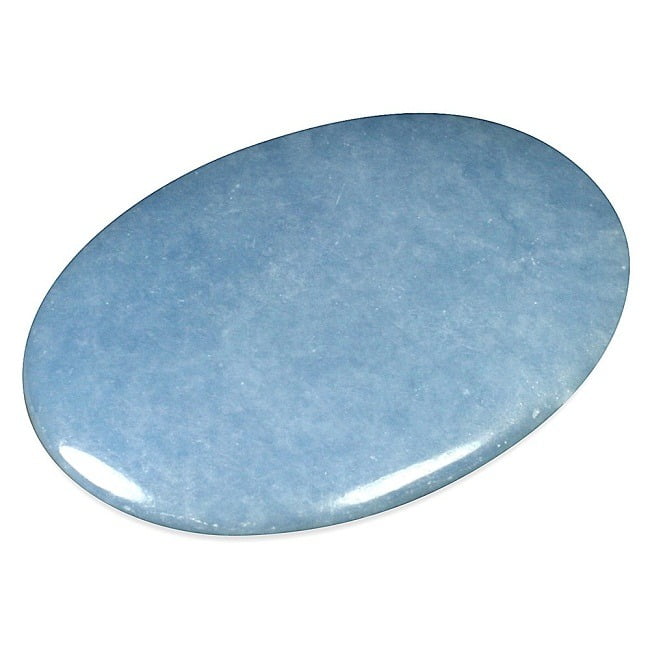
Angelite is a semiprecious gemstone which is found in blue, white, and sometimes flecked with red in color. Angelite has an opaque and often veined like wings on the surface. It is easily obtained. Angelite is an “awareness stone” for the new age. It facilitates the conscious contract with the angelic realm. It is a stone of confidence and self-esteem. Angelite is connected to the divine power and it gives excellent spiritual growth during meditataion. It is commonly called as a stone of divinity. Angelite is formed from celestite that has been composed for many million of years ago. Healers used Angelite to unblock the energy pathways. Sailors always kept Angelite bead as a talisman during their journey. Angelite is a birthstone for the Zodiac Aquarius. It heals throat chakra, third eye chakra and crown chakra.
Gemologically, Angelite is not a separate mineral species and is not formed from Celestite. It is a commercial and metaphysical trade name for a semi-transparent light blue-grey, fine-grained variety of Anhydrite with the chemical formula CaSO₄. Mindat specifically describes Angelite as Peruvian gem material consisting of Anhydrite, while GIA independently identified material sold as “Angelite” as blue-grey Anhydrite using standard gemological testing and X-ray diffraction.
Celestite is a different mineral altogether, composed primarily of strontium sulfate, SrSO₄. Therefore, Angelite and Celestite should not be treated as different stages of the same gemstone. Associations with angels, chakras, spiritual awareness and Aquarius belong to modern metaphysical or astrological traditions rather than mineralogical classification. Angelite is also not a universally standardized Aquarius birthstone.
Origin of Natural Angelite
Origin: Angelite is found in Britain, Egypt, Germany, Mexico, Peru and Poland.
Anhydrite as a mineral occurs in many parts of the world, but the material specifically marketed as Angelite is much more geographically restricted. Mindat defines Angelite as semi-transparent light blue-grey fine-grained Anhydrite marketed as gem material from Peru. Documented Angelite locations include the Casapalca area in Lima Department and Huancarqui District in Arequipa, Peru.
Mindat further notes that blue Anhydrite from Peruvian localities is the material to which the variety name Angelite should properly be applied. Paler bluish Anhydrite occurs elsewhere, including Germany, Mexico and the United States, but this does not automatically make all blue Anhydrite from those countries genuine Angelite in the traditional trade sense.
For SEO and product accuracy, “Peruvian Angelite” is therefore more precise than presenting Britain, Egypt, Germany, Mexico and Poland as equivalent established Angelite sources.
Angelite Gemological Properties
Natural Angelite takes its physical and optical properties from Anhydrite:
- Gem material – Angelite
- Mineral – Anhydrite
- Chemical formula – CaSO₄
- Mineral class – Calcium sulfate
- Crystal system – Orthorhombic
- Typical Angelite color – Light blue-grey to powder blue
- Transparency – Semi-transparent to translucent
- Mohs hardness – Approximately 3.5
- Specific gravity – Approximately 2.90–2.98
- Refractive index – Approximately 1.570–1.614
- Cleavage – Perfect
- Fracture – Uneven
- Tenacity – Brittle
- Typical form – Massive or fine-grained ornamental material
- Common uses – Cabochons, beads, carvings, spheres and decorative objects
Gemdat records Anhydrite with a Mohs hardness of 3.5, specific gravity approximately 2.90–2.98, perfect cleavage and refractive index around 1.570–1.614. GIA likewise identifies Anhydrite as an orthorhombic calcium sulfate mineral and notes that it is poorly suited to demanding jewelry because of its low hardness and perfect cleavage.
Why Is Angelite Blue?
The characteristic powder-blue to blue-grey appearance is an important feature of Angelite. Research summarized for the Peruvian Casapalca material attributes its distinctive blue color to trace amounts of divalent iron in the Anhydrite.
Pure Anhydrite can be colorless or white and may occur in several other colors depending on impurities. GIA has documented Anhydrite ranging from colorless and pale blue to pink, brown and even rare purple material. However, unusual red, green or strongly colored Anhydrite should not automatically be marketed as Angelite simply because it belongs to the same mineral species.
Angelite vs Celestite
The statement that Angelite has been formed from Celestite compressed for millions of years is mineralogically incorrect. Angelite is Anhydrite, CaSO₄, whereas Celestite is strontium sulfate, SrSO₄. They are different mineral species with different chemical compositions.
Anhydrite itself commonly forms through geological processes involving sulfate-rich environments and may also develop through dehydration of Gypsum. GIA describes Anhydrite as commonly formed by dehydration of Gypsum, whose formula is CaSO₄·2H₂O.
Interestingly, the opposite process can also occur: Anhydrite can rehydrate and form Gypsum under suitable conditions. At documented Peruvian Angelite deposits, groundwater alteration has produced white Gypsum coatings on some Angelite material. This is one reason prolonged water exposure should be avoided.
Angelite Benefit
Angelite increases telepathic communication. It helps to connect with the higher spirit. Its sparkling blue color imparts smoothness and relaxes the mind and the soul. It is a stone of divine communication and everyday reality of life.
It is a powerful stone for healers. It provides protection to the body, when taken as an elixir. Angelite has been formed from Celestine, which has been compressed over millions of years. Psychologically, it helps you to speak the truth. It alleviates psychological pain and brings deeper understanding of mathematics. It facilitates telepathic between two minds.
In modern crystal traditions, Angelite is commonly associated with peaceful communication, meditation, emotional calmness, compassion and spiritual awareness. Its pale-blue appearance also explains its symbolic association with the Throat Chakra and angelic communication. Telepathy, contact with higher spirits and direct improvement in mathematical ability are metaphysical beliefs rather than scientifically proven effects.
The reference to an Angelite elixir also requires caution. Direct-contact gemstone elixirs are not recommended. Angelite is Anhydrite and can alter through interaction with water under suitable conditions; natural stones may also contain unknown impurities. There is no medically established benefit from drinking water in which Angelite has been soaked.
Why Semi Precious Gemstone?
Semi precious gemstone has the same qualities as the precious gemstone. The semiprecious gemstone can be very well considered, if you are incapable of buying the precious gemstone. Although semi precious gemstone lack few characteristic of precious gemstone, but yet they have the quality which can act as a precious gemstone.
The terms “precious” and “semi-precious” are traditional commercial classifications rather than scientific measurements of gemstone quality, effectiveness or rarity. Angelite is valued for its distinctive powder-blue appearance, smooth polished finish, decorative appeal and popularity in spiritual practices.
Physically, however, Angelite does not have the same durability as many traditional precious gemstones. Its hardness of approximately 3.5 and perfect cleavage make it much softer and more fragile than Quartz, Topaz, Sapphire or Diamond.
Why Angelite Gemstone?
Although, Angelite is a semi precious stone, it carries strong healing property, as precious gemstone. It is light blue in color, which is very helpful for removing depression and mental anxiety. It enhances astrological understanding and brings deeper understanding of the science subject. It can be used in jewelry in pendant and bracelet.
Angelite may be worn as a symbolic or spiritual stone by people who associate its blue color with calmness, communication and reflection. However, there is no reliable scientific evidence that Angelite treats depression, anxiety or directly improves understanding of astrology, mathematics or science.
Persistent depression or anxiety may require qualified mental-health support. A gemstone can be used as a personal meditation object, but it should not replace professional assessment or treatment.
Healing Properties of Angelite
Healing
Angelite is a powerful healing stone. It heals the throat and removes inflammation. It regulates the functioning of thyroid and parathyroid gland. This soothing stone repair tissue and blood vessels, and balances the fluid. It can cool the pain of sun burn. It balances the physical body.
Angelite in Gems Therapy | Medical Astrology Angelite is used in the treatment of mental disorders and depression. It is highly beneficial for the curing chronic thyroid problem. It strengthens the upper part of the body, which includes thyroid gland, parathyroid gland and voice box.
It balances the fluid of the body. It aids in the circulatory system and cure the disorders of the blood related disorders.
These statements describe traditional crystal-healing and medical-astrology beliefs. There is no reliable scientific evidence that Angelite treats thyroid or parathyroid disease, inflammation, blood disorders, circulatory conditions, tissue damage, depression or other mental-health disorders.
Thyroid problems can involve significant hormonal changes and require appropriate medical testing and treatment. Likewise, blood and circulatory disorders should be professionally diagnosed. Wearing Angelite does not transfer therapeutic calcium or sulfate into the body in a way that treats these conditions.
For sunburn, affected skin should be managed with appropriate evidence-based care rather than rubbing or placing a mineral directly on irritated or damaged skin.
Angelite Jewelry and Uses
Angelite’s soft powder-blue appearance makes it popular for beads, pendants, bracelets, polished stones, spheres, eggs, carvings and meditation objects. Mindat specifically notes that Peruvian lapidary workshops have fashioned Angelite into balls, eggs, wands and animal carvings.
It is less suitable for rings and other jewelry exposed to frequent knocks. With hardness around 3.5 and perfect cleavage, the surface can scratch relatively easily and the material can chip or split after impact. Pendants, earrings and beads generally offer better protection.
Because Angelite is commonly massive and semi-transparent rather than transparent faceting-grade material, smooth cabochons and carvings normally showcase it better than traditional faceted cuts.
Angelite Care and Cleaning
Angelite should receive gentle care. Avoid prolonged soaking, steam cleaners, ultrasonic cleaners, harsh chemicals and abrasive cleaning products. Because Anhydrite can rehydrate toward Gypsum under suitable conditions, repeated or prolonged exposure to water is best avoided. Natural Angelite specimens from Peru have even been documented with Gypsum coatings formed through groundwater alteration.
For routine care, wipe the gemstone gently with a clean, dry or barely damp soft cloth and dry it immediately. Do not scrub it with hard brushes because its Mohs hardness is only about 3.5.
Store Angelite separately from Quartz, Topaz, Sapphire, Diamond and other harder gemstones. A soft pouch or lined jewelry box can reduce scratching and accidental impact.
Buying Certified Natural Angelite
Wholesale Prices of Angelite: Visit Astrokapoor office for buying certified, natural stone in a wholesale price. We provide certified natural gemstone.
When buying Certified Angelite, first confirm that the material is actually Anhydrite. Genuine traditional Angelite should normally show a soft light blue-grey to powder-blue appearance and fine-grained massive structure, especially when sourced from Peru.
Certification or reliable mineral identification is useful because pale-blue minerals such as Calcite, Celestite, dyed stones and other ornamental materials may resemble Angelite visually. For higher-quality pieces, consider natural identity, color, polish, surface scratches, fractures and origin disclosure.
Peruvian origin is especially relevant because authoritative mineralogical references specifically define Angelite as the blue-grey Anhydrite gem material marketed from Peru.
Frequently Asked Questions
What is Angelite gemstone?
Angelite is the trade name for a semi-transparent light blue-grey variety of the mineral Anhydrite. Its chemical formula is CaSO₄.
Is Angelite the same as Celestite?
No. Angelite is Anhydrite, while Celestite is a different mineral composed of strontium sulfate. Angelite is not formed by Celestite being compressed for millions of years.
What is the hardness of Angelite?
Angelite has a Mohs hardness of approximately 3.5 and perfect cleavage, so it requires careful handling and is better suited to protected jewelry and decorative objects.
Can Angelite be put in water?
Prolonged soaking is not recommended. Anhydrite can interact with water and rehydrate toward Gypsum under suitable conditions, so dry or minimally damp cleaning is safer.
What are the traditional benefits of Angelite?
In crystal traditions, Angelite is associated with calmness, peaceful communication, meditation, spiritual awareness and angelic connection. These are traditional beliefs rather than scientifically proven medical effects.


