Moonstone Value, Varieties, Properties & Price
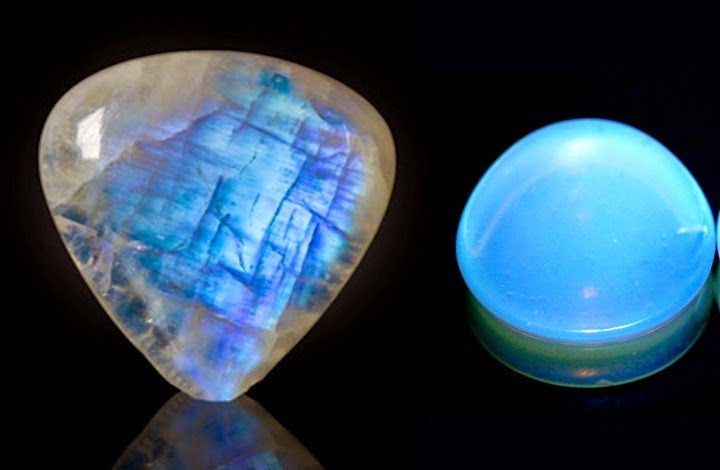
Moonstones are highly prized gemstones. The best-quality Moonstone can fetch a high price depending on its color, transparency, clarity, size, and optical effect. Moonstones are particularly prized for their adularescence – an optical phenomenon that creates a cloudy appearance of blue and white light with a beautiful moonlight-like sheen.
These are feldspar gems with varying compositions and are found in different parts of the world. They are known as feldspar gems with different compositions and alternating layers of orthoclase and albite. Like the name, the Moon has inspired a bit of romantic lore around this gemstone.
Despite having relatively low hardness and a tendency to chip, Moonstone remains a popular choice for jewelry and is commonly used in pendants, rings, and earrings. Moonstone is generally cut in the shape of cabochons and carvings, while transparent material may be faceted.
Moonstone Value
Usually, the more transparent and colorless the body, the stronger the blue adularescence, and the higher the value of Moonstone. Large quantities of opaque material with various body colors are carved into simple “moon faces” and other figures and may be available at lower prices.
Cabochons of translucent material, whether present in white or with a pleasing body color and attractive adularescence, are less common in the market and may command relatively modest to higher prices depending on quality.
For cat’s eyes and occasional star effects, expect to pay in proportion to the beauty and visibility of the eye or star, as well as the gemstone’s size and clarity.
Factors That Determine Moonstone Value
The value of a Moonstone can vary considerably depending on several factors:
- Adularescence: A strong and attractive blue sheen can significantly increase value.
- Transparency: More transparent material is generally more desirable.
- Body Color: Colorless and attractive body colors are often preferred.
- Clarity: Clean and well-formed gemstones can command higher prices.
- Size: Larger high-quality stones are generally more valuable.
- Optical Effects: Cat’s-eye and star effects can increase the gemstone’s desirability.
- Cut: Well-proportioned cabochons can display adularescence more effectively.
Blue Sheen Moonstone
Historically, some of the most valuable colorless and transparent Moonstones with a strong blue sheen were available from Myanmar. Unfortunately, this material is not commonly available today.
Many top-grade blue-sheen gemstones available today are traded from one dealer or collector to another, which can increase their prices due to limited availability and high demand.
The quality of the blue adularescence remains one of the most important factors considered when evaluating premium Moonstone.
Varieties of Moonstone
Moonstone occurs in different varieties and appearances depending on its mineral composition, body color, transparency, and optical phenomenon.
Orthoclase Moonstone
A blue soft color is found in orthoclase Moonstone if the albite crystals are very fine. The sheen is white if the albite plates are thick.
The color of the orthoclase may be white, beige, brown, red-brown, greenish, or yellowish. A small amount of red tinge may be due to the presence of small amounts of goethite inclusions.
A Moonstone with orthoclase feldspar sanidine is found in Grant County, New Mexico.
Rainbow Moonstone
There are some transparent plagioclase feldspars, such as labradorite, that have thin layers of albite. These can produce a light-blue schiller effect when the layers are thin and a white effect when the layers are thicker.
This phenomenon is known as labradorescence. Such stones are also commonly known as rainbow Moonstone or peristerite.
Technically, rainbow Moonstone is a variety of labradorite rather than traditional orthoclase Moonstone. Labradorescence is different from adularescence, even though the two optical effects can sometimes appear visually similar.
Moonstone Specific Gravity & Refractive Index
The best specimens of Moonstone are found in Sri Lanka, with a specific gravity at the low end of the Moonstone scale, around 2.56. Specimens from India tend toward the higher end, around 2.59.
The refractive index of most Moonstones is usually 1.520–1.525, with a birefringence of approximately 0.005.
Material from Virginia has a refractive index of approximately 1.518–1.524, with a birefringence of around 0.006.
These gemological properties can be useful when identifying and evaluating Moonstone and distinguishing it from similar-looking materials.
Moonstone Source
Myanmar has historically yielded some of the finest Moonstone material, particularly highly valued transparent stones with a strong blue sheen.
Sri Lanka and India are also important sources associated with Moonstone material, while different feldspar varieties and related materials can be found in other regions.
Buy Natural Certified Moonstone Gemstone
When buying Moonstone, it is important to consider its natural origin, quality, transparency, adularescence, color, clarity, and overall appearance. Certification from a reputed gemstone laboratory can provide additional confidence regarding the identity and authenticity of the gemstone.
AstroKapoor offers natural certified Moonstone gemstones in wholesale prices for customers looking for quality gemstone options.
Frequently Asked Questions
What makes Moonstone valuable?
Moonstone value is mainly influenced by its transparency, body color, clarity, size, cut, and adularescence. Colorless and transparent Moonstone displaying a strong blue sheen is generally considered more desirable and can command higher prices.
What is adularescence in Moonstone?
Adularescence is the characteristic optical phenomenon that gives Moonstone its soft, glowing appearance. It can appear as a cloudy or floating sheen of white or blue light across the surface of the gemstone.
What is the difference between Moonstone and Rainbow Moonstone?
Traditional Moonstone is generally associated with orthoclase feldspar containing albite layers that create adularescence. Rainbow Moonstone is technically a variety of labradorite and displays an optical effect known as labradorescence.
Which countries are known for Moonstone?
Moonstone has historically been sourced from Myanmar and Sri Lanka, while India is also an important source. Different varieties and related feldspar materials are found in several other locations around the world.
How can I buy a genuine Moonstone?
When buying a natural Moonstone, consider purchasing from a reputed gemstone dealer and ask for a certificate of authenticity from a recognized gemological laboratory. Evaluating the gemstone’s optical properties, quality, origin, and certification can help you make a more informed purchase.
