
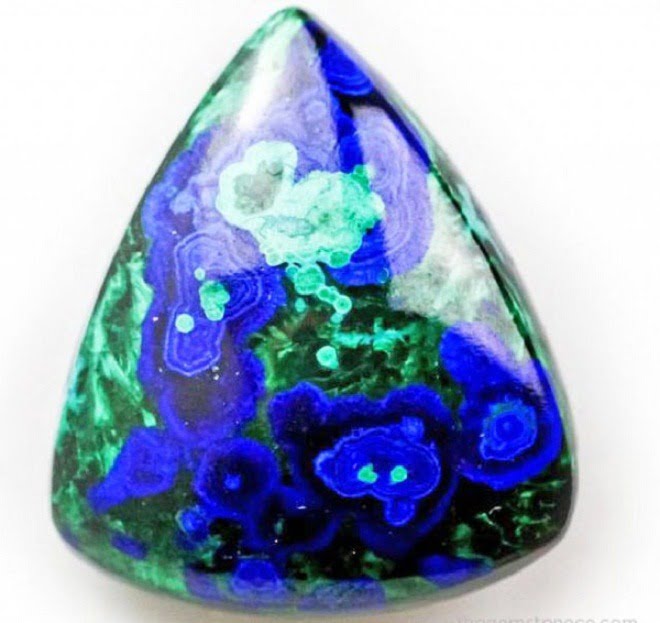
Azurite is found in blue color and also the combination of Greeish Blu, green color and is a very rare variety of gem. Azurite is composed of a very high copper content. Azurite is one of the basic carbonate minerals, which is malachite. It has got the name from the Persian word “lazhward”. It is a fairly soft stone and is used in jewelry making. It has a hardness of 3.4 to 4 on the Mohs scale. Azurite closely resembles that of lapis lazuli. It is found in deep blue in color. It is very small, shiny crystals and often stumbled stone. It is a meditative and a channeling stone. It also facilitates psychosomatic understanding of the effect of the mind and the body. It is also called as sobriety stone. Azurite brings peace and restores self confidence in a person. It also increases the slef esteem and brings new hope in the life of the wearer. Azurite bead is very good for removing mental depression.
Mineralogically, Azurite is a natural basic copper carbonate hydroxide mineral with the formula Cu₃(CO₃)₂(OH)₂. It is famous for azure blue, deep blue and dark-blue coloration and belongs to the monoclinic crystal system. Its name comes from the ancient Persian word “lazhward,” meaning blue. Azurite has a Mohs hardness of approximately 3.5–4 and a measured specific gravity near 3.77. Traditional associations with peace, confidence and meditation belong to crystal practices; Azurite is not scientifically established as a treatment for depression or other mental-health conditions.
Identifying Natural Azurite
Azurite can be easily identified by its unique green color. It is very soft and can be often scratch with a fine nail. Though it resembles lapis lazuli in color, but it lack gold inclusions. It can be identified by its rosy pink to dark red in color.
The original identification description needs clarification. Natural Azurite is characteristically blue rather than green, pink or dark red. Green areas commonly indicate associated Malachite, and Azurite frequently occurs together with Malachite because both develop in oxidized copper deposits. Azurite may also gradually alter or pseudomorph into Malachite. Azurite can resemble Lapis Lazuli from a distance, but Azurite is a copper carbonate mineral, whereas Lapis Lazuli is a multi-mineral rock and may contain distinctive golden Pyrite grains.
Azurite Gemological Properties
- Mineral – Azurite
- Chemical formula – Cu₃(CO₃)₂(OH)₂
- Mineral class – Basic copper carbonate
- Color – Azure blue, deep blue to dark blue
- Mohs hardness – 3.5 to 4
- Specific gravity – Approximately 3.77
- Crystal system – Monoclinic
- Cleavage – Perfect in one direction
- Transparency – Transparent to translucent in crystals; commonly opaque in massive material
- Lustre – Vitreous
- Streak – Light blue
- Refractive indices – Approximately 1.730, 1.758 and 1.838
- Tenacity – Brittle
Mindat confirms Azurite’s deep-blue coloration, hardness of 3.5–4, monoclinic crystal system, perfect cleavage and density around 3.77.
Azurite Origin and Sources
Azurite Origin: It is commonly found in United States, Australia, Chile, Peru, France, Namibia, Russia and Egypt.
Azurite occurs in the oxidized zones of copper-bearing ore deposits and is found in many countries. Historic and collectible specimens are known from France, the United States, Namibia, Australia and several other copper-producing regions. Its type locality is associated with the Chessy copper mines in France.
Determining Azurite Gemstone Value
Azurite Color: It is famous for its vivid blue color. It is often found mixed with green due to the presence of malachite. Azurite clarity and luster: It is generally opaque in color. When it is cut and polished, it has a very appealing vitreous luster. Cut and shape: It is typically a collector’s stone. It is sometimes treated as beads.
Fine Natural Azurite is valued for intense blue color, crystal formation, lustre, size, condition and attractive association with contrasting minerals such as green Malachite. Transparent or well-formed crystals are especially attractive to mineral collectors, while massive Azurite may be fashioned into cabochons, beads, carvings and decorative objects. Because the stone is soft and brittle, collector specimens are generally more common than heavy everyday jewelry.
Azurite and Malachite Combination
Azurite with Malachite combines the qualities of the two crystals and is a powerful conductor of energy. It unlocks spiritual vision. At an emotional level, it brings deep healing, cleansing, and overcomes muscle cramps.
Azurite and Malachite are two distinct copper carbonate minerals that frequently occur together. Azurite is Cu₃(CO₃)₂(OH)₂ and typically blue, while Malachite is Cu₂CO₃(OH)₂ and characteristically green. Azurite can alter naturally into Malachite under suitable environmental conditions, which explains many striking blue-and-green specimens. Spiritual vision, emotional cleansing and similar effects are metaphysical beliefs; there is no scientific evidence that this mineral combination treats muscle cramps.
Why Semi Precious Stone Azurite?
Azurite is famous as the stone of heaven. It can be used to enhance the optimism and positivity in the life of the wearer. It can be used against the black magic and ill eye. Semiprecious gems are cheaper than the precious stone. These are very soothing and can be worn, even if you don’t have any birth chart. These heal the mind and body and balance all the chakras of the body. Azuriteis highly effective for balancing the ill placed Venus and Saturn in the birth chart of the individual. Azurite can be used studded in pendants, beads and necklace as jewelry.
In modern crystal traditions, Azurite is associated with intuition, communication, self-reflection, confidence and spiritual awareness. Protection against the evil eye, balancing Venus or Saturn and chakra healing belong to astrological and metaphysical belief systems rather than scientifically demonstrated effects. The terms precious and semi-precious are traditional commercial classifications and do not determine a gemstone’s actual rarity or quality.
Benefits of Azurite
Azurite guides psychic and intuitive development. It uplifts the soul. This crystal enables journey out of the body. It is highly effective for raising consciousness to a higher level. It is a highly powerful stone. Mentally, Azurite brings about the clear understanding and new perspective to mind. Azurite releases long-standing blocks in communication. It challenges the unguided negative energies and releases the stress. It transmutes fear and phobias. It calms the overactive mind. Eliminates nervousness and brings self-expression.
These benefits are traditionally associated with meditation and crystal practices. Azurite may be used as a symbolic object for reflection, concentration and communication, but claims involving treatment of anxiety, phobias, depression or other psychological conditions are not scientifically proven and should not replace professional mental-health care.
Azurite Healing
Physically, it is a very powerful healer of the throat. It heals arthritis, joint pains and aligns the spine. It heals the kidney, gallbladder and liver problems. It treats the spleen, thyroid bones, teeth and skin. Since ancient time, Azurite is considered as a very powerful healer of the immune system. It energizes and realigns the subtle bodies. It physically clears the chakras of the body.
These statements represent historical or metaphysical healing traditions. There is no reliable scientific evidence that Azurite treats arthritis, joint pain, thyroid disorders, liver or kidney disease, gallbladder conditions, immune-system problems, skin disease or problems involving bones and teeth. Appropriate medical diagnosis and treatment should always be used for these conditions.
Azurite Safety and Handling
Because Azurite is a copper-containing mineral, rough material should be handled sensibly. It should not be ingested, placed in drinking water or used for direct-contact gemstone elixirs. Avoid grinding, drilling or sanding Azurite without appropriate dust-control measures because copper-containing dust can be harmful if swallowed or inhaled. Safety information for copper carbonate compounds identifies ingestion and inhalation as exposure concerns.
Normal handling of an intact polished specimen is different from exposure to loose mineral dust, but washing your hands after working with rough or dusty specimens is a sensible precaution. Keep small loose pieces away from children and pets.
Azurite Jewelry and Care
Azurite can be used for pendants, beads, necklaces, cabochons and protected decorative jewelry, but its low hardness, brittle nature and perfect cleavage make it unsuitable for rough daily wear. Clean it gently with a soft dry or slightly damp cloth. Avoid ultrasonic cleaners, steam, strong household chemicals, acids, abrasive materials and prolonged soaking.
Azurite jewelry should be stored separately from harder gemstones because Quartz, Topaz, Sapphire and Diamond can easily scratch its surface. Avoid heavy physical activity while wearing Azurite jewelry.
Buying Certified Natural Azurite
Wholesale Prices of Azurite: Visit Astrokapoor office for buying natural stone in a wholesale price. We provide certified natural gemstone.
When buying Certified Natural Azurite, look for a rich blue color, attractive crystal or matrix formation, good surface condition and reliable mineral identification. Blue-and-green Azurite-Malachite combinations can also be highly decorative. Certification becomes particularly useful for valuable specimens or when similar-looking blue minerals make visual identification uncertain.
Frequently Asked Questions
What is Azurite?
Azurite is a natural blue copper carbonate hydroxide mineral with the chemical formula Cu₃(CO₃)₂(OH)₂. It is famous for its intense azure to deep-blue coloration.
Is Azurite blue or green?
Azurite itself is characteristically blue. Green areas in many specimens are commonly Malachite, which frequently occurs together with Azurite.
What is the hardness of Azurite?
Azurite has a Mohs hardness of approximately 3.5 to 4, making it relatively soft and better suited to protected jewelry and mineral collections.
What are the traditional benefits of Azurite?
In crystal traditions, Azurite is associated with intuition, communication, confidence, meditation and spiritual awareness. These are traditional beliefs rather than scientifically proven medical benefits.
Is Azurite safe to use as a gemstone elixir?
Direct-contact Azurite elixirs are not recommended because Azurite contains copper. It should not be ingested, and dust created by cutting, sanding or grinding should be avoided.


