
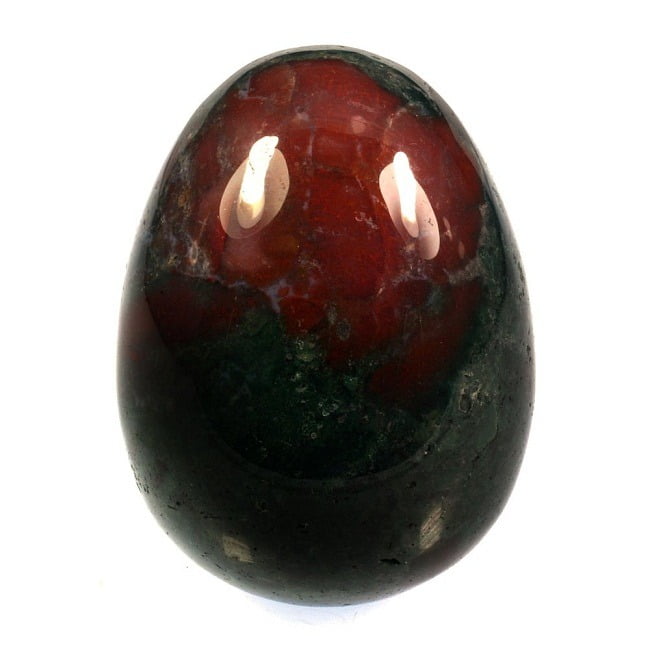
Bloodstone is also a semiprecious gemstone of the variety chalcedony. Blood stone is also defined as variety of micro crystalline. It is called as Heliotrope in Greek, which means sun turning. According to the belief, the Sun turns red when this stone is immersed in water. It is dark green in color with red spots all over the surface. This is also referred as Blood jasper in the market sometimes. It really doesn’t represent jasper, but a dark green chalcedony which is a mixture of red to brown. This gemstone is a traditional gemstone for the month of March along with aquamarine.
Gemologically, Natural Bloodstone is a variety of Chalcedony or cryptocrystalline Quartz with the basic chemical composition SiO₂. It normally has a dark-green to greenish-blue body color with red, reddish-brown or occasionally yellowish spots. GIA identifies the characteristic red inclusions as iron oxides, particularly Hematite. Gemdat notes that “Blood Jasper” is sometimes used as a trade name, although Bloodstone is generally classified within the Chalcedony family.
The name Heliotrope comes from ancient Greek words associated with the “sun” and “turning.” Ancient tradition held that placing the stone in water could make reflected sunlight appear red. This is a historical belief rather than an actual ability of the gemstone to change the Sun’s color.
Bloodstone is believed to have mystical and magical properties. It helps to heighten the intuition and increases creativity. It is an excellent grounding and protecting stone. It keeps out undesirable influences out form the negative surrounding. It stimulates dreaming and is a powerful revitalizer.
These associations belong to historical crystal and metaphysical traditions. Bloodstone has long been connected symbolically with courage, strength, vitality and protection, but these effects are not scientifically measurable properties of the mineral.
Bloodstone Origin and Sources
Origin: It is mainly found in Australia, China, Russia and India.
Bloodstone occurs in several parts of the world. GIA notes that most Bloodstone available in today’s gemstone market comes from India, with additional material occurring in Brazil, Australia, China, the United States and other countries. It may occur as pebbles in riverbeds or as material filling cavities and fractures in rocks.
India is especially important historically and commercially. Bloodstone occurrences are documented around Morbi and the wider Saurashtra region of Gujarat, and the region has a long history of cutting and polishing Chalcedony and Agate materials.
Bloodstone Gemological Properties
Natural Bloodstone takes most of its physical properties from its Chalcedony host:
- Gem material – Bloodstone / Heliotrope
- Mineral family – Chalcedony / Quartz
- Chemical formula – SiO₂
- Color – Dark green to greenish-blue with red or reddish-brown spots
- Red inclusions – Mainly iron oxides, especially Hematite
- Mohs hardness – 6.5 to 7
- Specific gravity – Approximately 2.55–2.70
- Refractive index – Approximately 1.530–1.543
- Transparency – Semi-translucent to opaque
- Lustre – Waxy to vitreous when polished
- Cleavage – None
- Typical cut – Cabochon, bead, carving or polished slab
Gemdat records Bloodstone at hardness 6.5–7, specific gravity around 2.55–2.70 and refractive index approximately 1.530–1.543.
What Causes the Red Spots in Bloodstone?
The red “blood-like” marks are natural mineral inclusions rather than actual blood or organic material. GIA identifies iron oxides, especially Hematite, as the principal source of these red spots. The green color can be associated with microscopic chlorite or amphibole-type inclusions within the Chalcedony.
The amount and distribution of red spotting can vary greatly. Some specimens have many distinct red spots, while others may contain only a few. Natural variation in pattern is therefore expected and can contribute to the individuality of each polished stone.
Bloodstone as a March Birthstone
Bloodstone is one of the two recognized March birthstones, together with Aquamarine. GIA describes Bloodstone as the traditional opaque-to-semi-translucent dark-green March birthstone with red iron-oxide inclusions.
The two March stones are visually very different: Aquamarine is usually transparent blue-to-greenish-blue Beryl, while Bloodstone is primarily opaque or translucent green Chalcedony. Their shared birth-month association is historical rather than mineralogical.
Bloodstone Healing Properties and Medical Astrology Purpose
Bloodstone is an energy cleanser and immune stimulator for acute infection. It stimulates the flow of lymph. It benefits blood rich organs, regulates and supports blood-flow. It is helpful in case of leukemia as it supports the blood and removes toxins. It was used by ancient Egyptians to heal tumors. It also cleanses the lower chakras and realigns their energies.
Mentally, Bloodstone calms the mind and removes confusion. It enhances the decision making capacity. Emotionally, this stone helps in grounding the heart energy. It helps to bring spirituality to the highest level. Psychologically, this stone gives courage and teaches how to avoid dangerous situations by strategic withdrawal. It helps to act in negative moment.
The bloodstone is a stone that fight against evil spirits and also prevents jealousy. It helps to boost one’s self confidence and brings good fortune. When this stone become red in color, then this gives signals as a danger to the wearer.
These statements represent historical crystal-healing, folklore and medical-astrology traditions. There is no reliable scientific evidence that Bloodstone stimulates immunity or lymph flow, treats leukemia or tumors, removes toxins, regulates circulation or predicts approaching danger by changing color.
Leukemia and tumors are serious medical conditions requiring specialist diagnosis and treatment. Bloodstone should never replace oncology care, medication, surgery or other professional healthcare.
Traditional associations with courage, confidence, emotional stability and protection may still be meaningful within personal or spiritual practices, but they should be presented separately from established medical effects.
Bloodstone Facts
It is a form of chalcedony, very similar to carnelian and Chrysoprase. Bloodstone makes great looking beads and is used for making pendants, bracelets. From the time immemorial this stone is used in jewelry making.
Bloodstone, Carnelian and Chrysoprase all belong to the broader Chalcedony family, but they are distinguished by appearance and coloring agents. Carnelian is typically orange to reddish Chalcedony, Chrysoprase is nickel-colored apple-green Chalcedony, while Bloodstone is characteristically dark green with contrasting red iron-oxide spots.
Bloodstone has a long history as a carving material and is commonly fashioned into cabochons, beads, signet-style pieces, pendants and ornamental objects. GIA notes that Bloodstone gems are normally cut as cabochons, although some material can also be faceted.
Why Bloodstone?
Semi precious gemstone has the same qualities as the precious gemstone. The semiprecious gemstone can be very well considered, if you are incapable of buying the precious gemstone. Although semi precious gemstone lack few characteristic of precious gemstone, but yet they have the quality which can act as a precious gemstone
The terms “precious” and “semi-precious” are traditional commercial classifications and do not scientifically determine a gemstone’s quality, rarity or effectiveness. Bloodstone is valued for its distinctive natural red-and-green pattern, historical importance, March birthstone status, durability and affordability.
Its suitability should be assessed on its own characteristics rather than by assuming that it has the same properties as Emerald, Ruby, Sapphire or another traditionally precious gemstone.
Traditional Benefits of Bloodstone
In crystal traditions, Bloodstone is associated with courage, grounding, vitality, determination, confidence and mental focus. Historical folklore has also connected the stone with protection, strength and good fortune. GIA records a long history of metaphysical beliefs surrounding Bloodstone, including associations with strength and preservation of health.
These symbolic meanings can make Bloodstone a personally meaningful meditation or birthstone gemstone. However, emotional, financial or physical outcomes cannot be guaranteed by wearing the stone.
Position and Traditional Use
Position
Wear continually for good health. Place in a bowl of water or glass beside the bed to ensure peaceful sleep. It acts as an immune stimulator.
Wearing Bloodstone continuously or positioning it near a bed is a personal spiritual practice rather than a medical treatment. There is no evidence that the gemstone stimulates the immune system or clinically improves sleep.
If a crystal practice involves water, it is preferable to keep the Bloodstone outside drinking water rather than prepare a direct-contact gemstone elixir. Natural stones can contain inclusions or contaminants, and ingesting mineral powders or gemstone-infused water has no established therapeutic benefit.
How to Buy Certified Natural Bloodstone
When buying Certified Bloodstone, examine the dark-green body color, natural red spotting, polish, cracks, pattern distribution and overall appearance. Well-defined red spots against an attractive green background create the classic Bloodstone appearance.
Because red spotting naturally varies, a specimen with fewer spots is not automatically artificial or low quality. Certification is particularly useful when a valuable stone is being sold with claims about natural identity, origin or treatments.
India currently supplies much of the Bloodstone seen in the gemstone market, so Indian origin is common and should not by itself be treated as an indicator of lower or higher quality.
Wholesale price of Bloodstone: Visit Astrokapoor office for buying certified, natural stone in a wholesale price. We provide certified natural gemstone.
Bloodstone Jewelry and Care
Bloodstone’s Mohs hardness of approximately 6.5–7 makes it suitable for pendants, bracelets, beads, cabochons, rings, carvings and ornamental jewelry. Its Chalcedony structure provides reasonable durability, although strong impacts and scratching by harder gemstones should still be avoided.
GIA recommends cleaning Bloodstone with warm soapy water and a soft brush, followed by drying with a clean soft cloth. Avoid harsh chemicals and extreme heat. Store it separately or in soft fabric to reduce scratching.
Frequently Asked Questions
What is Bloodstone?
Bloodstone, also called Heliotrope, is a dark-green variety of Chalcedony or cryptocrystalline Quartz traditionally identified by its red iron-oxide spots.
What causes the red spots in Bloodstone?
The characteristic red spots are mainly caused by iron-oxide inclusions, especially Hematite. They are natural mineral inclusions rather than organic material.
Is Bloodstone a March birthstone?
Yes. Bloodstone and Aquamarine are the two recognized birthstones traditionally associated with March.
What are the traditional benefits of Bloodstone?
In crystal traditions, Bloodstone is associated with courage, confidence, grounding, strength and protection. These are traditional beliefs rather than scientifically proven medical effects.
What is the hardness of Bloodstone?
Bloodstone has a Mohs hardness of approximately 6.5–7, making it suitable for cabochons, beads, pendants, bracelets and many other jewelry applications.


