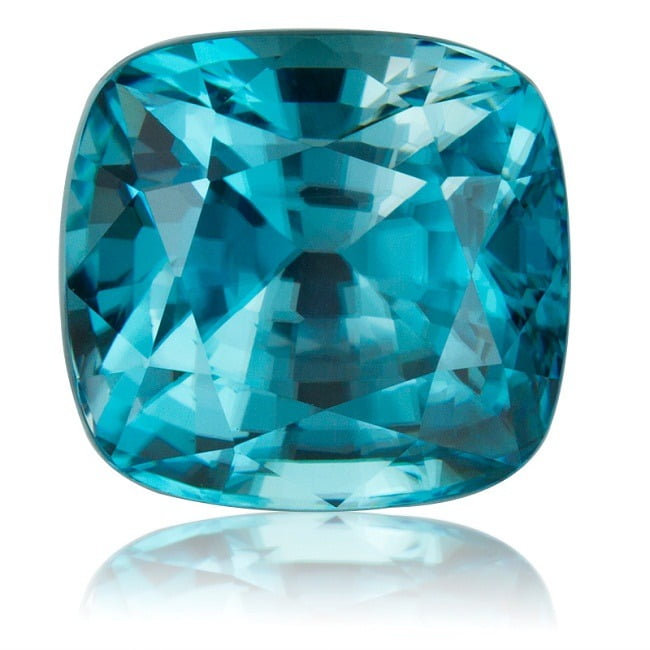
Blue Zircon is a group of mineral belonging to neosilicates. Blue Zircon is a traditional birthstone for December. Zircon is one of the heaviest gemstones till now. Blue Zircon has a hardness of 6.5 to 7.5 on the Mohs scale. It can be easily identified by it birefringence when observed from the bottom of any elevated surface. Natural Zircon suffers due to cubic zirconia which is the artificial diamond. Many people are unaware that there is a natural Zircon present in the earth’s crust. Of course the natural and the artificial zircon are completely different from each other.
Gemologically, Zircon is a natural zirconium silicate mineral with the chemical formula ZrSiO₄ and a tetragonal crystal structure. High-quality Zircon has strong brilliance, exceptionally high dispersion and pronounced double refraction, which can make the rear facet edges appear doubled when viewed through a cut stone. Zircon has a relatively high specific gravity of about 4.6–4.7 in its normal crystalline form, making it heavier than many common gemstones of similar size, although it is not literally the heaviest gemstone known.
Zircon must not be confused with Cubic Zirconia or CZ. Zircon is a naturally occurring mineral formed within the Earth’s crust, while Cubic Zirconia is laboratory-manufactured zirconium dioxide commonly used as a Diamond simulant. The similarity between their names has unfortunately caused significant consumer confusion.
Blue Zircon is found in wide range of colors, of which white is least valuable. The most popular zircon found in this group is Blue Zircon. Blue Zircon is produced by heating the brown zircon at a certain temperature. But only some brown zircon turns into blue while heating, typically the deposits found in the South East Asia.
Blue is currently the most commercially popular Zircon color. However, colorless Zircon should not automatically be described as the least valuable; value depends on color, clarity, cut, size and rarity. GIA notes that blue dominates consumer demand, while bright red and green Zircons are also especially valued by collectors.
Zircon is a traditionally very important mineral. The emergence of this mineral led to the study of “ziconolgy” in gemology.
The term “zirconology” is not a standard major branch of gemology. Zircon is, however, extremely important in geology and geochronology. Because Zircon crystals can incorporate uranium while excluding most initial lead, scientists use uranium-lead isotope ratios in Zircon to determine the age of rocks and reconstruct Earth’s early geological history. Some Zircon crystals from Australia are approximately 4.4 billion years old.
Blue Zircon Source and Origin
Sri Lanka is the best known source for the green metamict low zircon. The deposits of zircon are found in the alluvial deposits of the earth’s crust. Zircon deposits are also found in Burma and Cambodia. Other important sources of Zircon are Mozambique, Nigeria, Tanzania, Korea and Vietnam.
Zircon occurs in many regions worldwide. Sri Lanka is historically important for gem Zircon, including low or metamict green material, while Cambodia is particularly famous for brown Zircon that responds well to heat treatment and produces attractive blue stones. Myanmar, Vietnam, Australia, Madagascar, Tanzania, Mozambique and other regions have also produced gem-quality Zircon. GIA identifies Cambodia’s Ratanakiri region as an especially important source of rough that can be heated to produce vivid blue gems.
Blue Zircon Gemological Properties
Chemical Formula – Zirconium Silicate
Color – Blue
Hardness – 6.5 to 7.5 on the Mohs scale
Cleavage – Indistinct
Transparency – Transparent to translucent
Luster – Vitreous to brilliant sheen
A more complete gemological profile of normal or “high” Zircon includes:
- Mineral – Zircon
- Chemical formula – ZrSiO₄
- Mineral class – Nesosilicate
- Crystal system – Tetragonal
- Color – Blue, colorless, yellow, orange, red, brown, green and other shades
- Mohs hardness – Approximately 6 to 7.5 depending on structural condition
- Normal high-Zircon hardness – Around 7.5
- Specific gravity – Approximately 4.6–4.7 for high Zircon
- Refractive index – Approximately 1.925–2.015 for high Zircon
- Transparency – Transparent to translucent in gem material
- Lustre – Vitreous to adamantine
- Cleavage – Poor to indistinct
- Tenacity – Brittle
- Optical character – Uniaxial positive
- Birefringence – Strong
- Dispersion – Very strong
Zircon’s physical properties vary because naturally occurring trace uranium and thorium can gradually damage its crystal structure through internal radiation over geological time. Gemologists therefore describe Zircon as high, intermediate or low depending on the degree of structural alteration. Most Zircon used in modern jewelry belongs to the high type.
Why Does Blue Zircon Have a Blue Color?
Most gem-quality Blue Zircon does not naturally leave the ground with its familiar vivid blue color. GIA reports that nearly all blue and near-colorless Zircons have undergone heat treatment because these colors are rare naturally. Brown or reddish-brown rough can be heated under controlled conditions to create bright blue, greenish-blue or near-colorless gems.
Cambodian material is particularly famous for this transformation. GIA research on Ratanakiri Zircon found that suitable brown rough can produce intense blue coloration after controlled heating. The treatment is widely accepted in the gemstone market, but buyers should still receive clear treatment disclosure.
How to Identify Blue Zircon
One of Blue Zircon’s most recognizable characteristics is its strong double refraction or birefringence. When looking through a properly faceted stone, the back facet edges may appear doubled. Zircon also has unusually high brilliance and dispersion, producing strong flashes of spectral colors commonly called “fire.” These characteristics once made colorless Zircon a popular natural Diamond alternative.
Professional identification may involve refractive index, specific gravity, microscopic examination, spectroscopy and other laboratory tests. Because heat treatment is extremely common in Blue Zircon, certification is useful when treatment disclosure or confirmation of natural origin is important.
Blue Zircon vs Cubic Zirconia
Blue Zircon and Cubic Zirconia are not different versions of the same gemstone. Natural Zircon is zirconium silicate, ZrSiO₄, while Cubic Zirconia is laboratory-produced zirconium dioxide, ZrO₂. Natural Zircon has a tetragonal crystal structure and a geological history that may extend billions of years.
Cubic Zirconia became popular as a Diamond simulant because of its appearance and affordability, whereas Zircon has been used as a natural gemstone for centuries. Buyers should therefore look for the words “Natural Zircon” rather than assuming anything labelled “zircon” or “CZ” represents the same material. GIA specifically describes Zircon as being unfairly confused with Cubic Zirconia.
Blue Zircon Uses
Blue Zircon is not very costly stone, so it is available easily for jewelry making. Its various uses are as follows. Blue Zircon provides emotional, mental and physical balance. It brings visionary approach towards the life. Zircon brings abundance and prosperity to the wearer. It clears the blocked energy and brings smoothness in the chakra healing. This stone controls dizziness and insomnia. It increases self confidence and removes negativity thought. This stone heals the allergies and asthma condition. It improves the memory of the wearer. Zircon brings abundance and prosperity to the wearer.
In modern crystal traditions, Blue Zircon is symbolically associated with confidence, wisdom, mental clarity, prosperity, optimism and spiritual reflection. Chakra clearing and energy balancing are metaphysical practices rather than scientifically established gemstone effects.
Blue Zircon is highly useful in the treatmnt of various disease related to skin and infetility. Since ancient time, Blue Zircon is used in Medical Astrology for the treatment and healing of the diseases.
Claims that Blue Zircon treats asthma, allergies, insomnia, dizziness, infertility, skin disorders or other medical conditions are not supported by reliable scientific evidence. Blue Zircon should not replace professional diagnosis or treatment for any physical or mental-health condition.
Blue Zircon Metaphysical Properties
Zircon is the official birthstone for the person born in the month of December. The name zircon has thought to be derived from the Persian word “zargun”, which means “gold colored”. Found in middle ages, zircon is very useful to bring sleep, prosperity, and brings honor and wisdom to the wearer. It is assigned to the planet Pluto. It is very helpful for varicose vein and testicle problems.
Zircon is indeed one of the recognized December birthstones, together with Tanzanite and Turquoise. Historical traditions have associated Zircon with wisdom, prosperity, honour and restful sleep, while planetary associations can vary among astrological systems.
The traditional medicinal claims involving varicose veins, testicular disorders or sleep problems should not be interpreted as clinical treatment. Such conditions require appropriate healthcare.
Blue Zircon Quality and Value
Fine Blue Zircon is valued for vivid color, strong brilliance, eye-clean clarity, balanced cutting and attractive carat weight. GIA reports that blue is the most popular commercial color and accounts for a large proportion of Zircon sales. Well-cut Zircon can display exceptional fire because of its high refractive index and dispersion.
Because Zircon has strong birefringence, cutters carefully orient facets to manage the visible doubling effect while maximizing brilliance. Large fine-quality gems are less common, even though Zircon’s relatively high density means a stone may weigh more than another gemstone of identical dimensions.
Blue Zircon Jewelry and Care
Blue Zircon can be used in rings, earrings, pendants, bracelets and necklaces, but it requires more care than Sapphire. GIA rates Zircon at approximately 6–7.5 on the Mohs scale with fair-to-good toughness and notes that it can be brittle and susceptible to abrasion. Rings should therefore be removed during sports, gardening, household work or other activities involving hard impacts.
Warm soapy water is the recommended cleaning method. Ultrasonic and steam cleaners should be avoided. Some heat-treated Blue Zircons may also gradually shift toward a lighter brown color after prolonged exposure to very bright light, and high heat can alter their color.
Why Blue Zircon Stone from Astrokapoor?
We at Astrokapoor offer natural and certified gemstones of excellent quality. Each gemstone is passed from various tests by the team of our own gemologist and finally certified by government approved laboratories and best quality is picked for our clients. You can directly buy natural Blue Zircon gemstones from our online store by sending us your details and requirements. We offer best rates to our clients.
When buying Certified Blue Zircon, check the gemstone’s natural identity, treatment disclosure, color saturation, clarity, cutting quality and certification details. Since heat treatment is standard for most commercial Blue Zircon, a responsible listing should distinguish between a natural Zircon gemstone and whether its blue color has been enhanced by heat.
Frequently Asked Questions
Is Blue Zircon a natural gemstone?
Yes. Zircon itself is a naturally occurring mineral with the formula ZrSiO₄. However, the blue color seen in most commercial Blue Zircon is created by heat treatment of suitable natural brown Zircon.
Is Blue Zircon the same as Cubic Zirconia?
No. Natural Zircon is zirconium silicate, while Cubic Zirconia is laboratory-manufactured zirconium dioxide. They are completely different materials.
Is Blue Zircon a December birthstone?
Yes. Zircon is one of the recognized December birthstones, together with Tanzanite and Turquoise.
What is the hardness of Blue Zircon?
Zircon ranges approximately from 6 to 7.5 on the Mohs scale depending on its structural condition. High Zircon commonly used for jewelry is near the upper part of that range.
What are the traditional benefits of Blue Zircon?
In metaphysical traditions, Blue Zircon is associated with wisdom, confidence, prosperity, mental clarity and positive thinking. These are traditional beliefs and should not be considered scientifically proven medical effects.


