
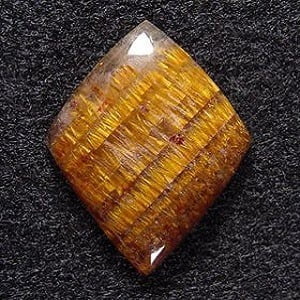
Cacoxenite is one of the most distinctive inclusion minerals in the crystal world. It appears as fine golden to reddish-brown needles that radiate outward in tufts and sprays inside a host of clear quartz or amethyst, so that the stone looks as though it has captured a small burst of light inside it.
Because cacoxenite crystals themselves are tiny, the stone sold as cacoxenite is almost always cacoxenite in amethyst or cacoxenite in quartz — the host carries the inclusion. This is not a shortcoming; it is what makes the material wearable, since the quartz gives it the durability the soft cacoxenite lacks on its own.
The stone is associated with heightened awareness and spiritual growth, and is widely used to deepen meditation. It is said to strengthen consciousness and intuition, guide a person towards their own direction, and help them recognise both the kindness in others and the larger design of the world they live in.
Cacoxenite vs Super Seven — They Are Not the Same Thing
This is the single most common error in how cacoxenite is sold, and getting it right will save you customer complaints.
Super Seven — also called Melody Stone or Sacred Seven — is a specific quartz from Espírito Santo in Brazil that contains seven minerals together in one piece: amethyst, clear quartz, smoky quartz, cacoxenite, rutile, goethite and lepidocrocite.
Cacoxenite is one of those seven. A stone containing cacoxenite is not automatically Super Seven, and true Super Seven material must contain all seven minerals from that one Brazilian source.
So cacoxenite in amethyst is a genuine and beautiful material in its own right, but it should be sold under its own name. If a seller labels every golden-included amethyst as Super Seven, they are either mistaken or hoping you won’t check.
What Is Cacoxenite? The Mineral Behind the Name
Cacoxenite is a rare iron aluminium phosphate. It was first described in 1825 at the Hrbek Mine in Bohemia, and is also recorded from Germany, Sweden, England and France. The gem-quality material that reaches the market as cacoxenite in amethyst, however, comes principally from Brazil.
The name has an unexpectedly blunt origin. It comes from the Greek kakos xenos, meaning “bad guest” or “harmful stranger” — mineralogists named it that because the phosphorus it introduced was considered a damaging impurity in iron ore. A stone now sold for spiritual clarity was named for being unwelcome, which is a fair reminder that a mineral’s reputation depends entirely on who is looking at it.
Why Should I Wear Cacoxenite?
Cacoxenite is traditionally associated with the third eye and crown chakras. It is described as opening a connection between the wearer and a wider sense of meaning, and as clearing the mind of negative and circling thoughts.
Working with the crown chakra, cacoxenite is said to support clearer thinking and a steadier relationship with the world as it actually is. The crown is described in crystal tradition as the seat of a person’s beliefs and understanding of life, and cacoxenite is used by those trying to make sense of their own place and direction.
Working with the third eye or brow chakra, cacoxenite is regarded as strengthening perception and insight. A settled brow chakra is said to bring balance to a person’s thought process and inner dialogue.
It is also associated with the solar plexus, the centre linked to personal power, confidence and the courage to act.
Many people keep cacoxenite in amethyst on a dining table or in a meeting room, where it is traditionally believed to encourage courtesy and reduce friction. In a workplace it is associated with a more open, honest working atmosphere.
Benefits and Effects
Cacoxenite is described as a stone that works on the whole person rather than one part — recognising the link between how someone feels, how they think and how they act.
It is regarded as a steadying stone during periods of upheaval. It is said to create a settled inner space a person can return to when they need it, and to make relating to others feel less effortful.
It is also associated with easing fear and quieting the loops of worry that keep a person from moving forward, and with self-acceptance — seeing yourself as you actually are rather than as you fear you might be.
Above all it carries a reputation as a stone of optimism. It is said to help a person notice the workable and favourable elements in a situation, and to act with judgement rather than reaction.
The benefits most commonly associated with cacoxenite are deeper meditation, clearer intuition, freedom from circling thoughts, self-acceptance, and a steadier and more optimistic outlook.
How to Identify Genuine Cacoxenite
A good deal of material sold as cacoxenite in amethyst contains something else entirely.
True cacoxenite appears as very fine golden-yellow to brownish-yellow needles arranged in radiating tufts, sprays or fan shapes, like tiny bursts. The individual needles are hair-thin.
Goethite and limonite, the most common substitutes, produce similar golden-brown inclusions but tend to appear as denser clumps, films or irregular masses rather than clean radiating sprays.
Rutile is often confused too, but rutile needles are longer, straighter, coarser and more metallic, and they run across the stone rather than radiating from a point.
Ask the seller what the inclusion actually is, and buy from someone willing to answer specifically.
Details
Origin – First described in 1825 at the Hrbek Mine, Bohemia. Also found in Germany, Sweden, England and France. Gem material in amethyst comes chiefly from Brazil.
Colour – Yellow to reddish-yellow, golden yellow, brownish yellow, deep orange and green
Species – Iron aluminium phosphate, usually included in quartz or amethyst
Hardness – Cacoxenite itself is 3 to 4 on the Mohs scale; as an inclusion in a quartz or amethyst host, the finished stone is 7
Density – 2.20 – 2.60 g/cm³ for cacoxenite; around 2.65 for the quartz host
Also known as – Cacoxenite amethyst
Birthstone month – November and December
Ruling planet – Jupiter
Associated chakra – Third eye and crown, with a secondary solar plexus link
Profession – Writer, journalist, counsellor, therapist and other professions as suggested by an astrologer
Jewellery metal – Silver and copper
Wearing day – Thursday
Significance – Cacoxenite is associated with dream work and sustained concentration, and with a closer sense of connection to something beyond the everyday. It is said to strengthen intuitive recognition and to bring a person to the understanding that the capacity they are looking for is already theirs to use — for their own benefit and for others’. It is described as more active and quicker in effect than plain amethyst, and its vibration is traditionally linked with setting aside self-interest in favour of a clearer sense of direction, making guidance easier to recognise when it appears.
Is Cacoxenite a Vedic Gemstone?
No. Cacoxenite is not one of the nine Vedic ratnas and is not prescribed in Jyotish for any planet. The Jupiter association above belongs to crystal tradition rather than Vedic astrology — the gemstone traditionally prescribed for Jupiter is yellow sapphire (Pukhraj).
The pairing is at least coherent on this page: Thursday is Jupiter’s day, and Jupiter governs wisdom, teaching and understanding, which matches what cacoxenite is kept for. It is also worth noting that amethyst — the usual host — is itself used in Jyotish as an upratna, a substitute stone for blue sapphire and the planet Saturn.
Because cacoxenite is not a prescribed ratna, there is no ascendant rule, no ratti weight, no trial period and no muhurat requirement. Anyone can keep or wear it regardless of their chart. If you want a genuine Jupiter remedy, a horoscope-based gemstone recommendation is the correct starting point.
Hardness and Everyday Wear
This is where cacoxenite in amethyst has a real practical advantage. Cacoxenite alone is soft at Mohs 3 to 4 and would never survive as jewellery. Locked inside a quartz or amethyst host at Mohs 7, it becomes a durable, everyday-wearable stone.
That makes it suitable for rings, pendants, bracelets and beads. The one thing to watch is prolonged strong sunlight, which can fade the purple of an amethyst host over time.
Care and Cleaning
Clean your stone roughly once a fortnight using baby liquid soap or another mild liquid soap. Never scrub it hard with a brush or rough object, and avoid scented detergents.
- Rinse with lukewarm water and dry completely with a soft cloth before storing
- Keep it out of prolonged direct sunlight to protect the amethyst colour
- Avoid ultrasonic cleaners, steam, bleach and household chemicals
- Store wrapped in a soft cloth, away from harder stones
- Remove before swimming, exercise and heavy household work
Frequently Asked Questions
What is cacoxenite?
Cacoxenite is a rare iron aluminium phosphate that forms fine golden needles in radiating tufts. It is almost always sold as an inclusion inside quartz or amethyst rather than as a standalone gemstone.
Is cacoxenite the same as Super Seven?
No. Super Seven is a Brazilian quartz containing seven minerals together — amethyst, clear quartz, smoky quartz, cacoxenite, rutile, goethite and lepidocrocite. Cacoxenite is one of those seven, so a cacoxenite stone is not automatically Super Seven.
What is cacoxenite good for?
In crystal tradition it is associated with deeper meditation, sharper intuition, clearer thinking, self-acceptance and a more optimistic outlook.
Which chakra is cacoxenite connected to?
Principally the third eye and crown chakras, with a secondary association to the solar plexus.
What does the name cacoxenite mean?
It comes from Greek words meaning “bad guest”, given by mineralogists because the phosphorus in it was regarded as a harmful impurity in iron ore.
How hard is cacoxenite?
The mineral itself is soft at 3 to 4 on the Mohs scale, but because it is set inside a quartz or amethyst host at Mohs 7, the finished stone is durable enough for everyday wear.
How do I know my cacoxenite is genuine?
Look for fine hair-thin golden needles radiating outward in tufts and sprays. Dense clumps or films are more likely goethite or limonite, and long straight metallic needles are rutile.
Where does cacoxenite come from?
The mineral was first described in Bohemia and occurs across parts of Europe. The gem material included in amethyst comes mainly from Brazil.
Is cacoxenite a navratna or a Vedic gemstone?
No. It is not among the nine Vedic gemstones and is not prescribed in Jyotish for any planet. It is kept as a crystal rather than as a planetary remedy.
Can cacoxenite be worn every day?
Yes, thanks to its quartz host. Just keep it out of long periods of direct sunlight so the amethyst colour does not fade.
Choosing Your Cacoxenite
No two pieces of cacoxenite in amethyst are alike — the density of the golden sprays, their placement and the depth of the amethyst all vary. Given how often other inclusions are sold under this name, buy from a supplier who will tell you exactly what is inside the stone. If you would like help choosing a piece, or want to know whether a prescribed Vedic gemstone suits your purpose better, Mr. Prashant Kapoor’s team is available for a personal consultation.


