
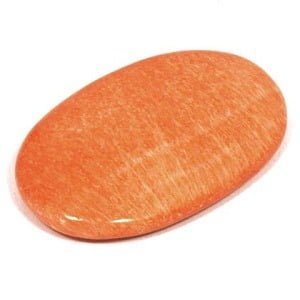
Celestobarite is one of the most striking yet least known stones in the crystal world. Banded in warm orange, cream and coral tones, it is valued for its unusual appearance and for its long-standing association with clarity of thought, decisiveness and personal boundaries.
It is described in crystal tradition as a stone that helps you see a situation as it actually is rather than as you fear or hope it to be — which is why it is so often chosen by people facing a difficult choice, a crossroads, or a problem they cannot see past.
What Is Celestobarite? The Honest Answer
Celestobarite is a trade name, not an officially recognised mineral species. It describes a natural intergrowth of two closely related minerals — celestite (celestine, strontium sulphate) and barite (barium sulphate) — which form together and produce the distinctive banded orange-and-cream patterning the stone is known for.
This matters when you are buying. Genuine celestobarite shows visible banding between the two minerals, is comparatively soft, and is noticeably dense for its size. It is sometimes spelled celestobaryte, and the two names refer to the same material.
Celestobarite vs Celestite vs Barite
| What it is | Typical appearance | |
|---|---|---|
| Celestite | Strontium sulphate, a single mineral | Pale sky-blue, often as clusters or geodes |
| Barite | Barium sulphate, a single mineral | Cream, white, brown or golden; heavy for its size |
| Celestobarite | The two grown together | Banded orange, cream and coral |
Celestite is the softer, calmer, sky-blue stone most people picture. Barite is the heavier, earthier one. Celestobarite carries the character of both, which is exactly why crystal tradition describes it as a stone that bridges the practical and the intuitive.
Celestobarite Meaning and Properties
In crystal tradition, celestobarite is regarded as a stone of clear seeing. It is associated with cutting through confusion, recognising what is actually happening in a situation, and acting on that recognition rather than hesitating.
It is also described as a boundary stone. That has two senses — it is said to support the ability to define personal limits and hold them without guilt, and it is said to help a person move between the practical demands of daily life and their inner or reflective life without either one overwhelming the other.
A third association is self-honesty. Celestobarite is traditionally said to bring a person’s own ego, jealousy and avoidance patterns into view, which is uncomfortable but is the starting point of any real change. It is not considered a gentle or soothing stone; it is considered a direct one.
Why Do People Keep Celestobarite?
For decision-making. Its best-known association is with making a considered choice when the path forward is unclear.
For concentration and study. It is popular with students, teachers and professionals for its association with attention span and sustained focus.
For boundary-setting. It is chosen by people who find it difficult to say no, or who feel their time and energy are constantly claimed by others.
For courage in difficult situations. Crystal tradition describes it as strengthening resolve — the willingness to face a problem directly rather than work around it.
For self-reflection and meditation. It is used as a focus stone in meditation, particularly where the aim is honest self-examination rather than relaxation.
Details of the Gemstone
| Detail | Description |
|---|---|
| Composition | Natural intergrowth of celestite (strontium sulphate) and barite (barium sulphate) |
| Colour | Banded orange, cream and coral |
| Hardness | 3–3.5 on the Mohs scale — soft, handle with care |
| Density | Approx. 4.0–4.5 g/cm³, heavy for its size |
| Origin | England, Poland, USA, Australia, Denmark |
| Also known as | Celestobaryte |
| Associated planet (crystal tradition) | Mars |
| Associated month (crystal tradition) | December |
| Suggested day | Tuesday |
| Jewellery metal | Silver or copper |
| Commonly chosen by | Students, teachers, writers, artists, lawyers, government officials |
Is Celestobarite a Vedic Gemstone?
No. Celestobarite is not one of the nine Vedic ratnas and is not prescribed in Jyotish for any planet. The Mars association above comes from crystal tradition, not from Vedic astrology — the gemstone traditionally prescribed for Mars is red coral (Moonga).
This is worth knowing before you buy, and it is also an advantage. Because celestobarite is not a prescribed ratna, there is no ascendant rule, no ratti weight, no muhurat requirement and no trial period attached to it. Anyone can keep or carry it regardless of their horoscope. If you are looking for a remedy for a specific planet in your chart, a horoscope-based gemstone recommendation is the right starting point instead.
Is Celestobarite Safe? Barium, Water and Elixirs
A straight answer, because this question is asked and rarely answered properly.
Celestobarite contains barium in the form of barium sulphate. Barium sulphate is chemically stable and highly insoluble, which is why it is used medically as a contrast agent that passes through the body unabsorbed. A polished celestobarite specimen is safe to hold, wear and keep in your home.
What you must not do is grind, powder or ingest it, and you should never make a crystal elixir by soaking it in drinking water. Soluble barium compounds are toxic, and no crystal of any kind should be used to prepare something you intend to drink. Use the indirect method — the stone beside a sealed container — if you want to work this way at all.
Care and Handling
Celestobarite is soft at 3–3.5 on the Mohs scale and has good cleavage, meaning it can chip or split from a knock. It needs more care than quartz or agate.
- Wipe with a soft dry or slightly damp cloth only
- Avoid prolonged soaking, salt water, harsh chemicals and ultrasonic cleaners
- Store it separately from harder stones, wrapped in a soft cloth
- Remove any celestobarite jewellery before sport, exercise, gardening or housework
- Keep it out of reach of small children, as with any small hard object
- Set it in silver or copper with a protective bezel rather than exposed prongs
Frequently Asked Questions
What is celestobarite?
Celestobarite is a natural intergrowth of celestite and barite, sold under a trade name rather than as an officially recognised mineral species. It is recognised by its banded orange, cream and coral colouring and its noticeable weight.
Is celestobarite a real mineral?
The two minerals in it are real and well documented. “Celestobarite” itself is a trade name for the combination rather than a separate species name — which is normal in the gem trade and does not mean the stone is fake.
What is celestobarite good for?
In crystal tradition it is associated with clear thinking, decision-making, concentration and setting boundaries. It is popular with students and with anyone facing a difficult choice.
Is celestobarite safe to handle?
Yes. The barium in it is present as barium sulphate, which is stable and insoluble, so handling and wearing a polished piece is safe. It should never be powdered, ingested or soaked in drinking water.
Can celestobarite go in water?
Brief contact with water will not destroy it, but prolonged soaking is not advisable given its softness, and it should never be used to make a drinkable crystal elixir.
How hard is celestobarite?
It is 3–3.5 on the Mohs scale, which is soft. It scratches and chips more easily than quartz, so it suits pendants, tumbles and display pieces better than rings worn daily.
Is celestobarite the same as celestite?
No. Celestite is a single pale blue mineral. Celestobarite is celestite grown together with barite, and it is banded orange and cream rather than blue.
Is celestobarite a navratna or a Vedic gemstone?
No. It is not one of the nine Vedic gemstones and is not prescribed in Jyotish for any planet. It is kept as a crystal for its qualities and appearance rather than as a planetary remedy.
Who should not wear celestobarite?
There is no astrological restriction, since it is not a prescribed ratna. The practical considerations are its softness and the need to avoid wearing it during physical activity.
How do I know if my celestobarite is genuine?
Look for natural banding between two clearly different materials, a soft surface that a steel blade will mark, and a weight that feels greater than the size suggests. Uniform colour with no banding and a light feel suggests dyed or reconstituted material.
Choosing Your Celestobarite
Every celestobarite piece is a natural stone, so banding pattern, colour depth and weight vary from specimen to specimen. If you would like help deciding whether celestobarite suits what you are looking for, or whether a prescribed Vedic gemstone would serve you better, Mr. Prashant Kapoor’s team is available for a personal consultation.


