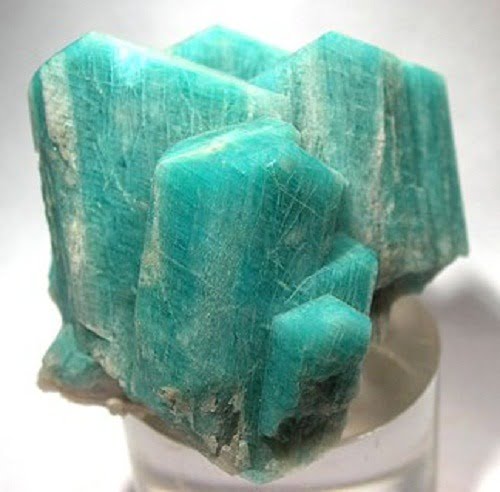
Amazonite is also known as Amazon stone. Amazonite is named after the South American Amazonite River. Amazonite is the variety of microcline feldspar. Feldspar is the most common mineral in the entire world. Certain green stones were extracted from the Amazon River and later it was found as amazonite.
Amazonite is found in light green to light blue in color. As, it is soft and bluish green in appearance, sometimes it closely resembles nephrite and jadeite. Amazonite can be identified in a number of ways. As, it resembles other gemstones the correct identification can be done by density testing and testing of refractive index. Polariscope testing is done to identify between isotroropic and anisotropic gemstones.
Natural Amazonite is a green to blue-green variety of potassium feldspar, most commonly Microcline. It is valued for its soothing blue-green color, white streaks and attractive opaque to translucent appearance.
The term Amazonite Fossil may be used commercially for particular products, but Amazonite itself is a mineral and not a fossilized biological material. Therefore, buyers searching for Certified Amazonite Fossil should primarily consider the mineral identity, authenticity, treatment status and certification of the Amazonite material.
The Amazonite name has historical links with the Amazon River region. However, the exact original locality associated with the name was not clearly defined, and Amazonite is now known from several important mineral-producing regions around the world.
Amazonite Color and Appearance
Natural Amazonite generally ranges from pale green and turquoise green to blue-green. Many stones display white streaks, mottling or grid-like patterns caused by the internal feldspar structure.
Amazonite is usually opaque to translucent. Transparent gem-quality material is considerably less common.
Its distinctive color makes Amazonite popular for cabochons, beads, pendants, bracelets, carvings and polished decorative stones.
Amazonite Fossil Origin and Sources
Amazonite fossil is found in only few locations in the World. The main sources of this green stone are United States, Russia, Canada, Brazil and Austria.
Amazonite occurs in several regions rather than being limited to one geographic source. Notable material has been documented from the United States, Russia, Brazil and other areas containing suitable feldspar-rich rocks and pegmatites.
One well-known source is the Pikes Peak region of Colorado in the United States, where attractive Amazonite crystals occur in granitic pegmatites.
Geographic origin cannot usually be determined accurately from color alone. When a particular origin is important, reliable provenance or laboratory information should be considered.
How Amazonite Forms
Amazonite commonly forms in granitic and pegmatitic geological environments where potassium feldspar crystals can grow.
The blue-green coloration is associated with structural and trace-element effects within the feldspar. Natural specimens can show different levels of green, turquoise and blue depending on composition and internal structure.
Unlike true fossil gemstones, Amazonite is created through geological crystallization and mineral formation rather than replacement of ancient plant or animal remains.
Amazonite Fossil Value
Color – Amazonite fossil color can vary between green, yellow green to blue green. Fine white streaks are found in many amazonite stones.
Clarity – It is opaque and translucent. Transparent variety of Amazonite is rarely found.
Cut and Shape – It is found in different shapes and cuts. These are cut en cabochon and are rarely faceted.
Amazonite value depends mainly on color, pattern, cut, polish, size and overall quality.
Strong blue-green or turquoise-green material with attractive color distribution is popular for jewelry. White streaks are common and can form part of the stone’s natural character rather than automatically reducing its quality.
Factors Affecting Amazonite Value
When choosing Natural Amazonite, important factors include:
- Attractive blue-green or green color
- Color saturation
- Natural white patterning
- Surface polish
- Size and shape
- Transparency or translucency
- Visible fractures
- Treatment disclosure
- Certification when required
Amazonite is commonly fashioned as a cabochon because its color and pattern are usually more important than faceted brilliance.
Beads, polished freeforms and carvings are also widely produced.
Amazonite Fossil Gemological Properties
Chemical Formula – Potassium Aluminum Silicate
Hardness – 6 to 6.5 on the Mohs scale.
Cleavage – Perfect.
Luster – Vitreous
Amazonite generally shares the gemological properties of Microcline feldspar.
Important characteristics include:
- Chemical formula – KAlSi₃O₈
- Mineral group – Feldspar
- Common mineral species – Microcline
- Mohs hardness – 6 to 6.5
- Specific gravity – Approximately 2.55 to 2.57
- Refractive index – Approximately 1.522 to 1.530 for common gem material
- Crystal system – Triclinic
- Cleavage – Perfect
- Lustre – Vitreous, sometimes pearly along cleavage
- Tenacity – Brittle
- Color – Green to blue-green
Because Amazonite has perfect cleavage and moderate hardness, it requires more careful handling than harder gemstones such as Sapphire.
How to Identify Natural Amazonite
Natural Amazonite can sometimes resemble Turquoise, Jade, dyed stones or other green-blue materials.
Visual appearance is useful, but reliable identification may require a combination of properties such as refractive index, specific gravity and optical testing.
Natural Amazonite commonly displays:
- Green to blue-green color
- White streaks or mottled patterns
- Opaque to translucent appearance
- Vitreous lustre
- Feldspar cleavage
- Mohs hardness around 6 to 6.5
For valuable or uncertain material, examination by a recognized gemological laboratory can provide greater confidence about identification.
Amazonite Metaphysical Properties
Amazonite enhances the masculine and feminine energy. It brings calmness and also strengthens the physical power and stamina. It soothes all the Chakra, but especially the heart chakra. It also increases artistic ability and stimulates creativity for the creative person.
Amazonite is the birthstone for Aquarius and represents Virgo according to the zodiac sign. When it is worn in pendants, rings, necklace, and bead as an amulet, it protects the wearer from the diseases and infections.
In modern crystal traditions, Amazonite is associated with calmness, communication, creativity and emotional balance. Its blue-green color also contributes to traditional associations with the Heart and Throat Chakras.
Astrological associations with Aquarius, Virgo or particular chakras vary between crystal traditions and are not universally standardized.
Claims that wearing Amazonite prevents diseases or infections are traditional beliefs and are not scientifically established medical effects.
Benefits of Amazonite
Amazonite has a powerful filtering action. Amazonite fossil blocks the geopathic stress. absorbs microwaves and cell phone emanations. This is an extremely soothing fossil. It calms the brain and nervous system and also aligns the physical body. Amazonite is a stone that helps you to see both side of yourself.
Amazonite on the emotional level soothes emotional trauma, removes worry, anxiety and fear. It removes negative energy and aggravation.
Traditional Amazonite benefits are commonly associated with emotional balance, communication, self-expression, meditation and maintaining a calm state of mind.
There is no reliable scientific evidence that Amazonite blocks mobile-phone radiation, microwaves or electromagnetic exposure. It should therefore not be used as a protective substitute for established safety measures.
People experiencing anxiety, emotional trauma or other mental-health concerns should seek appropriate professional support when needed.
Amazonite Chakra Association
Amazonite is commonly associated with the Heart and Throat Chakras in modern crystal traditions.
The Heart Chakra is symbolically connected with emotional awareness and compassion, while the Throat Chakra is associated with expression and communication.
Some people wear Amazonite jewelry or keep polished stones during meditation according to personal spiritual preferences.
These chakra associations are traditional beliefs rather than scientifically measurable gemstone properties.
Amazonite Healing
Amazonite heals and opens the heart and throat chakra. It also opens the third eye and brings divine communication. This stone dissipates negative energy and blockage of the nervous system. It is highly beneficial in osteoporosis as it fulfills the calcium demands of the body.
Amazonite cures tooth decay, calcium deficiency and balances the metabolic deficiencies. It also relieves muscular spasm.
Amazonite healing properties are discussed mainly in crystal-healing traditions. They should not be confused with evidence-based medical treatments.
Amazonite does not supply the body with clinically usable calcium merely by being worn or carried. Claims concerning osteoporosis, calcium deficiency, tooth decay, metabolic conditions, muscular spasms or nervous-system disorders are not scientifically established.
Anyone experiencing these conditions should seek qualified medical diagnosis and treatment.
Amazonite Jewelry and Care
Amazonite is widely used for pendants, bracelets, bead necklaces, earrings, rings, cabochons and ornamental carvings.
Its blue-green color makes it especially attractive when paired with silver-toned or neutral jewelry designs.
Because Amazonite has perfect cleavage and is relatively brittle, rings and bracelets should be protected from strong impacts.
Clean Amazonite using mild soap, lukewarm water and a soft cloth. Avoid ultrasonic cleaning, harsh chemicals and sudden temperature changes.
Store Amazonite separately from harder gemstones to reduce the possibility of scratching or chipping.
Why Amazonite Fossil from Astrokapoor
We at Astrokapoor provide natural gemstones and fossils in a wholesale price to our clients. Our gemstones pass through several tests for proper recognition of natural and excellent quality gemstones.
When buying Certified Amazonite Fossil or Natural Amazonite, customers should consider gemstone identity, color, quality, surface condition and available certification.
A gemstone report can be particularly useful when confirmation of the mineral type is important, especially because several green and blue-green materials may look similar to Amazonite.
Reliable product information should also state whether the material is natural and whether any color enhancement, impregnation or coating has been detected or disclosed.
Frequently Asked Questions
What is Amazonite Fossil?
Amazonite Fossil is a commercial term that may be used for Amazonite products, but Amazonite itself is not scientifically classified as a fossil. It is a green to blue-green potassium feldspar variety, usually Microcline.
What is Natural Amazonite made of?
Amazonite is generally a variety of Microcline feldspar with the ideal chemical formula KAlSi₃O₈. It belongs to the potassium feldspar group.
What is the hardness of Amazonite?
Amazonite has a Mohs hardness of approximately 6 to 6.5. It also has perfect cleavage and can be brittle, so jewelry should be protected from hard impacts.
What are the traditional benefits of Amazonite?
In metaphysical traditions, Amazonite is associated with calmness, communication, creativity, emotional balance and spiritual awareness. These are traditional crystal beliefs and are not scientifically proven medical effects.
Is Amazonite suitable for jewelry?
Yes. Amazonite is commonly used for beads, pendants, necklaces, cabochons, earrings and rings. Because it has perfect cleavage, careful handling and gentle cleaning are recommended.


