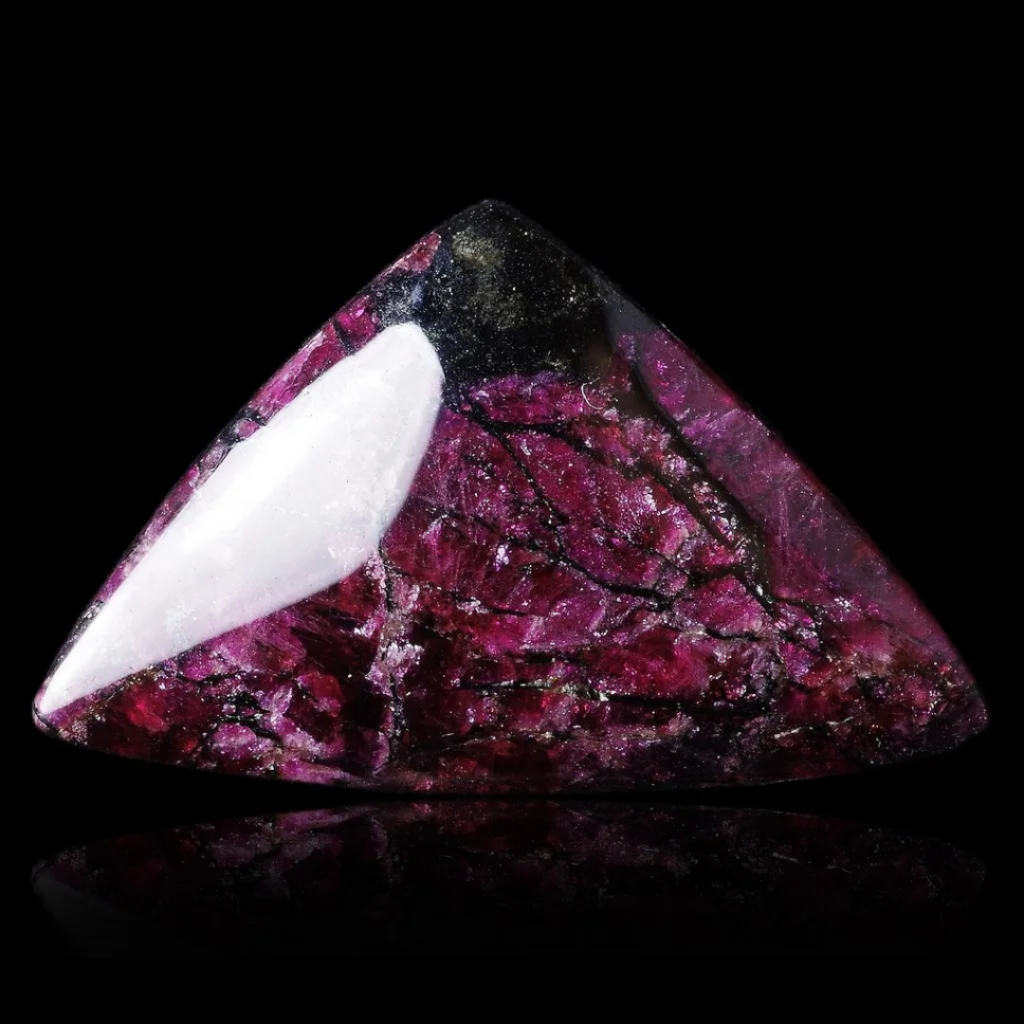
Eudialyte is one of the rarer collector stones in the crystal world, recognised by its deep raspberry-red to magenta flecks set in dark grey or greenish rock. It is best known as the Stone of the Heartland and is kept for emotional balance, self-love and a clearer sense of personal direction.
Eudialyte, a unique stone whose name has derived from the Greek phrase which means “well decomposable”. It is commonly found within the rough grained rocks and carry minerals like calcium, cerium, iron, sodium, zirconium, manganese and yttrium. As a water and earth component, Eudialyte’s vivacity assists to balance one’s emotions with external experiences. Eudialyte produces life energy, self love, and safeguard to those who work with it and has a powerful impression on the emotional frame of mind. It unlocks our wisdom of the heart, guides us how we can work on ourselves to cure and harmonise the emotions. Eudialyte is a mighty guide for plunging into the heart as it authorizes one to handle low moods and discontentment and helps us to find the underlying reasons for these feelings. It transcends the mind from that of negativity, fear, guilt, anger, and sorrow to that of positive mind, happiness. This motivates us which helps us to focus on work, ourselves and learn from our errors. Eudialyte brings immense changes of the inner self and is also mostly necessary during crisis time in one’s life.
The name comes from the Greek eu dialytos, meaning easily dissolved, a reference to the fact that the mineral breaks down readily in acid. In crystal tradition eudialyte is described as working across both the heart chakra and the root chakra at once, which is why it is so often chosen by people who feel pulled between what they must do and what they actually want to do.
Why Should I Wear Eudialyte?
Eudialyte has a deep interrelation with the soul and is able to teach us the purpose in each one in life. When we do meditation or sleep by wearing Eudialyte, it gives the purpose of meeting so many people in our life and their essential contribution in making our life better. It helps us to realize and sense all evil forces in advance. It eliminates all negative energy from our environment. The usage of this stone also helps to balance high libido functions in its users.
The vibrations of Eudialyte are ideal for eliminating the feelings of enmity, bitterness, and strong grudge, allowing one to strengthen self esteem to get rid of these negative feelings. Eudialyte is also very favourable for those who feel no meaning to life or “lost” and don’t know what they strive for or what path to be taken in life. It helps in recognizing our blessings and aptitude as well as and how to express them properly so that we can build a pathway to a fulfilling and cherishing life.
This is why eudialyte is so often described as a crystal for finding your life purpose. People typically turn to it at a transition point — after a career change, at the end of a relationship, on moving to a new city, or simply during a stretch where nothing feels clear. It is regarded as a working stone rather than a soothing one, chosen when something needs to shift rather than settle.
Effects
It’s vigour helps to clear hindrances to creativity and will help you to permit your inherent talents to flow as they were meant to. The high vibration of this stone assists you to learn from your own errors and helps you to bring balance between peace and self.
Feelings such as hatred, guilt or jealousy will convert into positive energy. The high spirit of this stone gives rise to a feeling of conviction in your capabilities, and a sense of inventiveness to restructure and improvement in your personal circumstances.
It has a beneficial vibration that will help to uplift low mood and negativity. It will help you to release negative emotions that may be keeping you from feeling happy and satisfied with your possession in life.
In summary, the benefits most commonly associated with eudialyte are self-love and self-worth, emotional balance, release of resentment and grudges, creative flow, and clarity about one’s direction in life.
Where Eudialyte Is Found
Eudialyte forms in alkaline igneous rocks such as nepheline syenite, which is why it occurs in only a handful of places worldwide and remains uncommon in the retail market.
The best-known source is the Ilímaussaq complex in south-west Greenland, which produces the deep red material the stone is most admired for. Other significant localities include the Kola Peninsula in Russia, Mont Saint-Hilaire in Quebec, Canada, parts of Norway, and Magnet Cove in Arkansas, USA.
Details
Origin – South-West Greenland. Also found in Russia (Kola Peninsula), Canada (Mont Saint-Hilaire, Quebec), Norway and the USA (Arkansas).
Birthstone month – June
Ruling planet – Moon
Profession – Any profession
Colour – Brown, magenta, red, also yellow and blue.
Density – 2.74 – 3.10
Species – Silicate mineral
Mineral family – Complex zirconium silicate, eudialyte group
Hardness – 5 to 6 on the Mohs scale
Also known as – Stone of the Heartland
Jewellery metal – Silver, copper
Wearing day – Wednesday
Significance – Eudialyte has evolved from the nickname of “The stone of the heartland” due to its relation to the zest of unquestioning love and its potential to begin with these energies through positive thoughts, affection, and manifestations. Eudialyte gives one with the energy to ensure not only our primary needs are met but also the love energy which is necessary to fulfill the heart’s desires are also encountered. It is a stone that helps to achieve a balance between physical and emotional needs so that one may experience harmony in life. Eudialyte energetically connects the heart and root together, opening a new path to increased conformity that builds the gap between what must be done and what one’s heart wants to do. It is a powerful tool that combines one’s dreams and inspirations to life.
Is Eudialyte a Vedic Gemstone?
No. Eudialyte is not one of the nine Vedic ratnas and is not prescribed in Jyotish for any planet. The Moon association listed above belongs to crystal tradition rather than to Vedic astrology — the gemstone traditionally prescribed for the Moon is pearl (Moti).
That distinction works in your favour. Because eudialyte is not a prescribed ratna, there is no ascendant rule, no ratti weight, no trial period and no muhurat requirement attached to it, and anyone can wear or keep it regardless of their birth chart. If you are looking for a remedy for a specific planet in your chart, a horoscope-based gemstone recommendation is the correct place to begin instead.
Hardness and Everyday Wear
Eudialyte sits at 5 to 6 on the Mohs scale, which places it below quartz. It will scratch against everyday dust and grit over time, so it is better suited to pendants, earrings and cabochons than to a ring worn daily.
Store it separately from harder stones, and never soak it or expose it to acidic cleaners — the name itself records how readily this mineral breaks down in acid. It should also never be powdered or used to prepare a drinkable crystal elixir, as with any complex silicate carrying trace rare-earth elements.
Caution
While wearing a gem, ensure that it is not covered with dirt. The bottom part of rings and lockets covered with gems should be open. When you wear different gemstones together always consult an astrologer for further suggestions. Never wear fake gems given by anyone, always judge its authenticity from an astrologer. Wash your gem with lukewarm water and do not rub it harshly.
Frequently Asked Questions
What is eudialyte?
Eudialyte is a rare complex zirconium silicate mineral, recognised by its raspberry-red to magenta colouring in a dark host rock. Its name comes from Greek and refers to how readily it dissolves in acid.
What is eudialyte good for?
In crystal tradition it is associated with self-love, emotional balance, releasing resentment and finding a sense of life purpose. It is known as the Stone of the Heartland for this reason.
Which chakra is eudialyte connected to?
It is described as working on the heart and root chakras together, bridging emotional needs and practical ones.
Where does eudialyte come from?
The finest material comes from south-west Greenland. It is also found in the Kola Peninsula in Russia, Mont Saint-Hilaire in Canada, Norway and Arkansas in the USA.
How hard is eudialyte?
It is 5 to 6 on the Mohs scale, softer than quartz. This suits pendants and cabochons better than daily-wear rings.
Is eudialyte a Vedic gemstone or a navratna?
No. It is not among the nine Vedic gemstones and is not prescribed in Jyotish for any planet. It is kept as a crystal rather than as a planetary remedy.
Who can wear eudialyte?
Anyone, since it carries no astrological restriction. The only practical considerations are its softness and careful cleaning.
How do I clean eudialyte?
Wash gently with lukewarm water and wipe dry with a soft cloth. Avoid harsh scrubbing, acidic cleaners, ultrasonic machines and prolonged soaking.
Is eudialyte rare?
Yes. It forms only in a small number of alkaline igneous complexes worldwide, which is why good specimens are uncommon and priced accordingly.
Choosing Your Eudialyte
Every eudialyte piece is natural, so the depth of red, the pattern of flecking and the host rock differ from stone to stone. If you would like help deciding whether eudialyte suits what you are looking for, or whether a prescribed Vedic gemstone would serve you better, Mr. Prashant Kapoor’s team is available for a personal consultation.


