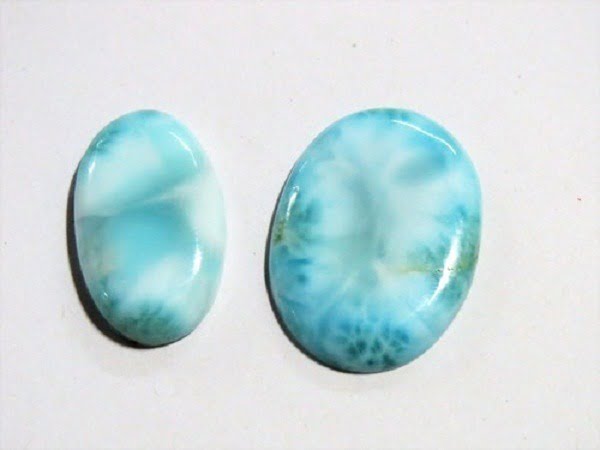
Larimar is a rare blue colored gem of the mineral pectolite, found in Dominican Republic in the Caribbean Island. Pectolite is an acid silicate hydrate of calcium and sodium. The blue color of this gem is due to the deposit of copper substitution for calcium. The composition of this blue stone is often contains calcite and hematite. It is also called as “stefilia’s” stone. The history of Larimar is based on many legends and stories. The most important outcrop of blue pectolite is found at Los Chupaderos about 10 kilometers southwest of city Barahona, of the Dominican Republic. It was originally discovered in 1916 by a Spanish priest. But, it was mined in the year 1974 by the American Peace Corps volunteer, Norman Riling. It was rediscovered by a Dominican Miguel Mendez.
Gemologically, Natural Larimar is the trade name for a blue to bluish-white massive variety of Pectolite with the ideal chemical formula NaCa₂Si₃O₈(OH). It is a calcium-sodium silicate hydroxide rather than simply a “hydrated calcium and sodium silicate.” Research published by GIA found that the characteristic blue color is believed to be associated with small amounts of Cu²⁺ in the material.
Larimar can occur with white, greenish, grey and blue areas and may contain other mineral components or host-rock material, but Calcite and Hematite are not required ingredients that define Larimar. “Dolphin Stone” is a commercial or metaphysical nickname. “Stefilia’s Stone” is not a standard gemological synonym for Larimar and should be verified before being used as an identification term.
Larimar History and Name
The recorded history of Larimar reaches back to 1916, when Father Miguel Domingo Fuertes Loren reported the unusual blue material and requested permission to explore it. The modern commercial history began in 1974 when Dominican Miguel Méndez and Peace Corps volunteer Norman Rilling rediscovered blue stones in the Barahona area. Dominican sources state that the name “Larimar” was formed from Larissa, the name of Méndez’s daughter, and mar, the Spanish word for sea.
The material became associated with the Caribbean because waterworn stones were found downstream and near the coast, but Larimar itself formed geologically in volcanic rocks inland rather than forming in the sea. GIA describes the material as occurring in cavities and veins within altered basalt.
Origin of Larimar
The only source of this gem is the Filipinas mines in Los Checheses, located in the Dominican Republic. Its deposit is surface of hot gases push crystallized mineral bought up by the volcanic chimneys or tubes. In some cases, it may be found as sediment on the shore of Caribbean Island washed up as alluvial deposit.
This general geographic statement is substantially correct: true Larimar is specifically associated with the Dominican Republic. Mindat records Larimar from the Filipinas Larimar Mines at Los Checheses in the Sierra de Baoruco, Barahona Province, and also documents waterworn Pectolite material in nearby beach gravel.
Larimar formed through hydrothermal processes associated with altered volcanic rocks. Mineral-bearing fluids filled cavities and veins in basaltic rocks, producing massive blue Pectolite. Erosion can later release pieces into rivers, where some material becomes naturally rounded before reaching coastal deposits.
Larimar Gemology
Color-Blue, Blue-Green, Gray, or Red with White
Appearance-Translucent, smooth, with whorls of color or white veins showing through the base color. Often small to medium, tumbled.
Rarity-Easily obtained
Source-Dominican Republic, Bahamas
Category- Triclinic
Luster-Silky
Mohs scale hardness- 4.5 to 5
Formula- NaCa2Si3O8 (OH)
A few corrections improve the accuracy of these properties. Larimar is rare in geological terms because its recognized gem deposit is localized in the Dominican Republic, although finished stones can be commercially available. The Bahamas should not be listed as an established Larimar source. “Triclinic” describes its crystal system rather than its category. Mindat lists Larimar as blue, bluish-white, white or grey Pectolite with hardness about 5 and specific gravity approximately 2.74–2.90.
Larimar Gemological Properties
- Gem material – Larimar
- Mineral – Pectolite
- Chemical formula – NaCa₂Si₃O₈(OH)
- Mineral type – Calcium-sodium silicate hydroxide
- Crystal system – Triclinic
- Color – White, pale blue, sky blue, greenish-blue to deeper blue
- Coloring agent – Small amounts of Cu²⁺ associated with blue color
- Mohs hardness – Approximately 4.5–5
- Specific gravity – Approximately 2.74–2.90
- Refractive index – Approximately 1.595–1.645
- Transparency – Commonly opaque to translucent
- Tenacity – Brittle
- Cleavage – Perfect in Pectolite
- Typical cut – Cabochon, bead, carving and polished freeform
Gemdat records Larimar with hardness around 5, SG 2.74–2.90 and RI approximately 1.595–1.645.
What Gives Larimar Its Blue Color?
Larimar’s blue color is one of its most important identifying features. GIA research concluded that small amounts of divalent copper, Cu²⁺, are believed to be responsible for the blue coloration in Dominican blue Pectolite.
Natural stones can range from almost white with pale-blue patches to attractive sky-blue and deeper blue material. White veins and cloud-like areas commonly create the ocean-like patterns for which Larimar is famous. The strongest uniform blue material with attractive natural patterning is often preferred in jewelry, although value depends on several quality factors.
Why Larimar Semiprecious Gemstone?
Semi precious gemstone has the same qualities as the precious gemstone. The semiprecious gemstone can be very well considered, if you are incapable of buying the precious gemstone. Although semi precious gemstone lack few characteristic of precious gemstone, but yet they have the quality which can act as a precious gemstone
“Precious” and “semi-precious” are traditional commercial terms and do not mean that different gemstones possess the same physical or metaphysical qualities. Larimar has its own value because of its localized Dominican origin, unusual Caribbean-blue color, attractive patterns and limited natural supply.
Its relative softness also distinguishes it from harder traditional gemstones such as Sapphire or Ruby. Larimar should therefore be selected for its own appearance and characteristics rather than considered a direct substitute for another gem.
Benefits and Metaphysical Properties
Larimar is one of the “spiritual stones” that opens to new way of life, stimulating evolution of the earth. It brings love and peace and brings tranquility. It effortlessly induces a deep meditative state. It naturally raises consciousness and harmonizes body and soul to new vibrations. Spiritually, it empowers the spiritual self. It facilitates angelic contact and communication with other realms. It is an excellent stone for seeking soul mate and it facilitates the healing of past-life relationship on heart trauma.
Mentally, Larimar brings serenity and clarity and constructive thought. It stimulates and encourages self confidence and self-esteem. Emotionally, it brings calmness and equilibrium. It is an antidote to emotional extremes. It heals trauma of the heart and reconnects to natural playfulness and joyful childlike energy.
In modern crystal traditions, Larimar is associated with calmness, communication, emotional balance, meditation and peaceful reflection. Its blue color also explains its symbolic connection with the Throat Chakra and water-related spiritual themes.
Angel communication, past-life healing, finding a soulmate and raising spiritual vibration are metaphysical beliefs rather than scientifically demonstrated effects. Larimar may be used as a meaningful personal or meditation object, but it cannot guarantee emotional or relationship outcomes.
Healing | Larimar Useful in Medical Astrology Treatment
Larimar stimulates third eye, heart crown, and throat chakra, and promotes healing. It is helpful for cartilage and throat disease, dissolving energy blockages in the chest, head, and neck. It can also be used for the constricted joints or blocked arteries. If placed on painful point, it draws out pain. Used as a reflexology tool.
These statements represent traditional crystal-healing and medical-astrology beliefs. There is no reliable scientific evidence that Larimar treats cartilage disease, throat disorders, blocked arteries, joint problems or physical pain.
Blocked arteries in particular can be a serious cardiovascular condition requiring qualified medical diagnosis and treatment. Larimar should never replace medicines, surgery, physiotherapy or other evidence-based healthcare. Chakra practices and reflexology use may be followed for personal spiritual purposes but should be kept separate from medical claims.
Larimar Jewelry
It is an extremely rare gem. This is soft, so it is rarely used in jewelry. Most Larimar is studded in silver, while more high quality gem can be studded along with white and gold gemstones. Pendants, bangles and bracelets are most popular, followed by earrings and various beads of necklace and hair pins.
Larimar is relatively soft compared with many popular jewelry gemstones, but it is actually widely used in jewelry. Cabochons, pendants, earrings, beads and bracelets are especially common because these designs can display its blue-and-white patterns while offering reasonable protection.
Rings can also be made with Larimar, but protective settings are advisable because its hardness is only around 4.5–5 and Pectolite is brittle with cleavage. Silver is particularly popular because its cool color complements the blue gemstone, although gold and other suitable jewelry metals can also be used.
Larimar in Gems Therapy
Larimar is widely used in gems therapy. It removes depression and mental trauma of the wearer. It calms the mind and nerve. Due its light blue color, it is a powerful healer of the mind. It is stone of dream interpretation. This helps to get the correct meaning of the dream and assist in healing the mental clarity. It heals the bone and arthritis. If it is placed on the painful spot, it quickly draws off the pain.
These are traditional gems-therapy claims and are not clinically proven effects of Pectolite. Larimar does not medically treat depression, psychological trauma, arthritis, bone disease or nervous-system conditions.
Depression and trauma can require qualified mental-health support, while arthritis and persistent pain should be medically assessed. Larimar can be used alongside meditation or personal spiritual practices, but not as a replacement for healthcare.
Larimar Quality and Value
Fine Larimar is generally judged by its blue color, pattern, surface polish, amount of unwanted matrix, size and overall visual appeal. Deep sky-blue to Caribbean-blue material with attractive white cloud-like patterns can be especially desirable.
Very pale, heavily fractured or predominantly grey material may have less commercial appeal, although unusual natural patterns can still make individual pieces collectible. Because Larimar generally occurs as massive material rather than transparent faceting rough, quality assessment differs from gemstones such as Diamond or Sapphire.
Origin is also central to identity. Mindat defines Larimar specifically as bluish massive Pectolite from the Dominican Republic, so similar blue Pectolite from another locality should not automatically be marketed as genuine Dominican Larimar.
Natural Larimar and Imitations
Buyers should be aware that other materials can imitate Larimar’s pale-blue and white appearance. GIA has documented quench-crackled dyed Chalcedony beads that closely resembled Larimar visually but were identified as Chalcedony rather than Pectolite through Raman spectroscopy.
This makes certification useful for valuable pieces. A gemological laboratory can use refractive index, specific gravity, microscopic examination, Raman spectroscopy and other tests to distinguish Larimar from dyed Chalcedony, ceramic imitations and other blue materials.
A stone should not be considered genuine Larimar simply because it has white-and-blue Caribbean-style patterns.
Larimar Care and Cleaning
Larimar requires gentle care because Pectolite is softer and more fragile than Quartz, Topaz or Sapphire. GIA research also found that Larimar’s blue color reacts to the high heat of a jeweler’s torch, so strong heat should be avoided.
Clean Larimar using lukewarm water, a small amount of mild soap and a very soft cloth. Avoid ultrasonic cleaners, steam, harsh chemicals, abrasive cleaning products and sudden temperature changes. Remove Larimar rings and bracelets before sports, cleaning or other activities where they could receive hard knocks.
Store the gemstone separately in a soft pouch or lined jewelry box so that harder gemstones do not scratch its polished surface.
Buying Certified Natural Larimar
Wholesale price of Larimar: Visit Astrokapoor office for buying certified, natural stone in a wholesale price. We provide certified natural gemstone.
When buying Certified Natural Larimar, check that the gemological report identifies the stone as natural Pectolite/Larimar and examine its blue color, pattern, surface polish, cracks, matrix and workmanship. Dominican origin is an especially important part of Larimar identity because the recognized gem material comes from the Barahona area of the Dominican Republic.
For better-quality stones, buyers should also check for imitations and ask whether any color enhancement or treatment has been detected. Certification becomes particularly useful when deep-blue material is offered at a premium price.
Frequently Asked Questions
What is Larimar?
Larimar is a rare blue variety of the mineral Pectolite found as gem material in the Dominican Republic. Its ideal chemical formula is NaCa₂Si₃O₈(OH).
Why is Larimar blue?
Its distinctive blue color is believed to result from small amounts of copper ions within the Pectolite material.
Is Larimar found in the Bahamas?
No. Genuine Larimar is specifically associated with the Dominican Republic, particularly the Barahona region. The Bahamas should not be listed as an established Larimar source.
What is the hardness of Larimar?
Larimar has a Mohs hardness of approximately 4.5–5, so it is softer than Quartz and should be protected from scratches and hard impacts.
What are the traditional benefits of Larimar?
In crystal traditions, Larimar is associated with calmness, communication, meditation, emotional balance and spiritual awareness. These are traditional beliefs rather than scientifically proven medical effects.


