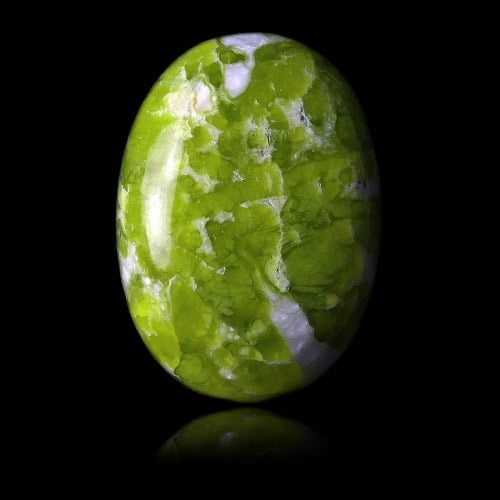
Lizardite is named after its discovery in Kennack Cove. It is the most common serpentine species of gemstone found in USA and Europe. The color of this stone is soft green in color with sometime dark hue on the inner part of the body. It was named in 1995 by Eric James Williams Whittaker based on the location in which it was found.
Lizardite is a composition of magnesium silicate hydroxide mineral in the serpentine group. It is mainly found in the metamorphic igneous rock. It is carved into ornamental stone in the shape of pendant and earrings.
Natural Lizardite is one of the most common minerals of the Serpentine group. Its chemical formula is Mg₃(Si₂O₅)(OH)₄, and it commonly occurs as extremely fine-grained scales or massive aggregates rather than large, well-developed crystals.
For factual clarification, Lizardite was formally named by Eric James William Whittaker and Jack Zussman in 1956 after the Lizard Peninsula in Cornwall, England. Material from Kennack Cove had been studied earlier, but 1995 is not the mineral’s naming date.
Lizardite Meaning and Appearance
Lizardite meaning in modern crystal traditions is associated with grounding, confidence, emotional balance and maintaining a positive mindset.
Natural Lizardite can occur in green, pale green, brown, light yellow and white shades. Its lustre is commonly waxy, greasy or resinous, and much of the material is translucent.
Because it is relatively soft, Lizardite is commonly used for ornamental carvings, polished stones and jewelry that is protected from frequent impact.
Lizardite Healing Properties
Lizardite is a strongly grounding stone. The soft green color of lizardite helps in healing of the nervous and the brain tissue. It helps in the proper production of insulin the patient suffering from diabetes. It is an extremely useful stone to place in your immediate environment. It removes the negative energy and dispels the psychic interference.
It promotes confidence, optimism and determination. This green stone finds the underlying cause of problems and offers a means of determination. It also gives support during deep emotional healing, including past life or bodywork to release emotional disease.
Emotionally,. Lizardite has the power to change and stabilize relationships. It can help in transmuting negative expectations into the positive ones.
Traditional Lizardite healing properties are mainly associated with grounding, optimism, emotional stability and personal confidence.
Claims involving diabetes, insulin production, brain or nervous tissue, or other medical conditions are not scientifically established effects of Lizardite. This mineral should not be used as a substitute for medical diagnosis, medication or professional healthcare.
Emotional and Spiritual Uses of Lizardite
Lizardite is sometimes used during meditation and personal reflection because its soft green appearance is symbolically associated with calmness and emotional balance.
Crystal practitioners may carry a polished Lizardite Stone or keep it in their meditation space according to personal spiritual traditions.
These uses are based on metaphysical beliefs rather than scientifically proven therapeutic effects.
Lizardite Properties
Cleavage – Perfect
Streak – Greenish white
Color – Yellow, Green White
Birthstone – May, June
Chakra Healing – Heart chakra, Crown chakra
Moh’s scale- 2 to 2.5
Lizardite has a Mohs hardness of approximately 2.5 and a specific gravity of about 2.55. It has perfect cleavage and commonly displays a waxy, resinous or greasy lustre.
Its mineralogical characteristics include:
- Chemical formula – Mg₃(Si₂O₅)(OH)₄
- Mineral group – Serpentine
- Crystal system – Trigonal
- Mohs hardness – Approximately 2.5
- Specific gravity – Approximately 2.55
- Refractive index – Approximately 1.538 to 1.560
- Transparency – Usually translucent
- Color – Green, brown, pale yellow to white
- Streak – White
- Cleavage – Perfect
The May and June birthstone associations sometimes given to Lizardite belong to modern crystal traditions and are not part of the standard modern monthly birthstone list.
How Lizardite Forms
Lizardite commonly develops during alteration or metamorphism of magnesium-rich ultramafic rocks.
It can form when minerals such as olivine and orthopyroxene are altered during serpentinization. This process produces Serpentine-group minerals, including Lizardite.
It is frequently found as fine-grained or massive material, although very small crystals can occasionally occur.
Where Is Lizardite Found?
It is found in USA, Russia and even some parts of Europe
Lizardite is known from many locations worldwide because it is one of the most common Serpentine minerals.
Besides its famous Cornwall locality in England, documented occurrences include parts of the United States, Canada, Italy, Australia, Japan and other regions containing serpentinite and ultramafic rocks.
Kennack Cove on the Lizard Peninsula in Cornwall is particularly significant because it is associated with the original mineral description.
Lizardite Metaphysical Properties
Lizardite is a commanding stone. It clears the blockages for the positive entrance of energy in the body and the soul. It assists the retrieval of freedom to the person. It sheds light on the chakra and raises the kundalini. It also assists the conscious management and corrects the mental as well as emotional trauma. It helps the wearer to feel more attractive and hopeful.
In metaphysical traditions, Lizardite is associated with grounding, emotional clarity, personal transformation and positive thinking.
Some crystal practices connect Lizardite with the Heart and Crown Chakras. Its green color contributes particularly to its traditional Heart Chakra association.
Kundalini and chakra associations are spiritual concepts and should be understood separately from the scientifically measurable mineral properties of Lizardite.
How to Identify Natural Lizardite
Natural Lizardite can range from pale green and yellowish green to brown or white. It is relatively soft and commonly has a smooth, waxy appearance.
When selecting Lizardite, consider:
- Natural green to pale-green color
- Waxy or greasy lustre
- Translucent appearance
- Relatively soft surface
- Natural color variation
- Reliable mineral identification
- Laboratory testing for valuable specimens
Visual identification alone can sometimes be difficult because Lizardite may occur together with other Serpentine-group minerals such as Chrysotile or Antigorite.
Lizardite Price and Buying Guide
This is a semiprecious gemstone and crystal. If you are looking for a natural Lizardite online in India, USA and UK, then make sure to get a lab certificate from a reputed lab such as GIA and IGLI.
Many fake gemstones and jewelry sellers sell artificial gemstone in the name of Lizardite, so a certificate of authentication is must before buying a natural Lizardite.
You can buy natural Lizardite from our astrostore. We have sell natural Lizardite in a wholesale price in India.
Lizardite price can vary according to color, size, polish, carving quality, mineral purity and overall appearance.
Because different Serpentine minerals may look similar, proper identification can be useful when purchasing material represented specifically as Natural Lizardite rather than simply Serpentine.
Lizardite Jewelry and Care
Lizardite may be carved into pendants, beads, earrings and ornamental objects. Its green color can produce attractive polished pieces.
However, with a Mohs hardness of only about 2.5, Lizardite is considerably softer than Quartz, Topaz or Sapphire.
Avoid scratches, hard impacts and abrasive cleaners. Clean polished pieces gently using a soft cloth and avoid harsh chemicals or ultrasonic cleaning.
Store Lizardite separately from harder gemstones to protect its surface.
Frequently Asked Questions
What is Lizardite Stone?
Lizardite is a magnesium silicate hydroxide mineral belonging to the Serpentine group. It commonly occurs in green, pale yellow, brown or white colors and usually forms fine-grained or massive aggregates.
Where was Lizardite discovered?
Lizardite is historically associated with Kennack Cove on the Lizard Peninsula in Cornwall, England. It was formally named by Whittaker and Zussman in 1956 after the Lizard Peninsula.
What is the hardness of Lizardite?
Lizardite has a Mohs hardness of approximately 2.5. It is therefore a relatively soft mineral and should be protected from scratching and rough handling.
What are the traditional benefits of Lizardite?
In crystal traditions, Lizardite is associated with grounding, optimism, emotional balance, confidence and spiritual awareness. These are traditional metaphysical beliefs rather than scientifically established health effects.
Can Lizardite be used in jewelry?
Yes. Lizardite can be used for pendants, earrings, beads and ornamental carvings. Because it is relatively soft, protected jewelry designs and careful handling are recommended.


