
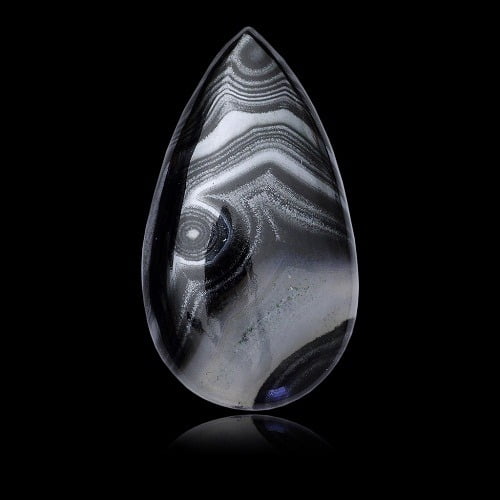
Psilomelane is a stone of duality. It is also known as a stone of luck. It enhances the vibes of luck in a person. Psilomelane reduces fear and brings courage and strength in a person. This stone is light black to grey in color. Psilomelane is widely used at the time of examination to attract luck and positive aura of the energy.
Psilomelane is traditionally recognized by its iron-black to dark steel-grey color, opaque appearance and sub-metallic to dull lustre. It commonly occurs as massive, botryoidal, mammillary or rounded mineral formations.
For mineralogical clarity, Psilomelane is no longer considered one precisely defined mineral species. Modern mineral references use the term as an obsolete group name for hard black manganese oxides. Material historically called Psilomelane may contain minerals such as Romanèchite, Cryptomelane and other manganese oxides.
Psilomelane Meaning
Psilomelane meaning in modern crystal traditions is commonly associated with courage, grounding, determination and balancing opposing energies.
Its deep black and metallic-grey appearance contributes to its traditional association with protection and stability. Some people carry a polished Psilomelane Stone during meditation, examinations or important activities as a symbolic stone of confidence and positive intention.
These metaphysical meanings are traditional beliefs rather than scientifically established effects.
Psilomelane Properties
Cleavage – None
Other Names – Cron of silver
Moh’s scale -5 to 5.5
Source – Arizona, USA, Arizona, England, Virginia
Color – Iron black, steel gray
Chakra Healing – Root or Base Chakra, Third Eye Chakra, Crown Chakra
Birthstone – NA
Historical Psilomelane material is generally described as opaque, iron-black to steel-grey and relatively dense. Modern mineral references commonly give a hardness range of approximately 5 to 6 and specific gravity around 4.7.
The term “Crown of Silver” may occasionally appear in lapidary or trade descriptions for manganese-rich patterned material, but it should not be considered a standardized mineralogical synonym for all Psilomelane.
Mineralogical Characteristics of Psilomelane
Typical characteristics historically associated with Psilomelane include:
- Mineral type – Mixture or group of hard manganese oxides
- Color – Iron-black to dark steel-grey
- Transparency – Opaque
- Mohs hardness – Approximately 5 to 6
- Specific gravity – Approximately 4.7
- Lustre – Sub-metallic to dull
- Streak – Brownish-black to black
- Habit – Massive, botryoidal, mammillary or reniform
- Common use – Mineral specimens and polished ornamental material
Because Psilomelane is an obsolete collective name, individual specimens may not share one exact chemical formula or crystal system.
Psilomelane Healing Properties
Psilomelanes heal the negative energies of the body and transmute them into positivity. It aids in realizing your own ideas and transforms destructive forms into constructive ones.
Mentally, it is a creative stone and brings the mind backs to its objectives after a blockage. Physically, Psilomelane encourages recovery from severe illness. It is a detoxifier, neutralizes over acidification, and reduces inflammation of the body. It strengthen the immune system and regenerates the cells of the body. This stone stimulates fertility and heals diseases of the ovaries and testicles when combines with other effective gemstones.
Traditional Psilomelane healing properties are mainly associated with confidence, emotional grounding, motivation and maintaining a positive mindset.
Claims involving severe illness, inflammation, immunity, fertility, detoxification, ovaries, testicles or cellular regeneration are not scientifically established medical effects. Psilomelane should not replace professional diagnosis, prescribed medicine or healthcare.
Psilomelane Metaphysical Properties
This opaque stone varies from bluish to steel gray and to iron-black in color, with a monoclinic crystal system. With powdery and earthy, its hardness is measured to be between 5 to 5.5 and its specific gravity is heavy for non-metallic minerals that are in between 4.4 to 4.5. It consists of conchoidal to uneven fracture with black or brownish black streak. It is sometimes banded with the mineral pyrolusite its associated minerals are barite, pyrolusite, hematite, quartz and other manganese oxide minerals.
In metaphysical traditions, Psilomelane is associated with grounding, courage, self-reflection, determination and protection from negative influences.
Some crystal practitioners associate the dark stone with the Root Chakra for grounding, while others connect it with the Third Eye or Crown Chakra during meditation and spiritual reflection.
These chakra and metaphysical associations are spiritual beliefs and are separate from the measurable mineral properties of manganese oxides.
Psilomelane and Romanèchite
Many older specimens labelled Psilomelane were later found to contain Romanèchite or mixtures of several manganese oxide minerals.
Romanèchite is a recognized manganese oxide mineral with a monoclinic crystal system, hardness around 5 to 6 and greyish-black to black color. Therefore, the monoclinic crystal system sometimes listed for Psilomelane may actually describe Romanèchite-rich material rather than every specimen historically sold under the Psilomelane name.
Accurate mineral identification may require laboratory techniques because different black manganese oxides can be difficult to distinguish by appearance alone.
Where Is Psilomelane Found?
Psilomelane is often banded an alternating layers of gray pyrolusite make it as a striking polished stone and is generally found in USA, Germany, Wythe County. It is also found in Arizona, England, Minas Gerais, Cornwall, Schneeburg, Austinville, Upper Peninsula of Michigan and Ouro Preto, Brazil, elsewhere. It is found bands of metallic gray and submetallic black.
Material historically identified as Psilomelane has been reported from many manganese-producing regions worldwide.
Documented occurrences include Arizona and Virginia in the United States, along with numerous localities in Europe, Brazil and other manganese-rich geological areas.
Because Psilomelane is an obsolete group name, locality records may refer to manganese oxide material that would now be identified more precisely as Romanèchite, Cryptomelane or another mineral after laboratory analysis.
How to Identify Psilomelane
Psilomelane material is commonly recognized by its dark coloration, heavy feel and metallic to dull surface.
Typical features include:
- Iron-black or steel-grey color
- Opaque appearance
- Brownish-black to black streak
- Dense and relatively heavy feel
- Sub-metallic or dull lustre
- Botryoidal or rounded formations
- Black and grey banding in some polished pieces
Visual appearance alone may not determine the exact manganese mineral. X-ray diffraction or other laboratory analysis may be needed for precise identification.
Psilomelane Facts
It is a mixture of number of minerals.
It is an important ore of manganese. Manganese is a valuable metal used in iron and steel industries.
It is an attractive polished stone
It is still sued in the world for various industrial and decorative purposes.
The first statement is particularly important for understanding Psilomelane. The term historically covered mixtures of hard black manganese oxides rather than one mineral with a completely fixed composition.
Manganese ores have considerable industrial importance, especially because manganese is widely used in steel production and other metallurgical applications.
Attractive banded or botryoidal manganese oxide specimens may also be polished for ornamental use and mineral collections.
Psilomelane Jewelry and Care
Polished Psilomelane can be fashioned into cabochons, pendants, beads or collector stones when the material is sufficiently stable.
Because the precise mineral composition can vary, gentle care is recommended. Clean polished material with a soft dry or slightly damp cloth and avoid harsh chemicals.
Do not casually grind, sand or cut rough Psilomelane without appropriate mineral-processing precautions. Manganese-rich mineral dust should not be inhaled.
Store polished pieces separately from harder gemstones to help preserve their surface and finish.
Frequently Asked Questions
What is Psilomelane?
Psilomelane is an obsolete mineralogical group name historically used for hard black manganese oxides. Material called Psilomelane may contain Romanèchite, Cryptomelane or mixtures of other manganese minerals.
What color is natural Psilomelane?
Psilomelane is generally iron-black, dark grey or steel-grey. It is opaque and commonly has a sub-metallic to dull lustre.
What is the hardness of Psilomelane?
Historical Psilomelane material generally has a Mohs hardness of approximately 5 to 6. The exact physical properties can vary according to the manganese minerals present.
What are the traditional benefits of Psilomelane?
In metaphysical traditions, Psilomelane is associated with courage, grounding, confidence, determination and positive energy. These are traditional crystal beliefs rather than scientifically proven health benefits.
Is Psilomelane a single mineral?
No. Modern mineralogy treats Psilomelane as an obsolete group term rather than a valid single mineral species. Precise laboratory testing may identify a specimen as Romanèchite, Cryptomelane or another manganese oxide mineral.


