
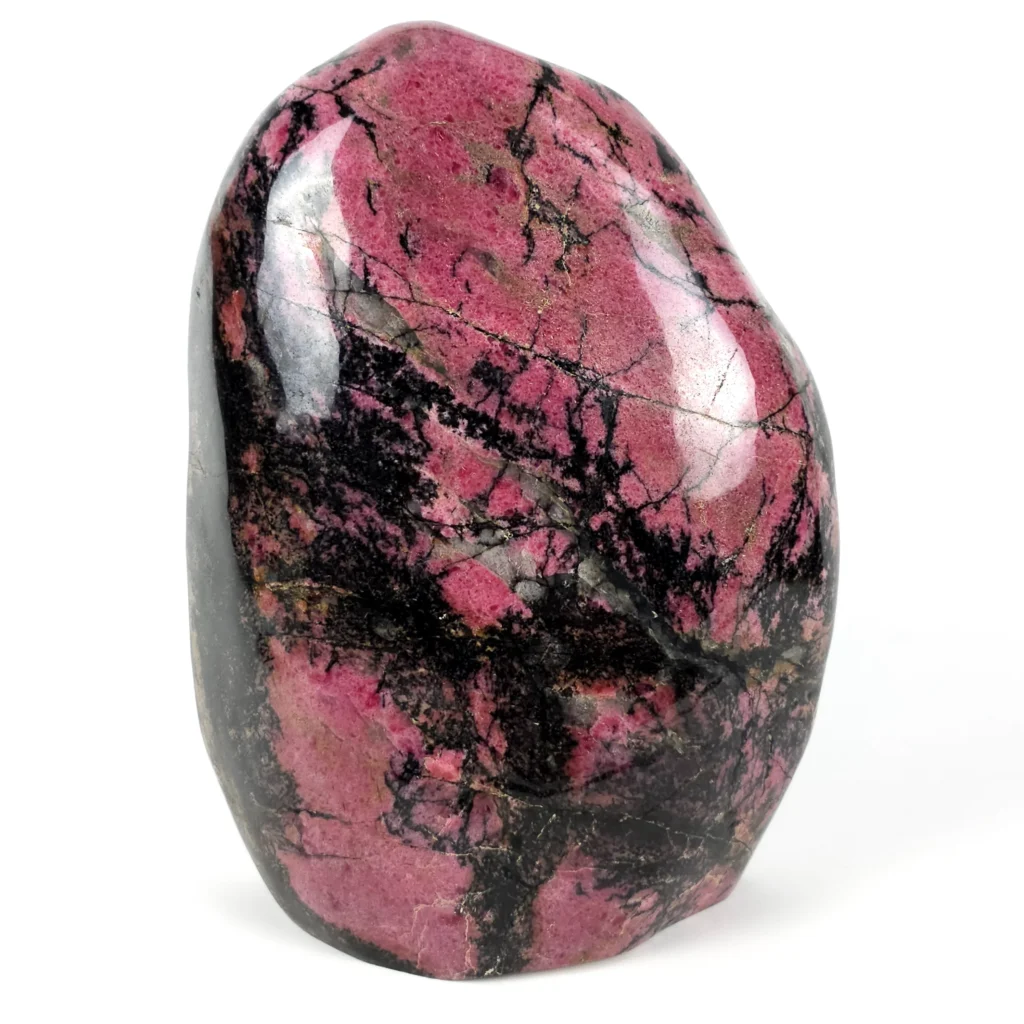
Rhodonite is also called a red and pink stone. This stone is an emotional balancer, and a strong healer. Rhodonite is rose pink to dark red in color. It has black dendritic inclusions on the surface. It has often mottled, often flecked with black and small tumbled shape. It is composed of manganese silicate and is a member of the pyroxenoid group. A grayish brown variety of Rhodonite, which contains 20% calcium oxide, is known as bustamite. It has a hardness of 5.5 to 6.5 on the Mohs scale. Rhodonite word has come from the Greek dictionary “rhodon”, which means rose color. It is a very attractive gemstone, so it is highly useful in jewelry and ornament making. In the year 1979, it was declared as the official gemstone of Massachusetts.
Mineralogically, Rhodonite is a manganese-rich silicate belonging to the Rhodonite Group and crystallizes in the triclinic system. Its name was introduced in 1819 from the Greek word meaning “rose,” referring to its characteristic pink-red color. Its typical hardness is 5.5–6.5 and measured specific gravity is approximately 3.57–3.76. Massachusetts officially adopted Rhodonite as its state gem in 1979.
The original Bustamite description needs clarification. Bustamite is now recognized as a separate mineral species with the formula CaMn²⁺(Si₂O₆), belonging to the Wollastonite Group. It is not simply a calcium-rich variety of Rhodonite. Historical material once called Bustamite was later found in some cases to contain mixtures including Rhodonite, which contributed to older classification confusion.
Identifying Natural Rhodonite
It can be identified by its rosy pink to dark red in color.
Natural Rhodonite commonly ranges from soft rose-pink to deep pink, reddish-pink, brownish-red or grey. Massive ornamental material frequently shows contrasting black manganese-oxide veins or dendritic patterns, while transparent red Rhodonite crystals are exceptionally rare and valued primarily as collector gemstones. The Australian Museum documents rare transparent red gem-quality crystals from Broken Hill, New South Wales.
Rhodonite Gemological Properties
- Mineral – Rhodonite
- Mineral group – Rhodonite Group
- Composition – Manganese-rich silicate
- Color – Pink, rose-red, brownish-red to grey
- Mohs hardness – 5.5 to 6.5
- Specific gravity – Approximately 3.57–3.76
- Refractive index – Approximately 1.711–1.752
- Crystal system – Triclinic
- Cleavage – Perfect in two directions, good in another
- Transparency – Transparent to translucent as a mineral; commonly opaque in massive ornamental material
- Lustre – Vitreous to pearly
- Streak – White
- Optical character – Biaxial positive
Modern mineralogical references confirm Rhodonite’s triclinic crystal system, perfect cleavage, hardness of 5.5–6.5 and pink to reddish coloration.
Rhodonite Origin and Sources
Rhodonite Origin: It is commonly found in Spain, Russia, Sweden, Germany, Mexico and Brazil.
Rhodonite occurs in manganese-rich geological environments in many parts of the world. Important material has also been documented from Australia, particularly Broken Hill in New South Wales, where transparent gem-quality crystals occasionally occur. Germany is especially significant historically because the type locality is in Saxony-Anhalt.
Determining Rhodonite Gemstone Value
Rhodonite color: This is soft pink to red in color. It has smooth surface and very less amount of black inclusions are present. Rhodonite clarity and luster: It is generally transparent to opaque. Transparent stone is very rarely found. Black inclusions on the surface are present due to manganese oxide. When polished, it exhibits a vitreous luster. Rhodonite cut and shape: It is typically cut on cabochon or carved. It is found in a natural way. It is not heated or enhanced.
For ornamental Rhodonite, value depends on attractive pink or red color, distribution of black manganese patterns, polish, size and absence of damaging fractures. Cleaner pink material with minimal dark veining may be preferred for some jewelry, while dramatic black-and-pink patterns are desirable for carvings and decorative pieces. Transparent red Rhodonite represents a much rarer category and may be faceted when quality permits.
The statement that Rhodonite is always untreated should not be taken as universal. Gemdat notes that dyed material can occur, while GIA has documented a transparent Rhodonite gemstone with clarity enhancement. Treatment disclosure is therefore useful when purchasing expensive or unusually transparent specimens.
Why Choose Semi Precious Stone Rhodonite?
Rhodonite can be used to enhance the optimism and positivity in the life of the wearer.It can be used against the black magic and ill eye. Semiprecious gems are cheaper than the precious stone. These are very soothing and can be worn, even if you don’t have any birth chart. These heal the mind and body and balance all the chakras of the body. It is highly effective to balance the ill placed Mars in the birth chart. It is a harmless stone and it also increases sexual vigor in a person. It increases romantic pleasure in a dull marital life. Rhodonite can be used studded in a necklace, rings or pendants.
In modern crystal and astrological traditions, Rhodonite is mainly associated with emotional balance, compassion, confidence, forgiveness and relationship harmony. Protection from the evil eye, balancing Mars and chakra healing belong to spiritual traditions rather than scientifically measurable gemstone effects. The terms precious and semiprecious are traditional commercial classifications and do not reliably indicate a gemstone’s rarity or value.
Rhodonite Benefits and Metaphysical Properties
It is a very supportive stone, which works and balances the heart chakra. It heals emotional shock and pain. This stone stimulates, clears, and activates the heart and crown chakra. It releases the negative energies and balances the yin-yang. Rhodonite heals emotional self-destruction and abuse. It clears the past emotional wounds also. This stone has a strong resonance with forgiveness and assists in reconciliation. It can also be sued in the past life healing and regression. It promotes unselfish love. Like Rhodochroscite it helps it invoke inner love and passion. It balances and integrates physical and mental energy in an optimum level. It builds up self confidence and removes the confusion.
Rhodonite is commonly used in modern crystal practices as a symbolic stone for compassion, forgiveness, self-confidence and emotional reflection. Its pink coloration contributes to its association with the Heart Chakra. Past-life healing, yin-yang balancing and chakra activation are metaphysical beliefs rather than scientifically established effects.
Rhodonite Healing
Physically, it supports detoxification. It is an excellent wound healer. It reduces confusion and emotional misbalance. It is very beneficial for bone growth and hearing organs. It stimulates fertility and enhances sexual strength. This treats stomach ulcers, inflammation of joints, arthritis, autoimmune disease, and multiple sclerosis. It is used as an elixir as a rescue remedy for shock. technical field. It is highly effective for the people who are in the public domain and administrators. This stone calms the overactive mind and releases tension and negative thoughts.
Claims involving wounds, fertility, ulcers, arthritis, autoimmune disease, multiple sclerosis, hearing, bone growth or detoxification are not scientifically established medical benefits of Rhodonite. Serious physical or psychological conditions require appropriate professional healthcare. Direct-contact gemstone elixirs are also best avoided unless the complete composition and safety of a specimen are known.
Rhodonite Gems Therapy
It activates the pineal gland. It aligns the chakra and removes blockages to clear chakra. Its gentle pink ray is particularly appropriate for assisting emotional healing.
In gemstone and meditation traditions, Rhodonite may be used as a personal object for intentions involving calmness, compassion and emotional awareness. There is no scientific evidence that wearing Rhodonite physically activates the pineal gland or alters chakra function.
Rhodonite vs Rhodochrosite
Rhodonite and Rhodochrosite are both well-known pink manganese minerals, but they are chemically and gemologically different. Rhodonite is a manganese silicate with hardness around 5.5–6.5, whereas Rhodochrosite is manganese carbonate and is much softer, generally around Mohs 3.5–4. Rhodonite often shows black manganese-oxide veining, while massive Rhodochrosite frequently displays pink-and-white banding.
This distinction is useful when buying polished pink stones because the two materials can sometimes look similar.
Rhodonite Jewelry and Care
Rhodonite is widely fashioned into cabochons, beads, pendants, necklaces, rings, carvings and decorative objects. Massive material is particularly popular for carved and polished items, while rare transparent material may be faceted.
Because Rhodonite has perfect cleavage despite moderate hardness, avoid hard impacts and rough everyday use. Clean it with lukewarm water, mild soap and a soft cloth. Avoid ultrasonic cleaners, steam, harsh chemicals and sudden temperature changes, particularly when treatment status is unknown. Store Rhodonite separately from harder gemstones such as Quartz, Topaz, Sapphire and Diamond.
Buying Certified Natural Rhodonite
Wholesale Prices of Rhodonite: Visit Astrokapoor office for buying natural stone in a wholesale price. We provide certified natural gemstone.
When buying Certified Natural Rhodonite, examine color, pattern, polish, fractures, transparency and treatment information. Strong pink to red color with an attractive distribution of dark manganese patterns is desirable for ornamental material, while rare transparent red crystals require greater attention to clarity, origin and laboratory identification.
Frequently Asked Questions
What is Rhodonite?
Rhodonite is a pink to reddish manganese-rich silicate mineral belonging to the Rhodonite Group. It is widely used as an ornamental and jewelry stone.
What causes the black patterns in Rhodonite?
The contrasting black veins and dendritic markings commonly seen in massive Rhodonite are generally associated with manganese oxide minerals.
What is the hardness of Rhodonite?
Rhodonite has a Mohs hardness of approximately 5.5 to 6.5, but its perfect cleavage means it still requires careful handling.
What are the traditional benefits of Rhodonite?
In crystal traditions, Rhodonite is associated with compassion, forgiveness, emotional balance, self-confidence and Heart Chakra practices. These are traditional beliefs rather than scientifically proven medical effects.
Is Rhodonite the official gemstone of Massachusetts?
Yes. Massachusetts adopted Rhodonite as its official state gem in 1979.


