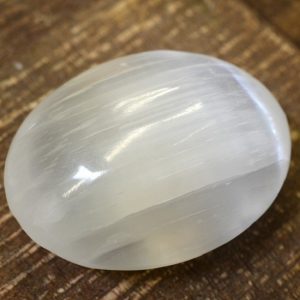
Selenite is a highly semiprecious gemstone, with translucent with fine rib like appearance on the surface. It is coarse, fishtail or petal like. Selenite is found in Pure white, orange, blue, brown and green in color. It is found in all sizes. It is easily obtained. It is composed of the mineral gypsum, which is found in obvious crystalline structure. It is composed of hydrated calcium sulfate, and it is very soft in appearance. It has a hardness of 2 on Moh’s scale findings. The name Selenite has come from the Greek word for “Moon”. It is obtained from United States, Mexico, Russia, Austria, Greece, Poland, Germany and England.
Mineralogically, Selenite is the transparent crystalline variety of Gypsum, with the chemical formula CaSO₄·2H₂O. Gypsum crystallizes in the monoclinic system, has a Mohs hardness of 2, specific gravity approximately 2.31–2.32 and perfect cleavage. Pure Gypsum is colorless to white, although impurities and inclusions can produce other shades.
The name Selenite comes from the Greek word connected with Selene, the Moon, referring to the moon-like appearance of its cleavage surfaces. It is better described as a mineral and ornamental crystal than as a durable jewelry gemstone because it is extremely soft and can even be scratched by a fingernail.
Selenite vs Satin Spar Gypsum
The fine rib-like, silky or fibrous material commonly sold in crystal shops as “Selenite” is often technically Satin Spar Gypsum. True Selenite usually forms transparent, glassy crystals, whereas Satin Spar is made of parallel fibrous Gypsum and displays a silky or chatoyant band of light. They share the same chemical composition but represent different growth habits of Gypsum.
This distinction is especially useful when buying Selenite towers and wands. Many polished white wands marketed as Selenite are actually Satin Spar. This does not make them artificial; Satin Spar is still natural Gypsum, but accurate product identification improves gemstone and mineral information.
Selenite Gemological Properties
- Mineral – Gypsum
- Variety – Selenite
- Chemical formula – CaSO₄·2H₂O
- Mineral class – Hydrated calcium sulfate
- Crystal system – Monoclinic
- Color – Normally colorless to white; other shades may occur due to impurities or inclusions
- Mohs hardness – 2
- Specific gravity – Approximately 2.31–2.32
- Refractive index – Approximately 1.521–1.531
- Transparency – Transparent to translucent
- Lustre – Vitreous to pearly
- Cleavage – Perfect
- Tenacity – Very soft and fragile
- Common forms – Tabular crystals, twinned crystals and crystalline masses
Gemdat records Gypsum at Mohs hardness 2, specific gravity around 2.20–2.40, perfect cleavage and refractive index approximately 1.521–1.531.
Why Selenite Semiprecious Gemstone?
Semi precious gemstone has the same qualities as the precious gemstone. The semiprecious gemstone can be very well considered, if you are incapable of buying the precious gemstone. Although semi precious gemstone lack few characteristic of precious gemstone, but yet they have the quality which can act as a precious gemstone
The terms “precious” and “semi-precious” are traditional commercial descriptions rather than scientific measurements of mineral quality or effectiveness. Selenite is valued primarily for its transparency, unusual crystal formations, soft moon-like appearance and popularity in decorative and spiritual practices.
Because its hardness is only 2 and it has perfect cleavage, Selenite is substantially less durable than gemstones such as Quartz, Topaz, Sapphire or Diamond. This makes it better suited to specimens, carvings and protected decorative pieces than to everyday rings.
Selenite Metaphysical Properties
Selenite is a calming stone. It instills deep peace in the life of the wearer. It enhances telepathy and increases positive vibration. The purest translucent white Selenite consists of ethereal quality. This stone is also used as a protective grid, if you keep it around a house. It creates a safe and quite space, which doesn’t allow intruders to get into the house.
The wands made of this stone are used to detach entities from the aura and also prevents anything external from influencing the mind. Psychologically, it assists correct judgment and insight. It clears confusion and helps to see the deeper picture of the consequence. This stone is a powerful disperser and stabilizer.
In modern crystal traditions, Selenite is associated with calmness, meditation, mental clarity, spiritual awareness and symbolic energetic cleansing. Protective grids, aura cleansing, telepathy and protection from spiritual entities are metaphysical beliefs rather than scientifically established properties.
It is also worth noting that many white fibrous “Selenite wands” used for these purposes are mineralogically Satin Spar Gypsum rather than transparent Selenite.
Healing | Selenite Useful in Medical Astrology Treatment
Selenite helps to align the spinal column. It helps to guard against epileptic seizures. This stone protects from dental problems and reverses the free radicals found in the body. It is an excellent stone for the female, and assists in breast feeding. Its finest healing occurs at the energetic level.
These statements represent traditional crystal-healing and medical-astrology beliefs. There is no reliable scientific evidence that Selenite aligns the spine, prevents epileptic seizures, treats dental problems, reverses free-radical damage or improves breastfeeding.
Epilepsy requires proper medical diagnosis and treatment, and a gemstone should never be used as a substitute for anti-seizure medication or specialist care. Breastfeeding concerns may also require professional guidance from a doctor or qualified lactation specialist.
Selenite can still be used as a personal meditation or spiritual object, but its symbolic energetic use should be clearly separated from medical treatment.
Green Selenite, Fishtail Selenite and Desert Rose
Green Selenite: It helps in the attainment of highest good. It makes one to feel good about them. It overcomes aging.
Fishtail Selenite: It helps to cure chronic disease. It stabilizes emotions and diffuse tensions. It is also called as Angel’s wing Selenite.
Desert Rose Selenite: It helps to strengthen the purpose of life. It increases the self-confidence and self-esteem.
These names require some mineralogical clarification. Pure Selenite is generally colorless, so strongly green, blue or other colored material should be checked carefully because color may result from mineral inclusions, impurities, coatings or trade terminology rather than defining a separate Selenite variety. Gypsum itself may be naturally tinted by impurities.
“Fishtail” or “swallowtail” refers to a characteristic twinned growth form of Gypsum rather than a separate mineral species. Natural swallowtail Selenite twins are well documented. “Angel Wing Selenite” is primarily a commercial or metaphysical trade term rather than a recognized mineral species.
Desert Rose is also broader than Selenite. Desert Roses are rosette-like mineral aggregates formed in sandy arid environments and are usually Gypsum containing trapped sand grains, although Barite, Celestine and other minerals can also form desert-rose structures.
Claims that Green Selenite reverses aging, Fishtail Selenite treats chronic disease or Desert Rose directly changes confidence are metaphysical beliefs and are not scientifically proven medical effects.
Astrological Purpose of Selenite
As, this stone is basically white in color, it helps to increase the benefic aspect of the “Moon”. It can remove the malefic effect of the Moon and calms the mind of the wearer. This tone can be used in the form of pendant or finger ring studded in silver.
It is highly beneficial for the students as it increases concentration power and helps to score god marks in the examination.
Because of its white, translucent and moon-like appearance, Selenite is naturally associated with the Moon in several modern spiritual and astrological traditions. Planetary remedies, Moon strengthening and astrological effects depend on the belief system being followed and are not scientifically measurable properties of Gypsum.
Similarly, Selenite cannot guarantee higher examination marks or improved academic performance. Students may use it symbolically during study or meditation, but academic results depend on preparation, concentration, knowledge and learning habits.
Selenite Jewelry, Handling and Care
Although Selenite can be fashioned into pendants, beads and decorative pieces, it requires considerably more care than most common gemstones. Mohs hardness 2 means that even a fingernail can scratch its surface, while its perfect cleavage makes thin crystals susceptible to splitting.
For this reason, Selenite is generally a poor choice for an everyday finger ring. Pendants, display specimens, towers, spheres and protected carvings are more practical options.
Avoid prolonged soaking in water. Gypsum is slightly soluble in water, so repeated or extended immersion can gradually affect the mineral’s surface. Use a dry, very soft cloth for routine dust removal; if moisture is necessary, use it sparingly and dry the piece immediately.
Also avoid ultrasonic cleaners, steam, abrasives, harsh chemicals and high temperatures. Gypsum can lose structural water when heated and transform toward other calcium-sulfate phases such as Bassanite or Anhydrite.
Buying Certified Natural Selenite
Wholesale price of Selenite: Visit Astrokapoor office for buying certified, natural stone in a wholesale price. We provide certified natural gemstone.
When buying Certified Selenite, first determine what material is actually being offered. Transparent glass-like crystals are consistent with Selenite, while white fibrous towers and wands are usually Satin Spar Gypsum. Desert Rose is another Gypsum formation and should not automatically be labeled simply as transparent Selenite.
Look for natural crystal structure, surface condition, transparency, cleavage, color and correct mineral identification. Because Gypsum is extremely soft, minor scratches and cleavage marks can occur naturally during handling. Colored material should receive additional attention if natural color is specifically claimed.
For decorative use, quality is often judged by attractive crystal formation, transparency, size and condition rather than by conventional gemstone faceting standards.
Frequently Asked Questions
What is Selenite?
Selenite is the transparent crystalline variety of Gypsum, a hydrated calcium sulfate mineral with the chemical formula CaSO₄·2H₂O.
Is Satin Spar the same as Selenite?
Not exactly. Both are varieties of Gypsum, but Selenite is generally transparent and crystalline, while Satin Spar has a white fibrous structure and silky appearance. Many commercial “Selenite wands” are actually Satin Spar.
What is the hardness of Selenite?
Selenite has a Mohs hardness of only 2, making it one of the softest minerals commonly sold for decorative and crystal purposes.
Can Selenite be kept in water?
Prolonged soaking is not recommended because Gypsum is slightly soluble in water and the soft surface can deteriorate over time.
What are the traditional benefits of Selenite?
In crystal traditions, Selenite is associated with calmness, meditation, clarity, spiritual awareness and energetic cleansing. These are traditional beliefs rather than scientifically proven medical effects.


