
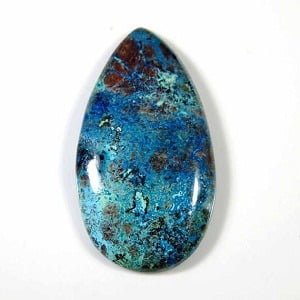
Shattuckite Stone is a distinctive blue to blue-green copper mineral admired by mineral collectors and people interested in crystals, meditation and spiritual practices. It is especially recognised for its beautiful shades of blue and its traditional metaphysical associations with communication, intuition, truth and spiritual awareness.
Shattuckite is a copper silicate hydroxide mineral. It was first described from the Shattuck Mine in Bisbee, Arizona, United States, and was named after this famous mining locality.
The stone often occurs alongside other colourful copper minerals, including azurite, malachite and chrysocolla. Because of these natural associations, specimens combining Shattuckite with Azurite or other copper minerals can display striking shades and patterns.
What Is Shattuckite?
Shattuckite is a relatively uncommon copper silicate hydroxide mineral.
Its mineral formula is:
Cu₅(Si₂O₆)₂(OH)₂
The mineral commonly occurs as fibrous, granular, spherical or acicular formations. Acicular means that the crystals can develop in fine needle-like forms.
Shattuckite generally displays shades ranging from light blue and turquoise-blue to rich dark blue and blue-green.
Its attractive colour comes from its copper content.
Why Is It Called Shattuckite?
The name Shattuckite comes from the Shattuck Mine in Bisbee, Arizona.
The Shattuck Mine is recognised as the type locality for the mineral, meaning it is the locality from which the mineral was originally scientifically described.
This connection with Bisbee is important because the region is famous for producing a variety of colourful copper minerals.
Shattuckite Azurite
Shattuckite Azurite generally refers to mineral material in which Shattuckite occurs together with Azurite.
Both are copper minerals, although their chemical compositions are different.
Shattuckite is a copper silicate hydroxide, while Azurite is a copper carbonate hydroxide mineral.
Natural mineral associations involving Shattuckite can include:
- Azurite
- Malachite
- Chrysocolla
- Quartz
- Other secondary copper minerals
When multiple minerals occur together, the specimen can show interesting combinations of blue, turquoise, green, white or darker colours.
If the AstroKapoor product contains genuine Azurite along with Shattuckite, the term Shattuckite Azurite is highly appropriate. If it is pure Shattuckite, however, the page should primarily describe it as Shattuckite Stone rather than automatically calling every specimen Shattuckite Azurite.
Shattuckite Stone Meaning
In modern crystal and metaphysical traditions, Shattuckite meaning is closely connected with truth, communication, intuition and spiritual awareness.
It is often described as a crystal for people who want to express their thoughts clearly while remaining connected with their inner values.
Shattuckite is traditionally associated with:
- Clear communication
- Speaking truthfully
- Self-expression
- Intuition
- Spiritual awareness
- Emotional understanding
- Confidence while communicating
- Personal reflection
- Meditation
- Inner harmony
These are spiritual and metaphysical associations rather than scientifically established health effects.
Shattuckite Benefits
According to crystal traditions, Shattuckite benefits are primarily connected with communication, intuition and emotional awareness.
People interested in crystal practices traditionally use Shattuckite for:
- Encouraging honest communication
- Supporting confidence in self-expression
- Promoting thoughtful conversations
- Encouraging intuitive awareness
- Supporting meditation
- Developing greater self-understanding
- Encouraging emotional balance
- Supporting positive thinking
- Strengthening personal intentions
- Promoting harmony between thoughts and communication
Shattuckite can therefore be particularly interesting to people whose professional or personal lives require regular communication.
Shattuckite for Communication
One of the best-known traditional uses of Shattuckite is its association with communication.
In metaphysical traditions, it is sometimes described as a stone that encourages a person to express thoughts clearly and honestly.
For this reason, Shattuckite may appeal to professionals such as:
- Teachers
- Lawyers
- Counsellors
- Speakers
- Writers
- Journalists
- Politicians
- Trainers
- Consultants
- Content creators
The crystal can be carried, worn or kept nearby as a symbolic reminder to communicate clearly and thoughtfully.
Shattuckite Chakra
Shattuckite is commonly associated with three chakras in modern crystal traditions:
Throat Chakra
The Throat Chakra is the strongest association for blue Shattuckite.
It is traditionally connected with communication, truth, expression and the ability to share thoughts clearly.
Lighter blue Shattuckite is frequently associated with Throat Chakra meditation.
Third Eye Chakra
Deep blue varieties of Shattuckite are also commonly linked with the Third Eye Chakra.
The Third Eye Chakra is traditionally associated with intuition, perception, inner awareness and spiritual understanding.
For this reason, dark blue Shattuckite may be used during meditation focused on intuition and self-reflection.
Heart Chakra
Blue-green or greenish Shattuckite is sometimes associated with the Heart Chakra in crystal traditions.
The Heart Chakra symbolically relates to compassion, emotional openness, relationships and communicating with kindness.
These chakra associations are part of spiritual traditions rather than scientific anatomy.
Shattuckite for Throat Chakra
Shattuckite is particularly popular as a Throat Chakra crystal because of its blue colour and its traditional association with communication.
During Throat Chakra meditation, Shattuckite may be used while setting intentions such as:
- Speaking clearly
- Communicating honestly
- Expressing ideas confidently
- Listening carefully
- Communicating with compassion
- Finding the right words during difficult conversations
It can be held during meditation or kept nearby during reflective practices.
Shattuckite for Third Eye Chakra
Dark blue Shattuckite is traditionally associated with the Third Eye Chakra.
People interested in spiritual practices may use a Shattuckite crystal while focusing on:
- Intuition
- Awareness
- Visualization
- Inner reflection
- Meditation
- Understanding personal experiences
- Developing greater clarity
The stone should be regarded as a symbolic meditation tool rather than something that guarantees psychic abilities.
Shattuckite for Meditation
Shattuckite is widely used within modern crystal traditions as a meditation stone.
A person may hold the stone, place it nearby or wear Shattuckite jewellery during meditation.
Shattuckite meditation may focus on intentions such as:
- Clear communication
- Truth
- Emotional awareness
- Personal growth
- Intuition
- Confidence
- Compassion
- Inner peace
Its blue appearance can also provide a visual point of focus during mindfulness exercises.
Shattuckite and Intuition
Shattuckite is frequently described in crystal traditions as a stone connected with intuition.
Rather than treating this as a supernatural guarantee, it can be understood as a symbolic tool for practices involving observation, reflection and attention to one’s own thoughts.
People may use Shattuckite while journaling or meditating on questions such as:
- What am I really trying to communicate?
- Am I expressing myself honestly?
- What does my intuition tell me about this situation?
- Am I listening carefully to others?
- Are my actions aligned with my values?
This makes the stone particularly relevant for reflective and mindfulness-based spiritual practices.
Shattuckite for Relationships
Because Shattuckite is traditionally associated with communication, it is also sometimes used in relationship-focused crystal practices.
Clear and respectful communication is important in relationships, and a Shattuckite crystal may serve as a symbolic reminder to:
- Listen carefully
- Speak thoughtfully
- Express feelings honestly
- Avoid unnecessary conflict
- Communicate with compassion
- Understand different viewpoints
A gemstone itself cannot guarantee relationship harmony, but it may form part of an individual’s meditation or intention-setting practice.
Shattuckite Properties
Important mineralogical properties of Shattuckite include:
Mineral Name: Shattuckite
Mineral Type: Copper silicate hydroxide
Chemical Formula: Cu₅(Si₂O₆)₂(OH)₂
Crystal System: Orthorhombic
Colour: Blue, deep blue, turquoise-blue and blue-green
Mohs Hardness: Approximately 3.5
Lustre: Dull to silky
Transparency: Usually translucent to opaque
Streak: Blue
Typical Formation: Fibrous, granular, spherical and acicular aggregates
Type Locality: Shattuck Mine, Bisbee, Arizona, USA
Shattuckite is considerably softer than gemstones such as quartz or sapphire, so jewellery and polished specimens should be handled with appropriate care.
What Colour Is Shattuckite?
Shattuckite is best known for its intense blue colour.
Depending on the specimen and associated minerals, it may appear:
- Light blue
- Sky blue
- Turquoise-blue
- Deep blue
- Blue-green
- Greenish blue
Some specimens can also include contrasting areas created by quartz, malachite, azurite, chrysocolla or other associated minerals.
These colour combinations are one reason Shattuckite specimens are attractive to collectors.
Where Is Shattuckite Found?
The original and most historically important locality is the Shattuck Mine at Bisbee, Arizona.
Shattuckite has subsequently been reported from other copper-rich mineral localities around the world.
Known localities include areas in:
- United States
- Namibia
- South Africa
- Germany
- Greece
- Argentina
- United Kingdom
The appearance and associated minerals can vary according to the deposit.
Is Shattuckite Rare?
Shattuckite is considered a relatively uncommon copper mineral compared with more familiar copper minerals such as malachite and azurite.
Attractive specimens with strong blue colour, interesting patterns or desirable associated minerals are especially popular among collectors.
Material combining Shattuckite with Azurite, Malachite, Chrysocolla or Quartz can also be visually distinctive.
Shattuckite vs Azurite
Shattuckite and Azurite are not the same mineral.
Shattuckite is a copper silicate hydroxide, while Azurite is a copper carbonate hydroxide.
Both can have strong blue colours and may occur in copper deposits, which can create confusion.
They can also naturally occur together.
This makes accurate mineral identification important when purchasing specimens advertised as Shattuckite Azurite.
Shattuckite vs Chrysocolla
Shattuckite and Chrysocolla can also look similar because both may display blue or blue-green colours and occur in copper-rich environments.
However, they are different mineral materials.
The two can sometimes occur together in the same specimen, producing colourful mixed-mineral material.
Professional mineralogical or gemological testing is the most reliable way to identify unusual specimens.
Shattuckite Jewellery
Because Shattuckite is relatively soft, it requires more care than harder jewellery gemstones.
It may be fashioned into:
- Pendants
- Cabochons
- Beads
- Earrings
- Collector pieces
- Decorative carvings
Protective settings can help reduce exposure to impact and scratching.
Shattuckite pendants may be especially practical because they generally experience less impact than rings.
How to Care for Shattuckite
Shattuckite has a Mohs hardness of only about 3.5, so gentle care is important.
For regular care:
- Handle the stone carefully.
- Keep it away from harder gemstones.
- Avoid scratching and strong impacts.
- Use a soft cloth for cleaning.
- Avoid harsh chemical cleaners.
- Avoid aggressive scrubbing.
- Store it separately in a soft pouch or jewellery box.
For valuable specimens or jewellery, professional cleaning may be preferable.
Shattuckite Birthstone and Astrology
Shattuckite is not generally recognised as one of the standard modern birthstones.
Different crystal and metaphysical systems sometimes associate Shattuckite with particular zodiac signs, planets or days, but these correspondences vary considerably between sources.
Therefore, claims such as December–January being the official Shattuckite birthstone period, Venus being its universal ruling planet or Friday being its required wearing day should not be presented as established mineralogical facts.
If Shattuckite is being selected according to astrology, personalised guidance can be used according to the astrological tradition being followed.
Who May Consider Shattuckite?
Shattuckite may appeal to:
- Crystal collectors
- Mineral collectors
- Meditation practitioners
- People interested in Throat Chakra practices
- People exploring Third Eye Chakra meditation
- Speakers and communication professionals
- Teachers and counsellors
- Writers and creative professionals
- People interested in rare blue minerals
- Collectors of copper minerals
Its combination of striking blue colour, unusual mineralogy and traditional spiritual symbolism makes it interesting from both mineral-collecting and metaphysical perspectives.
Why Choose a Shattuckite Stone?
Shattuckite is much more than an attractive blue mineral.
From a mineralogical perspective, it is an uncommon copper silicate hydroxide named after one of Arizona’s famous copper mines. From a crystal-tradition perspective, it has become associated with communication, truth, intuition, meditation and spiritual awareness.
Whether you are interested in Shattuckite Stone for collecting, meditation, chakra practice or jewellery, understanding both its genuine mineral properties and its traditional spiritual meaning allows you to appreciate the stone more fully.
Frequently Asked Questions About Shattuckite
What is Shattuckite Stone?
Shattuckite is a blue to blue-green copper silicate hydroxide mineral originally described from the Shattuck Mine in Bisbee, Arizona.
What are Shattuckite benefits?
According to modern crystal traditions, Shattuckite is associated with communication, truth, intuition, emotional awareness, meditation and self-expression. These are spiritual beliefs rather than scientifically proven medical benefits.
What chakra is Shattuckite associated with?
Shattuckite is most commonly associated with the Throat and Third Eye Chakras. Greenish varieties are also sometimes linked with the Heart Chakra.
Is Shattuckite the same as Azurite?
No. They are different copper minerals. However, Shattuckite and Azurite can naturally occur together in the same mineral specimen.
What is Shattuckite Azurite?
Shattuckite Azurite generally describes a mixed-mineral specimen containing both Shattuckite and Azurite.
Where is Shattuckite found?
Shattuckite was first described from the Shattuck Mine in Bisbee, Arizona. It has since been reported from several other copper-mineral localities worldwide.
Is Shattuckite rare?
Shattuckite is a relatively uncommon copper mineral. Attractive specimens with intense blue colour or associations with minerals such as Azurite, Malachite and Chrysocolla can be particularly desirable to collectors.
What is the hardness of Shattuckite?
Shattuckite has a Mohs hardness of approximately 3.5, so it should be protected from scratches, hard impacts and rough handling.
Is Shattuckite good for meditation?
In crystal traditions, Shattuckite is commonly used during meditation focused on communication, intuition, truth and personal reflection.
Can Shattuckite be worn as jewellery?
Yes, Shattuckite can be fashioned into jewellery, particularly pendants and cabochons. Because it is relatively soft, it should be worn and stored carefully.


