
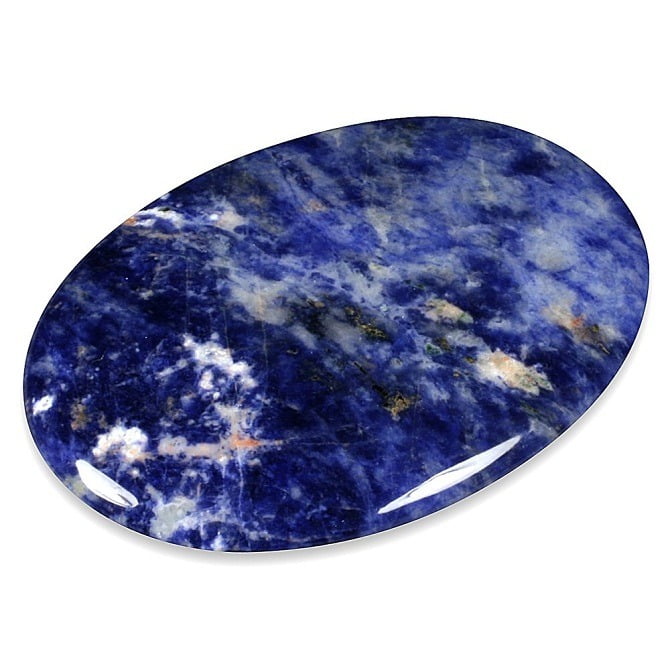
Sodalite is a gemstone of peace. Sodalite brings inner peace. Sodalite Simply holding small piece of sodalite in the hands brings deep peace and calm. Sodalite is a typical blue crystal. It is named sodalite due to the presence of mineral sodium. Sodalite can be identified by deep blue color with strong orange fluorescence. Sometimes violet tint is also found on its surface. Sodalite has white veins or patches on the surface composed of calcite. This stone is usually found in masses and rarely found in crystal form in the nature. Gem cutters usually take a large chunk of Sodalite and shape it into crystal form. It is purchased in slabs and chunks.
Mineralogically, Sodalite is a sodium-rich feldspathoid mineral of the Sodalite Group with the formula Na₄(Si₃Al₃)O₁₂Cl. Its name reflects its sodium content. Natural Sodalite can be colorless, white, yellowish, green, grey, pink, violet or blue, although deep royal blue material is the best known for ornamental use. It commonly occurs in massive form, while well-developed crystals are comparatively rare.
Sodalite Gemstone Sources
Sodalite is mainly found in India, Greenland, Brazil, Canada, Russia and USA.
Sodalite occurs in several countries and is particularly associated with silica-poor alkaline igneous rocks. Its type locality is the Ilímaussaq complex in Greenland, while ornamental-quality blue material is also well known from Canada and other international localities.
Recognizing Sodalite and Gemstone Value
Sodalite Color – It is found in blue to grey in color.
Sodalite Clarity and Luster – It exhibits a vitreous luster on its surface.
Sodalite Cut and Shape – Opaque stone is cut in a cabochon shape. It is also cut in oval, round or fancy in shapes.
Fine Natural Sodalite is valued primarily for an attractive deep-blue to violet-blue color, appealing white veining, even polish and overall pattern. Much of the material used in jewelry is opaque, although Sodalite as a mineral can be transparent to translucent. Its lustre ranges from vitreous to greasy. Cabochons, beads, carvings, spheres and polished slabs are among its most common uses.
Sodalite Gemological Properties
- Mineral – Sodalite
- Mineral group – Sodalite Group / Feldspathoid Group
- Chemical formula – Na₄(Si₃Al₃)O₁₂Cl
- Color – Blue, violet-blue, grey, white, green, yellow or pink
- Mohs hardness – Approximately 5.5 to 6
- Specific gravity – Approximately 2.27–2.33
- Refractive index – Approximately 1.483–1.487
- Crystal system – Isometric
- Cleavage – Poor to indistinct
- Fracture – Sub-conchoidal
- Transparency – Transparent to translucent as a mineral; commonly opaque in ornamental material
- Lustre – Vitreous to greasy
- Optical character – Isotropic
Mindat records Sodalite at Mohs 5.5–6 with a measured density of about 2.27–2.33, isometric crystallography and poor cleavage.
Does Sodalite Always Show Orange Fluorescence?
Sodalite can show attractive fluorescence, including orange, red-orange or yellowish responses under ultraviolet light, but this should not be treated as a universal identification feature. Fluorescence varies according to composition and locality. Hackmanite, a variety of Sodalite, is particularly famous for fluorescence and tenebrescence, meaning that its color can temporarily deepen after exposure to certain wavelengths of ultraviolet light.
Therefore, strong orange fluorescence can support identification in some specimens, but a Sodalite that does not fluoresce strongly is not automatically fake.
Metaphysical Properties and Qualities of Sodalite
Sodalite is a gemstone of Sagittarius Zodiac. It unites logic with intuition. This bead of gemstone brings perception, and brings information from the higher mind. Sodalite instills a drive for truth and an urge toward idealism. Sodalite clears electromagnetic pollution. If placed on computer it blocks the harmful rays of computer. This is useful for the people who are in group work. It encourages rational thought, truth and intuitive perception.
In modern crystal traditions, Sodalite is associated with communication, calmness, logical thinking, confidence, self-expression and intuition. Its blue color is also commonly linked with the Throat Chakra. Sagittarius, Venus, Water and the number 4 are associations found in some spiritual systems, but they are not standardized gemological properties.
There is no reliable scientific evidence that placing Sodalite near a computer blocks electromagnetic radiation or harmful computer emissions. Appropriate device safety practices should be followed instead of relying on a gemstone for radiation protection.
Sodalite Healing Properties
Sodalite balances the metabolism. It overcomes calcium deficiencies and cleanses the lymphatic system. Sodalite beads boost the immune system. This stone removes the ill effect of radiation damage and insomnia. It is very useful in the treatment of digestive disorders. Fever and high blood pressure are cured by using Sodalite. It stimulates the absorption of fluid in the body.
Sodalite is a power stone. It calms the body and the mind. If a person is over critic then wearing a piece of sodalite can bring calmness. This stone is very powerful for people who are in the profession of writing. Person who writes for living can place sodalite beads on the table. It will help writers to be more prolific. Sodalite releases the old mental conditioning and rigid mind sets. It brings new insights into practice. Sodalite is a great worry stone. Simply put in near yourself in a regular basis. It is associated to the throat chakra. It vibrates to number – 4. Venus is the ruling planet for Sodalite. Element – Water.
Traditional Sodalite benefits are better described as associations with calmness, communication, concentration and personal reflection. Claims involving high blood pressure, fever, calcium deficiency, immune function, metabolism, insomnia, digestion, lymphatic conditions or radiation damage are not scientifically established medical effects of Sodalite. It should not replace professional diagnosis or healthcare.
Sodalite vs Lapis Lazuli
Sodalite is sometimes confused with Lapis Lazuli because both can display a rich blue color with pale markings. However, Sodalite is a defined mineral species, while Lapis Lazuli is a rock composed primarily of Lazurite along with minerals such as Calcite and Pyrite. Sodalite typically lacks the golden Pyrite specks commonly associated with high-quality Lapis Lazuli.
White Calcite veins can occur in blue Sodalite, giving it an attractive blue-and-white pattern that is popular for decorative stones, beads and cabochons.
Sodalite Gemstone Jewelry and Care
Sodalite is fairly tough stone. It has smooth, glossy surface. It is 5.5 to 6 on the Moh’s scale. It is soft in comparison to many gemstones. Sodalite jewelry should be cleaned with soft cloth and soft soap. Harsh chemicals and liquids shouldn’t be used while cleaning this stone. Always remove Sodalite Gemstone before exercising or in any heavy physical work.
Because Sodalite has moderate hardness and brittle tenacity, it can scratch or chip when subjected to hard impact. Use lukewarm water, mild soap and a soft cloth for cleaning. Avoid harsh household cleaners, strong acids, steam, rough brushing and prolonged high heat. Store it separately from harder stones such as Quartz, Topaz, Sapphire and Diamond.
Famous Sodalite Gemstone
Sodalite is used as a decorative stone. A stone of 18th century, sodalite was sold for $44,797 at Christie’s auction in Paris.
A gemstone industry reference reports that an 18th-century Qing Dynasty Sodalite plaque in a bronze frame sold for $44,797 at a Christie’s auction in Paris in December 2013. This refers to a decorative artwork containing Sodalite rather than an individual loose gemstone.
Frequently Asked Questions
What is Sodalite?
Sodalite is a sodium-rich feldspathoid mineral with the chemical formula Na₄(Si₃Al₃)O₁₂Cl. It is best known for its rich blue to violet-blue ornamental material.
What is the hardness of Sodalite?
Sodalite has a Mohs hardness of approximately 5.5 to 6, so it is softer than Quartz and requires reasonable care in jewelry.
Does every Sodalite fluoresce orange?
No. Some Sodalite specimens show strong orange or red-orange fluorescence, while others may respond differently or weakly depending on composition and locality.
What are the traditional benefits of Sodalite?
In crystal traditions, Sodalite is associated with peace, communication, logical thinking, confidence, intuition and Throat Chakra practices. These are traditional beliefs rather than scientifically proven medical effects.
Is Sodalite suitable for jewelry?
Yes. Sodalite is widely used for cabochons, beads, pendants, earrings, bracelets and decorative pieces, but it should be protected from hard impacts and abrasive cleaning.


