Star Sapphire Gemstone is a very rare variety of Sapphire, that exhibit asterism. Star Sapphire belongs to the family corundum. Star Sapphire corundum has a hardness of 9, which makes it a second hardest material on earth. Star Sapphire stone brings you into its depths and clears intuition. It brings about centering of your thoughts and aids in anticipating the intentions of other people. It is said to contact extramarital beings. Star Sapphire gives immense benefits if worn in a pendant, earrings, rings and necklace as jewelry.
Gemologically, Star Sapphire is phenomenal Corundum with the chemical formula Al₂O₃. Corundum has Mohs hardness 9 and is the hardness-9 reference mineral on the Mohs scale, making Sapphire exceptionally durable for jewelry. The star-shaped optical phenomenon is known as asterism. GIA explains that it develops when light reflects from numerous tiny needle-like inclusions arranged in specific crystallographic directions.
The name “corundum” comes from Sanskrit word “Kuruvindam”, which means Ruby Sapphire, while the term “sapphire” is derived from the Persian word “safir”. Star Sapphire can be a very dark blue, to seeming dense and blackish from a distance. Some stone have clearly defined streaks of pale color, in contrast to a dark ground.
The name Corundum is historically connected with Sanskrit kuruvinda, referring to ruby. The history of the word Sapphire is more complex: the modern English word developed through Old French, Latin and Greek, with related ancient terms also occurring in Persian, Hebrew and Arabic.
What Causes the Star in Star Sapphire?
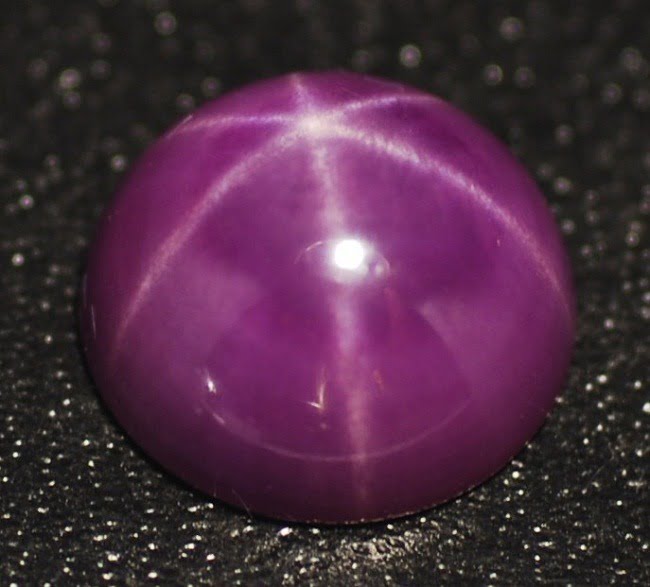
Star Sapphire has specific lightning, when observed in clear light. A six rayed star is observed in Star Sapphire Gemstone. It is best viewed, under a direct source of light.
The six-rayed star usually results from three sets of oriented microscopic inclusions, commonly rutile needles, reflecting light from beneath a polished cabochon surface. The star should appear to move smoothly across the gemstone as the stone or light source moves. Most Star Sapphires show six rays, while four-ray stars occur and twelve-ray stars are much rarer.
GIA notes that twelve-rayed stars can develop when two different sets of inclusions, such as rutile and hematite, produce overlapping stars. Fine-quality asterism should be sharp, centered, complete and clearly visible against the body color.
Star Sapphire Colors and Sources
Star Sapphire Gemstones can range in color blue in various shades to red, pink, yellow, green, lavender, gray and black. The most desirable color of this stone is intense blue. Most of this stone has an appearance of star, but star sapphire from Thailand has gold colored asterism. Star sapphire is mostly found in Australia, Burma, Srilanka, Thailand, and Brazil.
Star Corundum can occur in blue, pink, yellow, purple, grey, brown, black and other shades. However, red Corundum displaying a star is properly called Star Ruby rather than Star Sapphire. Blue is among the most desirable Star Sapphire colors, particularly when combined with a strong, well-centered star.
Thailand is particularly famous for dark or black Star Sapphires that can display yellowish-golden asterism. GIA attributes this effect in many Thai stones to dense, oriented iron-rich particles such as hematite and ilmenite. Australia also produces similar dark star material.
Important Sapphire-producing regions include Sri Lanka, Myanmar, Thailand, Australia, Madagascar and Tanzania. Geographic origin can influence rarity and market interest, but star sharpness, body color, transparency and overall appearance remain major quality factors.
Identifying Star Sapphire Gemstone
It can be differentiated from the other sapphire, by presence of unique asterism. The six-rayed-star effect more clearly visible under light, if rotated in a circular motion. Chemically, this stone is a combination of aluminum oxide and forms as trigonal crystals.
A genuine star is best examined under a single focused light source. As the cabochon is tilted, the star should move naturally across the curved surface. Star Sapphire is normally cut en cabochon because the domed shape properly orients and concentrates reflected light from the inclusions. GIA notes that cabochon proportions and orientation strongly influence how centered and sharp the final star appears.
Star Sapphire Gemstone Properties
Color – Blue in various tones, pink, yellow, green, lavender
Hardness – 9
Cleavage – None
Transparency – Transparent, translucent, opaque
Luster – Vitreous, silky
Density – 3.95 to 4.03
These properties are broadly consistent with natural Corundum. A more complete gemological profile includes:
- Mineral species – Corundum
- Chemical formula – Al₂O₃
- Color – Blue, pink, yellow, purple, grey, brown, black and other shades
- Mohs hardness – 9
- Specific gravity – Approximately 3.98–4.10
- Refractive index – Approximately 1.760–1.770
- Crystal system – Trigonal
- Cleavage – None
- Transparency – Transparent to opaque
- Lustre – Vitreous to silky
- Optical phenomenon – Asterism
- Typical cut – Cabochon
Mindat records Corundum at hardness 9, specific gravity approximately 3.98–4.10 and trigonal crystallography.
Star Sapphire Quality and Value
A high-quality Star Sapphire should combine attractive body color with a sharp and well-centered star. GIA considers the finest stars to have straight, complete rays with strong contrast against the gemstone and smooth movement when the stone is tilted. Too many inclusions can make the stone excessively opaque, while too few may produce a weak star.
Color is also important. Rich blue Star Sapphires are particularly desirable, although exceptional black, grey, purple and other fancy-color stars can also be collectible. Cut quality matters because incorrect orientation can make the star weak, incomplete or off-center.
Natural, Treated and Synthetic Star Sapphire
Both natural and laboratory-grown Star Sapphires exist. Treatment can also influence color and asterism. GIA has documented synthetic Sapphire in which both blue color and the star effect were produced by diffusion treatment.
Heat treatment of Corundum can modify color and may improve, weaken or remove asterism depending on the process because the inclusions responsible for the star can be altered. For a valuable Certified Natural Star Sapphire, a recognized laboratory report is useful for confirming natural versus laboratory-grown origin and identifying detectable treatment.
Star Sapphire Metaphysical and Crystal Properties
Sapphire is the gemstone for those who are born in the month of September, and it also depends upon the individual birth chart and the ascendant. The ancient regarded this stone as powerful talisman for protecting travelers and seekers. It is one of the most durable gemstone and can be worn daily as earrings, necklace and bracelets. It is very suitable for jewelry which is exposed to direct light. It is readily available in large size. Some black star sapphires can be found in large size and very perfect for oversize rings and pendants.
Sapphire is internationally recognized as the September birthstone. In crystal and astrological traditions, Star Sapphire is associated with intuition, focus, protection, discipline and spiritual awareness. Claims involving prophecy, communication with supernatural or extraterrestrial beings, or psychic protection are metaphysical beliefs rather than scientifically established gemstone effects.
Star Sapphire Benefits
Star Sapphire gemstones give immense benefit to the wearer. Star Sapphire is useful for the people who are in the profession of administration, teaching and in creative filed. Star Sapphire makes a person shine like the illumination of the star. People who want to attain spiritual soul can also wear this star gemstone.
In traditional gemstone practices, Star Sapphire is symbolically associated with concentration, confidence, wisdom, leadership and spiritual reflection. These associations may make it meaningful as an astrological or meditation stone, but career success and personal development depend on education, skills, decisions and circumstances rather than gemstone use.
Famous Star Sapphire Gemstone
The Smithsonian Institution in Washington D.C has Star Sapphire of more than 50 carats and was found in Sri Lanka. The mega star of impressive gem collection is the “Star Asia”, or star sapphire of 30 carats.
The famous gemstone referred to here is the Star of Asia, and its weight requires correction. The Smithsonian National Museum of Natural History records the Star of Asia at 330.00 carats, not 30 carats. The Smithsonian describes it as one of the world’s finest Star Sapphires because of its impressive size, intense color and sharp star, and states that it is from Sri Lanka and is said to have belonged to the Maharajah of Jodhpur.
Why Star Sapphire from Astrokapoor?
We provide authentic and certified Star Sapphire in a wholesale price to our clients. Our gems are passed through various tests so that we can collect original, natural and authentic gemstones for our clients.
When buying Certified Star Sapphire, check body color, star sharpness, centering, ray completeness, transparency, cut, carat weight and treatment status. Certification is particularly valuable because natural, treated and laboratory-grown star Corundum can all appear in the gemstone market.
Star Sapphire Jewelry and Care
Corundum is highly suitable for rings, pendants, earrings, necklaces and bracelets because it has Mohs hardness 9, excellent toughness and no cleavage. GIA recommends warm soapy water as a safe routine cleaning method for Sapphire. Untreated and conventionally heat-treated stones are durable, while fracture-filled, cavity-filled or dyed material needs more careful cleaning.
For a Star Sapphire, protect the polished cabochon dome from strong impacts and scratches because surface damage can reduce the visual quality of the star. Treatment information should be checked before ultrasonic or steam cleaning.
Frequently Asked Questions
What is a Star Sapphire?
Star Sapphire is Sapphire Corundum that displays a star-shaped optical phenomenon called asterism, usually across a polished cabochon surface.
What causes the six-rayed star in Star Sapphire?
The six-ray effect usually develops when light reflects from three sets of oriented microscopic needle-like inclusions, commonly rutile, inside the Corundum.
Is every Star Sapphire blue?
No. Star Sapphire can occur in blue, pink, yellow, purple, grey, black and other colors. Red star Corundum is classified as Star Ruby.
How can I check the quality of a Star Sapphire?
Look for a sharp, centered and complete star that moves smoothly under a focused light, together with attractive body color and good polish.
What is the famous Star of Asia Sapphire?
The Star of Asia is a famous 330-carat Star Sapphire in the Smithsonian collection, known for its large size, rich color and distinct star.


