
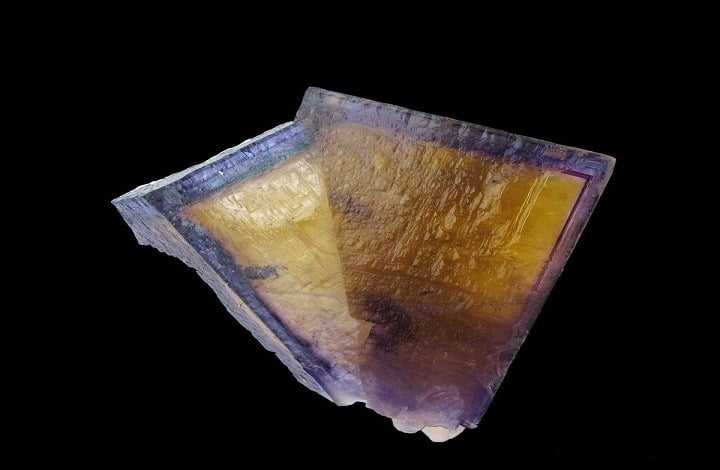
What Does Cleavage Actually Mean?
Inside a crystal, atoms are held together by bonds — and in some directions those bonds are weaker than others. Cleavage is the natural tendency of the crystal to split cleanly along these planes of weakness, producing smooth, flat surfaces. It is not the same as the way a gem is cut — cleavage is a natural structural property, while cutting is done by a person. (A gem with strong cleavage must be cut very carefully to avoid splitting.)
Cleavage Grades
Gemologists describe cleavage in five grades, from none to perfect:
| Grade | Meaning |
|---|---|
| None | No tendency to cleave (e.g. quartz) |
| Poor / Weak | Barely noticeable cleavage |
| Fair / Moderate | Cleaves with some effort, not always clean |
| Good / Imperfect | Cleaves fairly easily along planes |
| Perfect | Splits very easily into smooth, flat surfaces (e.g. topaz, diamond in certain directions) |
Gems with perfect cleavage — such as topaz and spodumene — need extra care during cutting, setting and daily wear, because a sharp knock in the wrong direction can split them.
Cleavage vs Fracture vs Parting
These three terms are often confused, so here’s the difference:
- Cleavage — breaking along the crystal’s natural planes of weakness (structural, predictable).
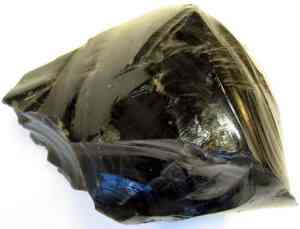
- Fracture — breaking in a non-cleavage direction, leaving an irregular surface. Types include:
- Fibrous / splintery — long, sharp, splinter-like points
- Hackly — jagged, torn points (as seen in metals)
- Uneven — rough surfaces without sharp points
- Parting — breaking along planes caused by an individual crystal’s growth or strain, not by its basic atomic structure (so it doesn’t occur in every specimen).
Can Cleavage Affect Jewellery Setting?
Yes. A gem with perfect or good cleavage is more vulnerable during setting and wear — pressure from prongs or an accidental knock can cause it to split along a cleavage plane. This is why jewellers handle stones like topaz with care, choose protective settings, and cut them at angles that avoid the cleavage direction. Understanding cleavage helps keep a gem safe for years.
Explore Gemstones at AstroKapoor
Choosing the right gemstone means understanding its beauty and its durability. Get a Vedic Gemstone Recommendation, get a Free Gemstone Recommendation, or Buy Certified Gemstones Online.
Frequently Asked Questions
What is gemstone cleavage?
Gemstone cleavage is the tendency of certain crystals to break along definite, flat planes where the atomic bonds are weakest, producing smooth surfaces. It is a natural structural property, not the same as how a gem is cut.
What are the grades of cleavage?
Cleavage is graded as none, poor (weak), fair (moderate), good (imperfect) and perfect. Perfect cleavage means the gem splits very easily along smooth, flat planes, as in topaz.
What is the difference between cleavage and fracture?
Cleavage is breaking along the crystal’s natural planes of weakness, giving smooth surfaces, while fracture is breaking in a non-cleavage direction, giving irregular surfaces such as fibrous, hackly or uneven breaks.
What is gemstone parting?
Parting is breakage along planes caused by an individual crystal’s growth or strain, rather than by its basic atomic structure. Unlike cleavage, it does not occur in every specimen of a mineral.
Which gemstones have perfect cleavage?
Topaz and spodumene have perfect cleavage, and diamond has cleavage in certain directions. These gems need careful cutting, setting and handling to avoid splitting.
