
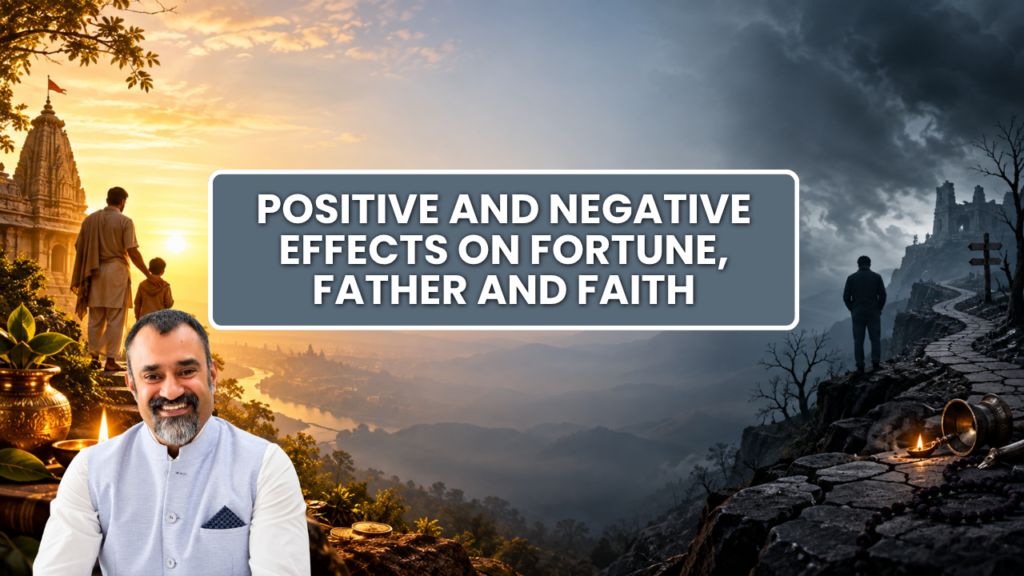
Some people carry an old kind of religiousness. Not the loud kind — they rarely argue about it. They were interested in these questions before anyone taught them to be. And underneath, very often, there is an unfinished conversation with their father that neither of them ever managed to have.
In Vedic astrology, that combination points to Ketu in the 9th house.
Among all twelve positions, this is the one traditional astrology speaks of most warmly. The Lal Kitab tradition counts it among Ketu’s exalted placements. The reasoning is simple: Ketu is the significator of moksha, and the 9th house is the house of dharma. They belong together.
The cost sits in the same house, and it is a real one.
What the 9th House Represents in Vedic Astrology
The 9th house is called Dharma Bhava and Bhagya Bhava — the house of righteousness and fortune. It governs:
• Luck, fortune and blessings carried from past karma
• The father and the father’s influence
• Gurus, mentors and teachers
• Religion, philosophy and personal belief
• Higher education and advanced study
• Long-distance travel, foreign residence and pilgrimage
• Ethics and the framework by which you judge right and wrong
• Publishing, teaching and law
It is a trikona — one of the three trine houses — and among the most auspicious positions in the chart.
For a deeper understanding of how the 9th house influences fortune, dharma and life direction, a detailed Financial Astrology Consultation can also help when financial decisions and fortune-related questions overlap.
Why This Is Ketu’s Natural Home
Ketu is the south node of the Moon, the body without a head. It signifies detachment, past-life completion, spirituality and moksha. Its flag marks a journey already finished.
The 9th house is where the chart records dharma and inherited merit. Ketu in a house means the soul has already done that work — so Ketu in the 9th house indicates a native who arrives with spiritual work already substantially complete. This is why the placement produces people who were drawn to philosophy, ritual or contemplation as children, without being taught.
Traditional readings treat this as one of Ketu’s best positions for exactly that reason.
The difficulty is that the 9th house also governs the father, formal religion and the ordinary machinery of luck. Detachment applied there is felt as distance from the father, disengagement from inherited faith, and a strange sense that fortune operates by rules other than effort.
With Ketu here, Rahu occupies the 3rd house of effort, courage and siblings — producing restless daily striving alongside spiritual completeness, which is an odd and often exhausting combination to carry.
Ketu in the 9th House: The Core Signature
Common patterns:
• Genuine spiritual inclination present from an early age
• Emotional or physical distance from the father
• Disengagement from the religion the native was raised in, without hostility toward it
• Travel undertaken for meaning rather than pleasure
• Disinterest in formal higher education despite real intellectual capacity
• A sense that luck arrives unasked and does not respond to being chased
• Difficulty accepting a guru, alongside real longing for one
Positive Effects of Ketu in the 9th House
Deep, natural spirituality
This is the placement’s defining gift and the reason it is regarded so highly. Contemplative practice, philosophy, ritual and inner enquiry come naturally. Many natives report an interest in these subjects that predates any exposure to them.
A personalised astrology consultation can help determine whether this spiritual inclination is supported by other planetary combinations in the birth chart.
Strong past-life merit
The 9th house is the account of accumulated dharma, and Ketu here indicates that account is substantial. Natives frequently find that help appears in genuine crises from directions they did not arrange.
Freedom from religious dogma
They are not bound by the framework they inherited, and they are also not reacting against it. That gives them an unusual ability to take what is true from several traditions without needing to defend any of them.
Pilgrimage and meaningful travel
Long journeys undertaken with spiritual purpose are strongly indicated, and these tend to be genuinely transformative rather than merely enjoyable.
Wisdom without formal credentials
They understand things they were never taught. In teaching, counselling and writing, this produces authority that does not depend on qualifications.
Ethical clarity
Ketu removes self-interest from moral judgement. These natives are frequently the person others go to precisely because they have nothing to gain from the advice they give.
Fortune that arrives without being chased
An unusual pattern, and a real one. Opportunity tends to appear when the native stops pursuing it. Many report that their best outcomes came from directions they had not been working toward.
For people whose professional growth depends on timing, leadership and decision-making, corporate astrology can provide a broader astrological perspective alongside the natal chart.
Negative Effects of Ketu in the 9th House
Distance from the father
The most consistently reported difficulty. It is rarely conflict. More often it is a father who was physically or emotionally absent, a relationship that never quite formed, or a framework that was never passed down. Health concerns affecting the father are also traditionally noted.
Loss of faith, or faith without warmth
Some natives disengage from religion entirely. Others continue the practices while feeling nothing in them. Both are Ketu’s emptiness applied to belief, and both can be genuinely painful to carry.
Disillusionment with gurus and teachers
The longing for a teacher is real, and so is the pattern of finding one, investing deeply, and then losing faith in them. This repeats until the native stops looking outward for the authority they already carry.
Disinterest in higher education
Formal advanced study frequently does not hold them. Degrees are left unfinished, and academic potential goes unconverted — not from lack of ability, but from lack of felt purpose.
Luck that feels absent
Because fortune here does not respond to effort in the normal way, natives often conclude they are unlucky. In practice, the mechanism is different rather than absent — but that distinction is hard to feel in the middle of a difficult decade.
When questions around money, investments or financial timing become important, stock market astrology may be considered as an additional astrological perspective rather than relying only on general interpretations of Ketu.
Restlessness from the other end
With Rahu in the 3rd house, the native pushes hard on daily effort, communication and short-term achievement while feeling internally that none of it matters. That tension is the axis’s central difficulty.
Detachment from the country or culture of origin
A sense of not belonging to one’s own tradition or homeland, often resolved by living elsewhere.
The emotional impact of detachment can also extend into close personal relationships. Where questions around emotional connection, marriage or relationship compatibility are involved, Love and Relationship Astrology can provide a more focused interpretation.
How the Sign Changes the Result
• Ketu in Sagittarius or Pisces in the 9th house — Jupiter’s signs. The most favourable version: genuine dharmic depth with warmth intact.
• Ketu in Scorpio — deepest mystical capacity; the most intense spiritual journey.
• Ketu in Virgo — mooltrikona; philosophical precision, well suited to teaching and writing.
• Ketu in Taurus — debilitated; the least comfortable version of this placement.
Jupiter’s condition is the decisive factor. Jupiter is the natural significator of dharma, guru and the 9th house itself. A strong, well-placed Jupiter converts this placement’s detachment into genuine wisdom and preserves the warmth in it. A weak Jupiter leaves the native spiritually able and emotionally cold.
The condition of the Sun matters equally, since it signifies the father.
When the Results Arrive
During Ketu Mahadasha — seven years — or Ketu Antardasha, natives commonly experience pilgrimage or meaningful travel, a significant shift in belief, turning points with the father, withdrawal from formal study, and a marked deepening of spiritual practice.
Jupiter’s transit over the 9th house is the classical trigger for fortune and dharmic development.
Remedies for Ketu in the 9th House
Serve and honour the father
This is the most directly targeted remedy for this placement. Care for him, contact him, and close the distance deliberately rather than waiting for the feeling to arrive first. Where the father is no longer living, performing Shraddh sincerely and observing ancestral rites is strongly prescribed — the 9th house connects directly to ancestral karma, and this is not a symbolic gesture in traditional practice.
Strengthen Jupiter
For this placement, Jupiter is the priority. Thursday worship, offering yellow items, lighting a ghee lamp, and chanting Om Gram Greem Graum Sah Gurave Namah all support the significator of dharma and preserve the warmth that Ketu tends to remove from belief.
Worship Lord Ganesha
The primary Ketu remedy. Chant Om Gam Ganapataye Namah daily.
Ketu mantra
Chant the Ketu Beej Mantra — Om Sram Sreem Sroum Sah Ketave Namah — 108 times daily.
Undertake pilgrimage deliberately
Because the 9th house governs sacred travel and Ketu governs moksha, pilgrimage undertaken as genuine practice rather than tourism is a remedy specifically suited to this placement — and one natives usually find they enjoy.
Do not keep discarding teachers
The pattern of finding a guru, investing, and losing faith is characteristic here. Where a teacher is genuinely sound, stay longer than the disillusionment suggests. Where they are not, leave without bitterness. Either way, recognise the pattern as the placement rather than as evidence about every teacher.
Charity and conduct
Donate multicoloured or grey blankets, sesame seeds and yellow items on Thursdays and Saturdays. Feeding stray dogs is Ketu’s classical remedy. Supporting religious education, temple maintenance, or a student’s higher study aligns directly with the 9th house.
Finish something you started
Because this placement disengages from formal study, deliberately completing one course — however small — breaks the pattern and usually restores confidence more than expected.
Gemstone — with a clear caution
Cat’s Eye (Lehsunia) is Ketu’s stone. Do not wear it without a chart reading. Ketu is already strong in the 9th house in most classical assessments, so amplifying it is often unnecessary. Strengthening Jupiter is generally the better route for this position.
Practical discipline
• Contact your father regularly regardless of how the conversation goes
• Keep some form of practice going even during periods when it feels empty
• Do not confuse detachment from religion with an absence of dharma
• Take one meaningful journey a year with an actual purpose behind it
What to Avoid
• Letting years pass without repairing the relationship with your father
• Abandoning practice entirely because the feeling has gone
• Concluding you are unlucky because effort is not producing results in the usual way
• Wearing Cat’s Eye on a generic recommendation
Get a Personalised Reading
Everything above describes the placement in general. Your chart is specific.
The same Ketu in the 9th house produces a genuinely wise, spiritually settled person in one horoscope, and in another someone drifting without a framework and estranged from their father. The difference lies in the sign, the condition of Jupiter and the Sun, the strength of the 9th lord, and the dasha currently running.
Get a complete Kundli and fortune analysis from our experienced Vedic astrologer — including what your 9th house actually promises, the timing of your fortune period, and the remedies your chart genuinely needs.
Also Read
Frequently Asked Questions
Is Ketu in the 9th house good or bad?
It is considered one of Ketu’s finest placements, and the Lal Kitab tradition counts it among its exalted positions. It grants deep natural spirituality, ethical clarity and strong past-life merit. The costs are distance from the father, disengagement from inherited faith, and a sense that ordinary luck does not respond to effort.
Why does Ketu in the 9th house affect the relationship with the father?
The 9th house signifies the father and the framework he transmits, and Ketu creates detachment in whatever it occupies. The result is usually absence rather than conflict — a relationship that never quite formed. Serving the father, or performing Shraddh where he has passed, is the most effective remedy for this placement.
Does Ketu in the 9th house make a person lose faith?
It commonly produces disengagement from inherited religion — not usually hostility, but an absence of felt meaning in the practices. Many natives later arrive at a genuine, self-found spirituality that is deeper than what they left. Keeping some form of practice going through the empty phase makes that transition easier.
Is Ketu in the 9th house good for spirituality?
It is among the best placements in the chart for it. Ketu is the significator of moksha and the 9th house is the house of dharma, so the two reinforce each other directly. Many natives show genuine spiritual inclination from childhood without any external influence.
Does Ketu in the 9th house affect higher education?
Frequently. Formal advanced study often fails to hold the native’s interest, and courses go unfinished — not through lack of ability but through lack of felt purpose. The underlying understanding is usually strong and finds its outlet in self-directed study.
Does Ketu in the 9th house mean bad luck?
Not exactly. Fortune under this placement operates differently — it tends to arrive unasked and to resist being chased. Natives often report that their best outcomes came from directions they were not pursuing. That feels like bad luck during effortful periods, but it is a different mechanism rather than an absence of one.
Which remedy works best for Ketu in the 9th house?
Honouring the father, including ancestral rites where he has passed, together with strengthening Jupiter on Thursdays. Support these with Ganesha worship, the Ketu Beej Mantra, and genuine pilgrimage.
🌟 Subscribe to AstroKapoor for insightful content on Astrology, Health, and Spiritual Well-being!
📺 YouTube: AstroKapoor Channel
🔮 Join Our Upcoming Webinar
👉 Register here: astrokapoor.com/webinar
🌐 Become a Channel Member for exclusive perks:
👉 Join Now
📞 Book Your Personalised Astrology Consultation:
🔗 Astrology Consultancy
📜 Order Your Custom Astrology & Numerology Report
📲 Contact: +91 9289205568
🔗 Purchase Report Online
💎 Buy 100% Authentic Gemstones
🌐 Visit: astrokapoor.net
📩 For enquiries: media.astrokapoor@gmail.com
🌐 Website: astrokapoor.com
🔔 Follow Prashant Kapoor for Daily Insights & Tips:
- 🐦 Twitter: @AstroKapoor
- 📘 Facebook: Prashant Kapoor
- 📸 Instagram: @pkapoor80
- 📸 Instagram (Official): @astrokapoorcom
🔢 Follow Akanksha Srivastava for Numerology Guidance:
- 📘 Facebook: Akanksha Srivastava
- 📸 Instagram: @akankshasri84
