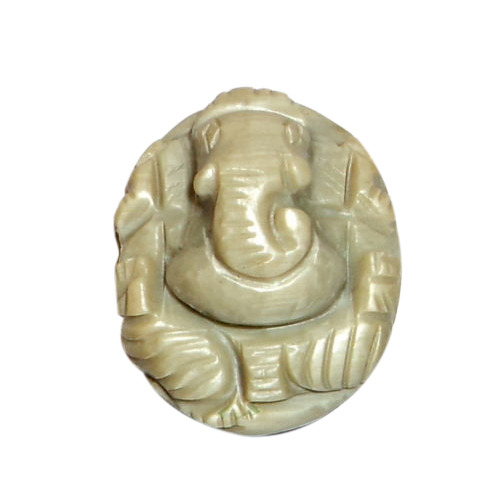
A Cat’s Eye Ganesha is the one idol in the gemstone Ganesha family where the stone and the deity belong to the same planet. Cat’s Eye is the ratna of Ketu. Lord Ganesha is Ketu’s presiding deity. Bringing the two together in a single carved murti is not a decorative choice — it is a coherent Ketu remedy you keep in your home rather than wear on your hand.
Ganesha Is the Presiding Deity of Ketu
Among the Navagraha, every planet has an adhidevata — a governing deity invoked when that planet needs to be pacified or strengthened. For Ketu, that deity is Lord Ganesha.
The connection runs deeper than convention. Ketu is the headless body of Svarbhanu, separated at the neck when the amrita was distributed — the same event that produced Rahu, his opposite node. Ganesha too was beheaded and given a new head, and emerged transformed rather than diminished. Ketu shows the head removed; Ganesha shows the head restored.
This is why Om Gam Ganapataye Namah is traditionally chanted before Ketu mantras, and why Ganesha worship is the classical starting point for anyone working with a difficult Ketu. Ganesha is Vighnaharta, the remover of obstacles, and Ketu is the planet most associated with sudden obstruction and confusion. The pairing is exact.
Understanding Ketu — Not Only Suffering
Ketu is a chhaya graha, a shadow planet with no physical body, and it is commonly described only in terms of what it takes away — sudden setbacks, confusion, detachment, losses that arrive without warning. During Ketu Mahadasha or a difficult Ketu placement, that experience is real.
But this is only half of Ketu. Ketu is also the moksha karaka — the strongest significator of spiritual liberation in the entire chart. A well-placed Ketu gives sharp intuition, detachment from what does not matter, mastery of occult and healing sciences, research ability, and genuine spiritual progress. Ketu does not simply obstruct; it removes what you were holding on to so that something truer can take its place.
A Cat’s Eye Ganesha is kept not to fight Ketu but to work with it — to soften the disorientation and keep the clarity.
Cat’s Eye — The Gemstone of Ketu
Cat’s Eye, known in Hindi as Lehsunia and in Sanskrit as Vaiduria, takes its name from the single bright band of light — chatoyancy — that moves across its surface as the stone turns, exactly like the slit pupil of a cat’s eye. Traditionally it is described as opaque and hot in constitution, and it is classified as the ratna of Ketu among the nine Vedic astrological gemstones.
In Vedic practice, the benefits of Cat’s Eye are associated with:
- Reducing the malefic effects of an afflicted Ketu
- Protection against sudden, unforeseen loss
- Sharper intuition and clearer discernment
- Courage and relief from persistent tension
- Freedom from over-analysis and mental circling
- Steadiness and renewed warmth in relationships
[Insert the actual material, colour, dimensions and weight of this idol here — for example: “This idol is carved in natural cat’s eye quartz, honey-brown with a distinct chatoyant band, 2.5 inches high, approx. 160 g.”]
Why an Idol Instead of a Ring — The Cat’s Eye Question Nobody Answers
This is the most important thing to understand before you buy, and almost no seller will tell you.
Cat’s Eye is the most heavily cautioned gemstone in the entire Vedic system. Classical practice requires a mandatory three-day trial before it is accepted. It is prescribed only when a Ketu Mahadasha or Antardasha is running. It is never worn lifelong. An unsuitable Cat’s Eye is traditionally said to bring exactly the isolation and disruption the wearer was trying to avoid — which is why the rules on who should wear Lehsunia are so strict, and why every responsible astrologer insists on a full horoscope reading first.
A murti is not a worn ratna. A gemstone worn against the skin is prescribed to channel a specific planetary energy directly into the wearer’s system — which is precisely why the trial period, the dasha timing and the suitability rules exist. An idol kept on a shelf carries none of that mechanism and none of that caution.
That means a Cat’s Eye Ganesha can be kept by anyone — no three-day trial, no waiting for a Ketu period, no ring, no risk of an unsuitable stone. And because Ganesha is Ketu’s adhidevata, the murti stands as a Ketu remedy in its own right, not merely as a substitute for one.
If you have been told your chart shows Ketu affliction but you have been advised against wearing Lehsunia — this is the remedy that remains open to you.
Ketu Remedies You Can Practise at Home
A Cat’s Eye Ganesha works best as the focal point of a simple, consistent practice rather than as an object kept alone:
- Chant Om Gam Ganapataye Namahbefore the idol, ideally 108 times
- The Ketu beej mantra — Om Sram Sreem Sraum Sah Ketave Namah— may follow the Ganesha mantra
- Light a sesame oil lamp, traditionally associated with the shadow planets
- Tuesdays and Chaturthi tithi are the traditional days for Ganesha worship
- Offer durva grass — Ganesha’s most classical offering — along with modak or laddoo
- Keep the space around the idol clean and uncluttered; Ketu responds to simplicity
None of this requires a horoscope, a consultation or an auspicious muhurta to begin. If you do want the planetary picture behind your Ketu period, a Vedic astrology consultation will tell you far more than any single object can.
Where to Place a Cat’s Eye Ganesha — Vastu Direction
The South-West (Nairutya) — for stability and consolidation
Place this Ganesha idol in the south-west corner of your home or main room. In Vastu, the south-west is Nairutya — the direction of earth element, weight and permanence. It governs stability, long-term relationships, retained wealth, and the ability to hold on to what has been built.
For a Ketu remedy this is a deliberate and fitting choice. Ketu’s difficulty is not weakness but instability — the sudden shift, the ground moving, the sense of losing hold. The north-east is the classical direction for prayer and new beginnings, and is a valid placement for a puja-room murti. But the south-west is the corner that anchors, and anchoring is exactly what an afflicted Ketu asks for. Place it here for growth and prosperity that holds, in both professional and personal life.
Other suitable placements
- Puja room, north-east — if the idol is for daily formal worship, alongside a sphatik Shivlingor other consecrated pieces
- Living room — on a stable surface at or above eye level
- Study or work desk — where Ketu’s scattering tends to show up as loss of focus
Avoid placing any Ganesha idol in a bathroom, on the floor, beneath a staircase, or facing directly out of the main door.
Caring for Your Cat’s Eye Ganesha
- Wipe with a soft, dry or barely damp cloth
- Never use detergent, acid, ultrasonic cleaners or abrasive polish
- Do not soak the idol for extended periods
- Keep away from prolonged direct sunlight
- Place on a stable, cushioned surface — carved stone chips if dropped
- Do not use this or any gemstone idol to prepare crystal elixirs or place it in drinking water
A Meaningful Gift for Ganesh Chaturthi and New Beginnings
A Cat’s Eye Ganesha is especially appropriate for:
- Ganesh Chaturthi— a permanent murti to keep alongside the clay idol
- Griha praveshand housewarmings
- A new business, shop or office— Ganesha is invoked before every venture
- Someone entering or completing a Ketu Mahadasha
- Researchers, healers, spiritual practitioners and occult students — Ketu’s own domain
If you are choosing between stones, the wider gemstone Ganesha collection includes the Crystal Ganesha, Blue Sapphire Ganesha for Saturn, the Hessonite Ganesha for Rahu, the Fluorite Ganesha for focus and study, and the Lemon Quartz Ganesha. A Ganesha Rudraksha is a further option for those who prefer a wearable form of the same devotion.
Frequently Asked Questions
Can I do a Ketu remedy without wearing Cat’s Eye?
Yes. Wearing Lehsunia requires a horoscope reading, a three-day trial and an active Ketu period. Keeping a Cat’s Eye Ganesha requires none of these. Because Ganesha is Ketu’s presiding deity, the murti combined with regular Ganesha mantra japa is a complete Ketu remedy on its own.
Which god should be worshipped for Ketu?
Lord Ganesha. Ganesha is Ketu’s adhidevata in the Navagraha system, and Ganesha worship is the classical first step for anyone with an afflicted Ketu. Lord Shiva is Ketu’s other traditional refuge.
Do I need an astrologer’s consultation before keeping this idol?
No. Consultation rules apply to worn gemstones, not to murtis. If you do want to know how Ketu sits in your chart and which remedies suit you personally, a gemstone recommendation or a full reading will tell you far more than any single object can. If your exact birth time is not known, a Prashna Kundli reading can still be done.
Is a stone Ganesha immersed at visarjan?
No. Visarjan applies to the temporary clay idol installed for the ten days of Ganeshotsav, made specifically to be returned to water. A gemstone Ganesha is a permanent murti — like a metal or marble idol, it stays in your home year after year.
What is the difference between the Cat’s Eye and Hessonite Ganesha?
Cat’s Eye is the gemstone of Ketu, the south node. Gomedh or Hessonite is the gemstone of Rahu, the north node. The two nodes always sit exactly opposite each other, so the choice depends on which node is active or afflicted in your chart.
Which direction should a Cat’s Eye Ganesha face?
Place it in the south-west (Nairutya) corner for stability, positioned to face into the room — ideally toward the north or east.
Is every idol identical?
No. Each is hand-carved from natural stone, so the chatoyant band, tone and grain of your piece will be unique to it.
For a full picture of your Ketu period and the remedies suited to it, explore our astrology services.


