

Almost everyone has read a horoscope column at some point. Far fewer people could explain what astrology actually is, where it came from, how a birth chart is calculated, or what a trained astrologer is really doing when they look at one. The gap between the popular image of astrology and the discipline itself is enormous, and most of the confusion around the subject lives inside that gap.
This guide is written to close it. It covers what astrology is and is not, how the system is built from the sky outward, the difference between the Vedic and Western approaches, how timing is calculated, what science says about the subject and how practitioners respond to it, and the spiritual framework that gives Jyotish its purpose in the Indian tradition. It also states plainly what astrology cannot do, because a guide that leaves that part out is not worth reading.
Whether you have never looked at a chart before or you already know your Moon sign and your current Mahadasha, you should finish this article with a clear working understanding of the subject.
What Is Astrology? A Working Definition

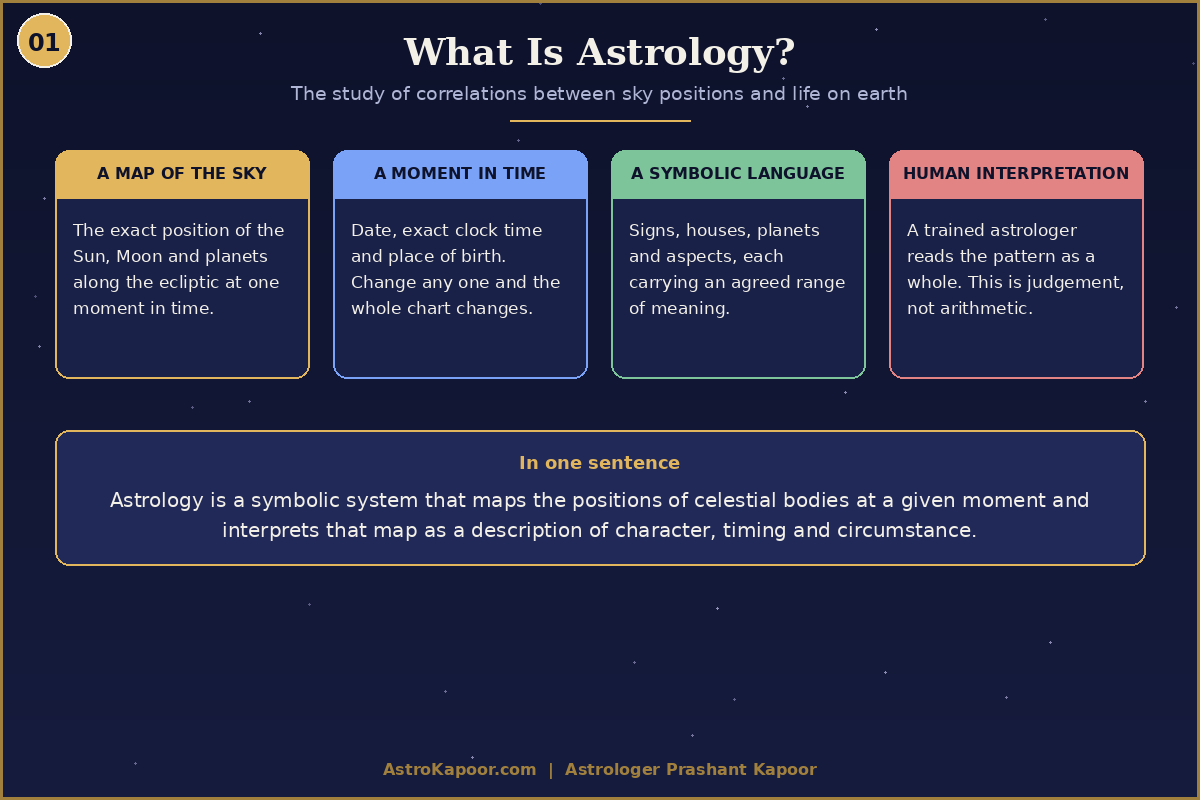
Astrology is the study of the relationship between the positions of celestial bodies and events on earth, particularly human life. It works by taking the exact positions of the Sun, Moon and planets at a specific moment, arranging them into a chart, and interpreting that chart according to an established symbolic system.
Four elements have to be present for something to count as astrology rather than folklore:
- A map of the sky. The measured positions of the celestial bodies along the ecliptic at one precise moment. This part is pure astronomy and is not in dispute.
- A moment in time. Date, clock time and geographic place. Change any one of these and the chart changes.
- A symbolic language. Signs, houses, planets, aspects and periods, each carrying an agreed range of meaning built up over centuries of recorded practice.
- Human interpretation. A trained reader who weighs the whole pattern rather than adding up isolated factors. This is judgement, and it is where two astrologers can differ.
Strip out any one of the four and what remains is not astrology. Sun-sign columns, for instance, keep the symbolic language but discard the moment in time, which is why they can only ever produce broad statements addressed to one twelfth of the world at once.
Astrology in one sentence
Astrology is a symbolic system that maps the positions of celestial bodies at a given moment and interprets that map as a description of character, timing and circumstance.
What astrology is not
It is not fortune telling in the sense of stating what will definitely happen. It is not a religion, and it is not the property of any single faith. It is not the same thing as tarot, numerology, palmistry or vastu, though many practitioners work across several of these. And it is not a substitute for medicine, law or financial planning. An astrologer who behaves otherwise is exceeding what the discipline actually claims.
Astrology and Astronomy: The Difference That Confuses Most People
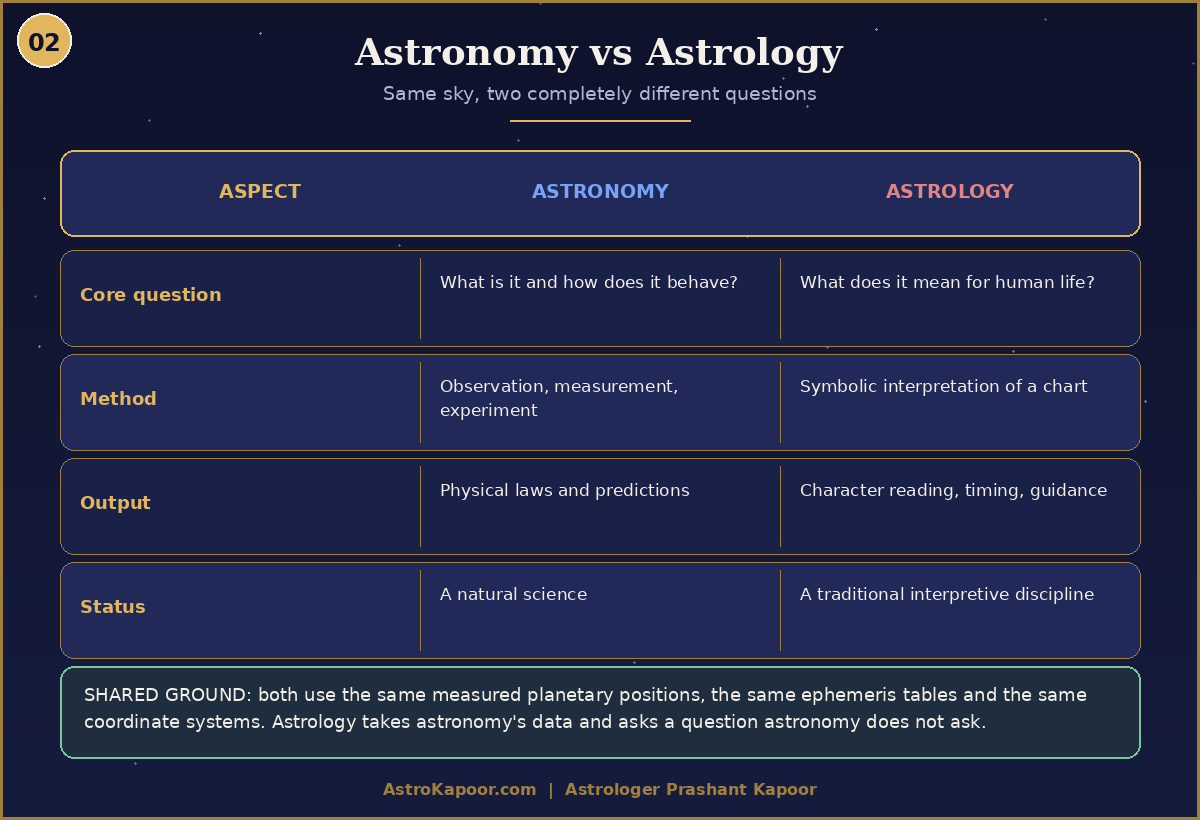
For most of recorded history the two were a single field. The person who tracked Jupiter’s motion was the same person who interpreted it. They separated during the scientific revolution, and today they ask fundamentally different questions of the same sky.
Astronomy asks what a celestial object is and how it behaves. It answers through observation, measurement and experiment, and it produces physical laws. Astrology asks what a configuration of the sky means for human life. It answers through symbolic interpretation of a chart, and it produces character readings, timing and guidance.
The two still share a great deal of technical ground. Astrology uses astronomy’s ephemeris data, its coordinate systems and its understanding of precession. A correctly cast chart is astronomically accurate. The disagreement between the fields is not about where the planets are; it is about whether their positions carry meaning.
Where Astrology Came From: A Short History
Astrology is not a modern invention or a twentieth-century revival. It is one of the oldest continuously practised intellectual traditions on earth, and knowing its history explains a great deal about why its different branches look so different today.
Mesopotamia: the first sky records
Systematic sky-watching begins in Mesopotamia. Babylonian scribes kept celestial diaries for centuries, recording planetary positions alongside events such as harvests, floods, wars and the fortunes of kings. This early astrology was mundane rather than personal, concerned with the state rather than the individual. The division of the ecliptic into twelve equal signs is a Babylonian achievement, and it survives in every system used today.
Vedic India: the birth of Jyotish
In India the tradition developed as Jyotish, literally the science of light, and it was formalised as one of the six Vedangas, the auxiliary disciplines attached to the Vedas. Its distinguishing feature is the nakshatra system, the division of the zodiac into twenty-seven lunar mansions, which is older than the twelve-sign division in Indian usage and remains central to Vedic practice. Classical texts such as the Brihat Parashara Hora Shastra, the Brihat Jataka of Varahamihira and the Jaimini Sutras still form the working syllabus of a traditional Indian astrologer.
Hellenistic Greece and Egypt
Around the second century BCE, Babylonian technique met Greek geometry and Egyptian calendar science in Alexandria. The result was horoscopic astrology as we now recognise it: a chart cast for an individual birth, with an ascendant, twelve houses and aspects measured in degrees. Ptolemy’s Tetrabiblos, written in the second century CE, systematised this material and remained the standard reference in the West for more than a thousand years.
The Islamic world and medieval Europe
After the decline of the classical world, Greek and Indian astrological texts were preserved, translated and considerably extended by scholars in the Islamic world. Figures such as Al-Biruni and Abu Ma’shar wrote works that later returned to Europe through Arabic-to-Latin translation, where astrology was taught in universities alongside medicine and mathematics well into the Renaissance.
The modern period
Astrology lost its academic standing in Europe during the seventeenth and eighteenth centuries as the sciences professionalised. It never lost its place in India, where it remained continuously practised. The twentieth century brought two developments that shaped the present picture: newspaper Sun-sign columns, which made a highly simplified version of astrology universally familiar, and computer calculation, which removed the mathematical barrier that had always limited who could cast a chart.
The Building Blocks: How a Birth Chart Is Actually Made
A birth chart is not drawn by intuition. It is calculated. Every element in it corresponds to a measurable astronomical fact, and understanding those elements is what separates reading astrology from guessing at it. A properly cast handmade birth chart is built from the components below, in roughly this order.
The ecliptic and the twelve signs
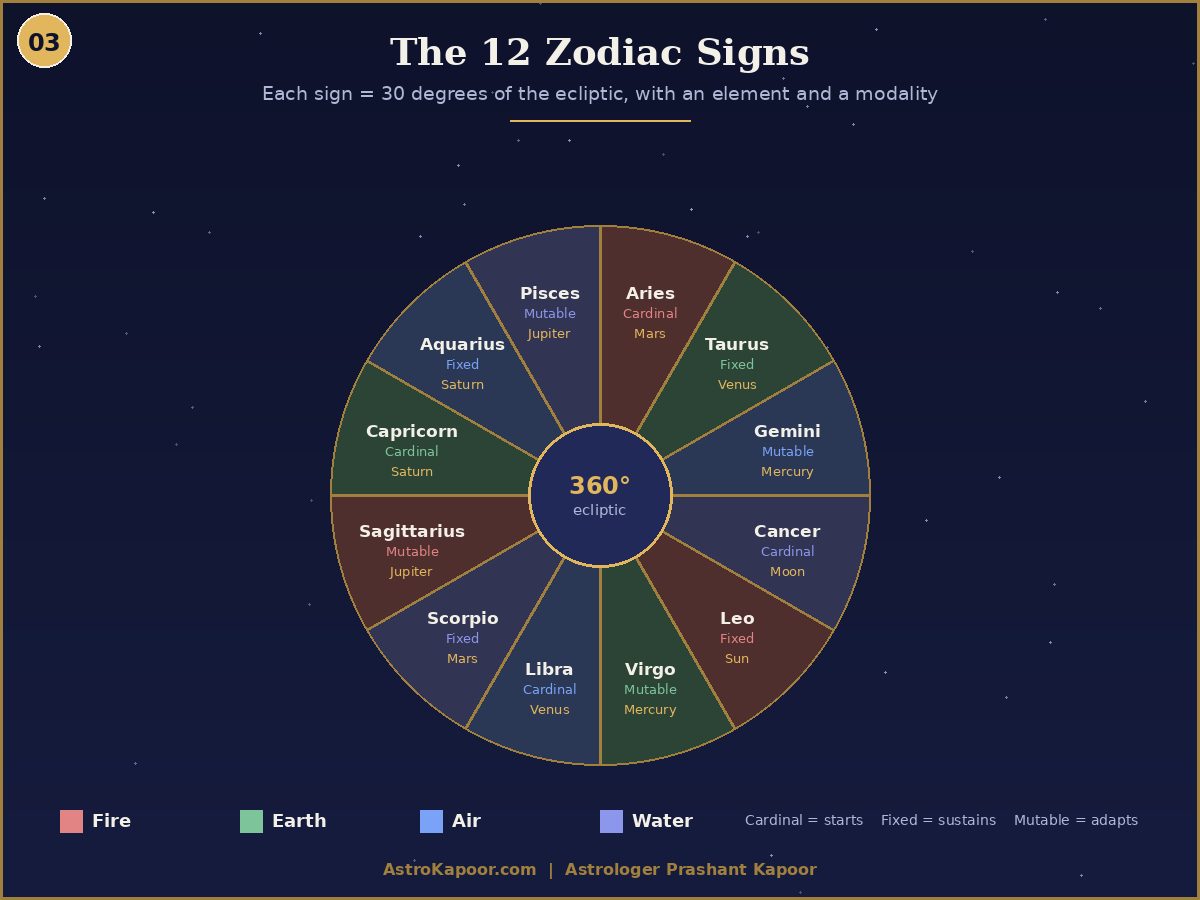
The ecliptic is the apparent path the Sun traces against the background sky over a year. Astrology divides that circle of 360 degrees into twelve equal segments of 30 degrees each: the signs of the zodiac. Every planetary position is expressed as a longitude along this circle.
Each sign carries three classifications that do most of the interpretive work:
- Fire, earth, air or water, describing the basic temperament of the sign.
- Cardinal signs initiate, fixed signs sustain and mutable signs adapt.
- Ruling planet. Each sign has a graha that governs it, which links the sign network to the planetary network.
A common misunderstanding is that the signs are constellations. They are not. They are equal 30-degree divisions of the ecliptic. The constellations that share their names are irregular in size and no longer line up with them, which is a point we return to when discussing the sidereal and tropical zodiacs.
The twelve houses
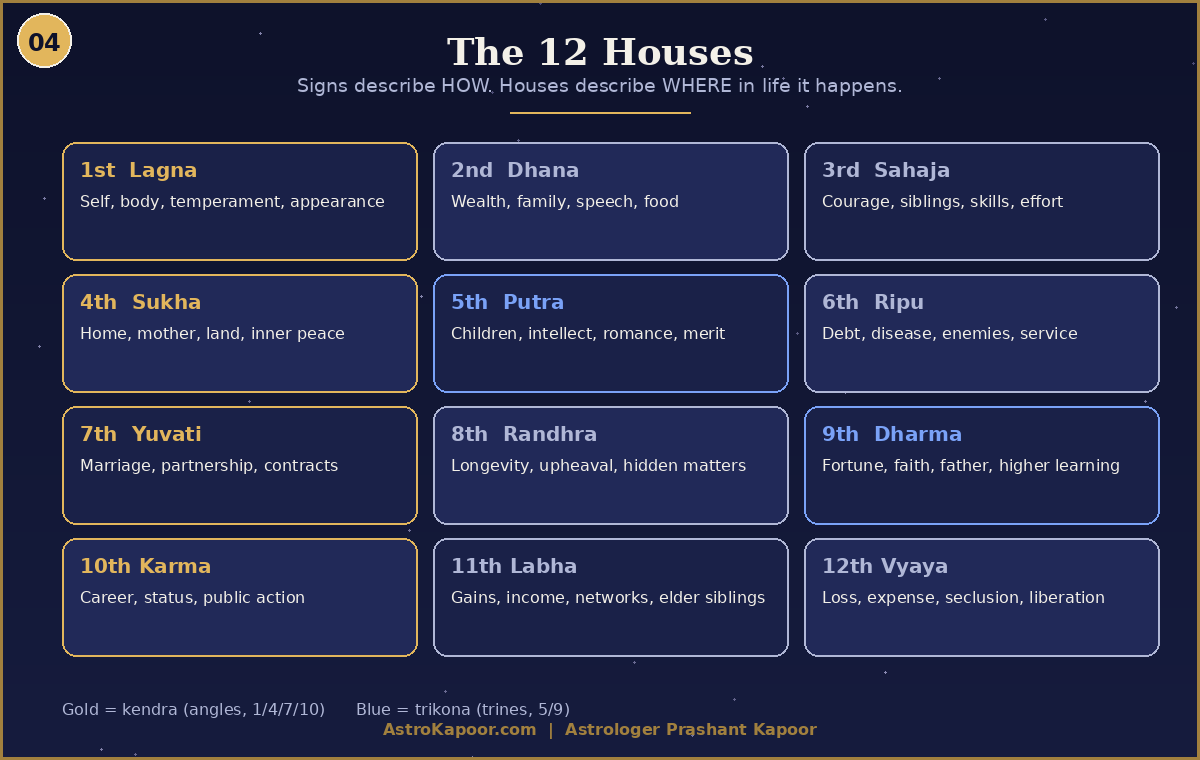
If signs describe how something expresses itself, houses describe where in life it happens. The twelve houses divide the chart into fields of experience: body and self, wealth and family, courage and siblings, home and mother, children and intellect, debt and disease, marriage and partnership, upheaval and longevity, fortune and faith, career and public standing, gains and networks, and finally loss, expense and liberation.
Two groupings matter more than the rest. The kendras, houses one, four, seven and ten, are the angular houses and carry the most weight in a chart. The trikonas, houses one, five and nine, are the trines and are considered the most auspicious. A planet’s strength depends heavily on which of these it occupies.
The nine grahas
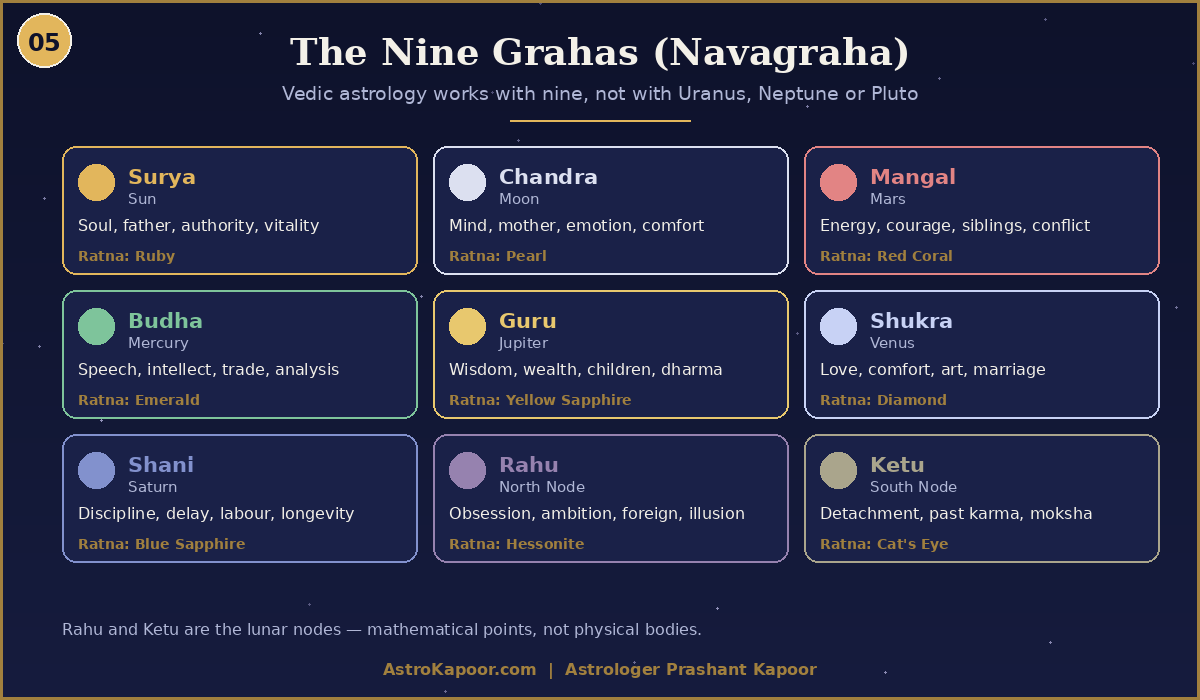
Vedic astrology works with nine grahas: the Sun, Moon, Mars, Mercury, Jupiter, Venus, Saturn, Rahu and Ketu. It does not use Uranus, Neptune or Pluto, which is one of the sharpest technical differences from Western practice. Rahu and Ketu are not physical bodies at all but the north and south lunar nodes, the two points where the Moon’s orbit crosses the ecliptic and where eclipses occur.
Each graha carries a stable set of significations. The Sun stands for the soul, the father and authority; the Moon for the mind, the mother and emotional life; Mars for energy and conflict; Mercury for speech and analysis; Jupiter for wisdom, expansion and dharma; Venus for love, comfort and art; Saturn for discipline, delay and endurance; Rahu for ambition and obsession; Ketu for detachment and past karma.
Interpretation depends on far more than which sign a planet sits in. An astrologer weighs its dignity, whether it is exalted, debilitated or in its own sign; its house placement; the house it rules; the planets it is joined with or aspected by; and its condition in the divisional charts. Any of these can reverse the reading of the others, which is why single-factor astrology is unreliable.
The ascendant, and why birth time matters so much
The ascendant, or lagna, is the sign and degree rising on the eastern horizon at the exact moment of birth. It defines the first house and therefore fixes the entire house framework of the chart. Because the earth rotates once a day, the ascendant moves through the whole zodiac every twenty-four hours, changing sign roughly every two hours.
This is why birth time is the single most important piece of data you can supply. An error of a few minutes usually does little. An error of two hours can shift the ascendant to the next sign and move every planet into a different house, producing a chart that describes a different life. Where the time is genuinely unknown, an astrologer can attempt birth time rectification by working backwards from dated life events, or can use a Prashna Kundli reading cast for the moment the question is asked instead.
Aspects, or drishti
Planets do not only affect the house they sit in. They also cast drishti, a gaze, onto other houses. In Vedic astrology every planet aspects the seventh house from itself. Mars additionally aspects the fourth and eighth, Jupiter the fifth and ninth, and Saturn the third and tenth. This is how influence travels across a chart, and it explains how a planet in one corner can materially affect an area of life on the opposite side.
The twenty-seven nakshatras
[ INSERT IMAGE 08 ] 08-27-nakshatras-lunar-mansions-vedic-astrology.png Alt text: The 27 nakshatras or lunar mansions of Vedic astrology with their ruling planets
The nakshatras divide the same 360-degree circle into twenty-seven lunar mansions of 13 degrees and 20 minutes each, tracking the Moon’s daily movement rather than the Sun’s annual movement. Each has a ruling graha, a symbol and a distinct character, and each is further divided into four padas.
Two things make them indispensable in Vedic work. The nakshatra occupied by the Moon at birth, the janma nakshatra, is what starts the dasha timing system. And nakshatra positions drive the Gun Milan scoring used in kundali matching, which is why traditional Indian matchmaking looks so different from Western compatibility astrology.
Yogas and planetary combinations
A yoga is a defined combination of planets, houses or signs that classical texts associate with a particular result. Raja yogas indicate rise in status, dhana yogas indicate wealth, and there are hundreds of named combinations in the literature, alongside difficult ones such as Kemadruma or Kala Sarpa.
Two cautions apply here, and reputable practice observes both. First, most yogas are far more common than popular writing suggests, and a chart containing an impressive-sounding yoga is not thereby remarkable. Second, a yoga only delivers if the planets forming it are actually strong and if the relevant period is running. The presence of a combination on paper is the beginning of the analysis, not the conclusion.
Divisional charts, or vargas
Beyond the main birth chart, Vedic astrology subdivides each sign to produce additional charts that magnify specific areas of life. The most used are the D9 or Navamsa for marriage and the underlying strength of a planet, the D10 or Dashamsha for career, the D7 for children and the D4 for property. A planet that looks strong in the main chart but collapses in the divisional chart is treated as weaker than it first appeared, which is exactly the kind of check that distinguishes a full reading from a superficial one.
Tropical and Sidereal: Why You May Have Two Different Sun Signs
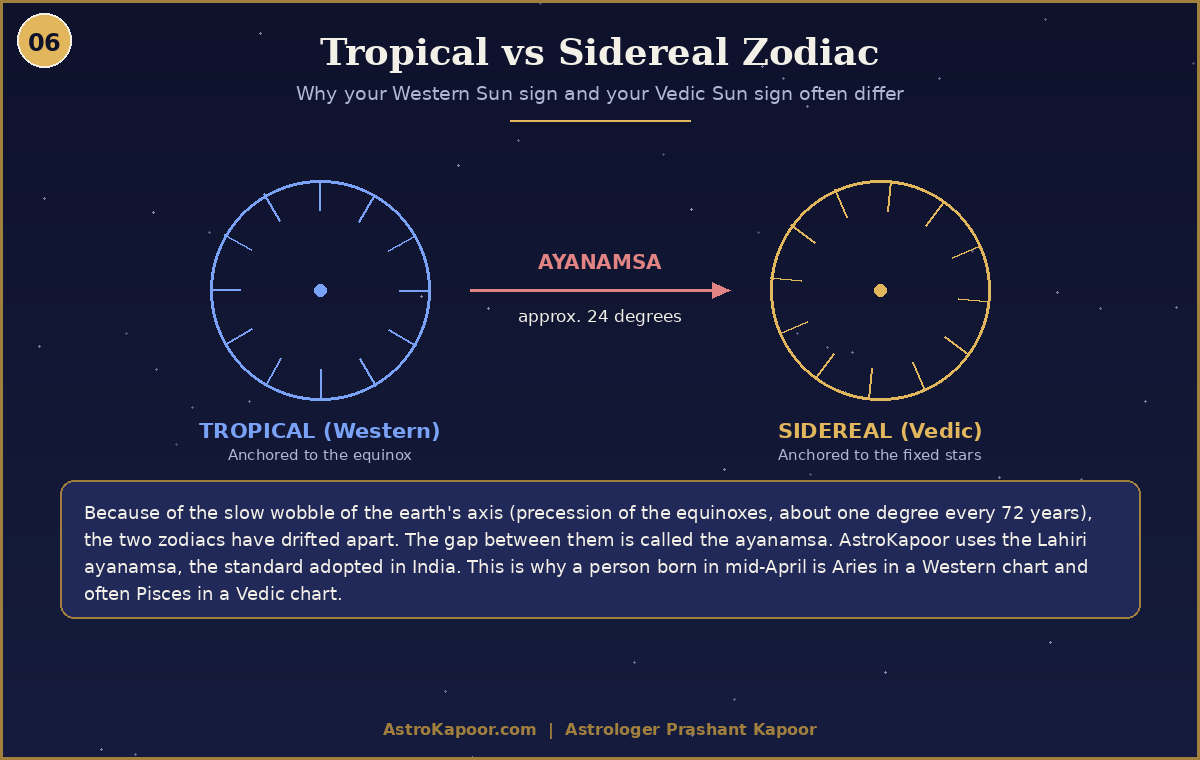
This is the technical difference that surprises most newcomers, and it accounts for the majority of confused questions about Vedic astrology.
The tropical zodiac, used in Western astrology, anchors zero degrees Aries to the March equinox. It is tied to the seasons. The sidereal zodiac, used in Vedic astrology, anchors the zodiac to the fixed stars.
These two starting points once coincided, roughly two thousand years ago. They no longer do, because the earth’s axis wobbles slowly in a cycle of about 25,800 years, a motion called the precession of the equinoxes, which shifts the equinox point backwards by roughly one degree every seventy-two years. The accumulated gap between the two zodiacs is called the ayanamsa, and it currently stands at approximately twenty-four degrees.
The practical consequence is that a Vedic chart usually places the planets about one sign earlier than a Western chart does. Someone born in mid-April is an Aries in a Western reading and frequently a Pisces in a Vedic one. Neither system has made an arithmetic error. They are measuring from different reference points, and each is internally consistent. AstroKapoor uses the Lahiri ayanamsa, the value officially adopted in India, across all Vedic astrology services.
Anatomy of a Birth Chart
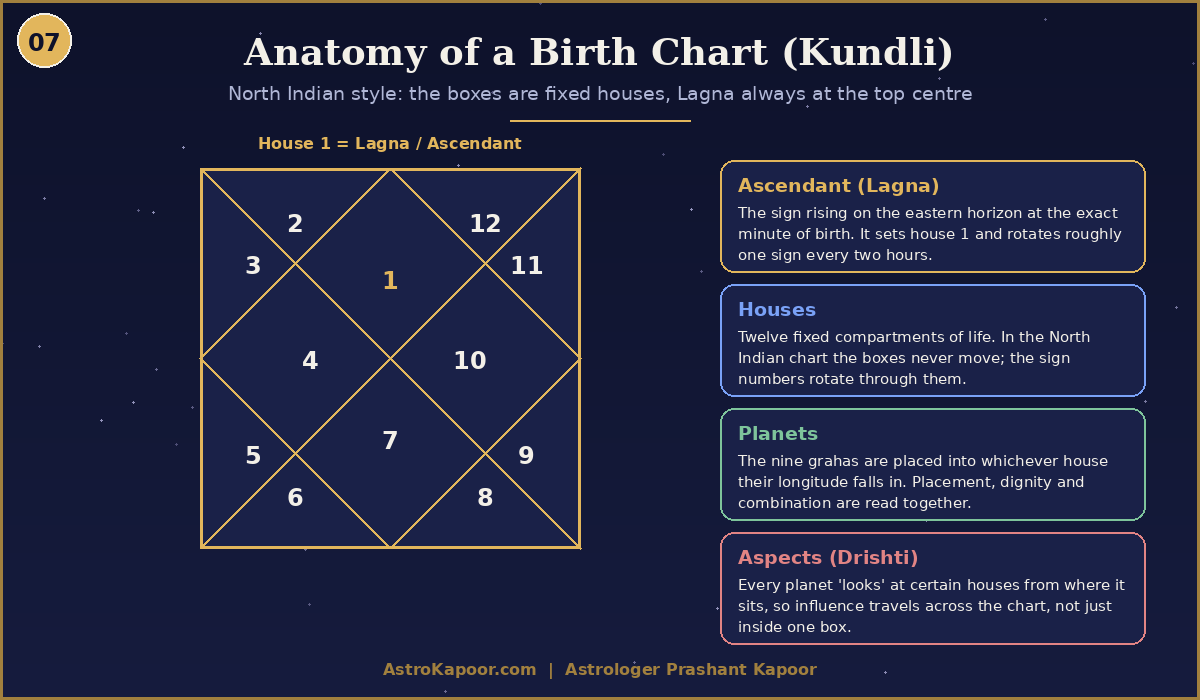
Indian charts are drawn in two common visual styles, and they contain identical information despite looking nothing alike. In the North Indian diamond format, the house positions are fixed on the page and the sign numbers rotate through them, with the first house always at the top centre. In the South Indian square format, the sign positions are fixed and the houses rotate. A South Indian chart is read clockwise; a North Indian chart is read anticlockwise.
When an astrologer looks at a chart, the reading sequence is broadly consistent: identify the ascendant and its lord, assess the condition of the Moon, locate the strong and weak planets, examine the house that corresponds to the client’s question along with its lord, check the relevant divisional chart, and only then look at which dasha period is running and what the current transits are doing. A unique birth chart prediction follows that same order rather than jumping straight to conclusions.
How Astrology Handles Timing
Description is the easier half of astrology. Timing is the harder half, and it is where Vedic astrology differs most usefully from the Western tradition.
The Vimshottari Dasha system
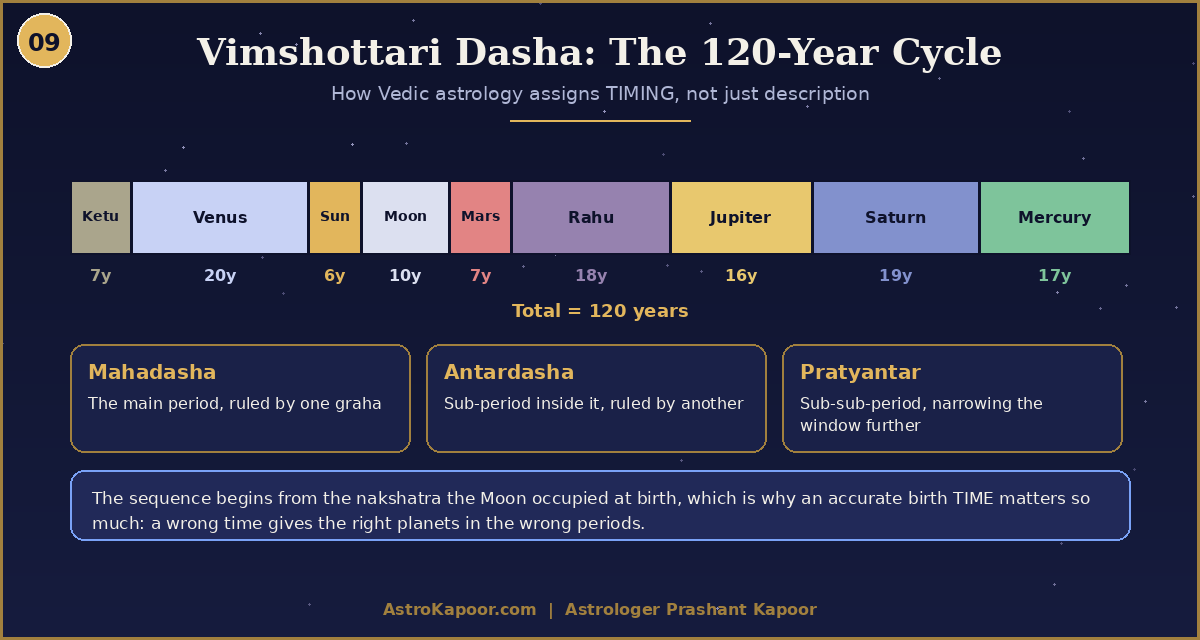
Vimshottari is the principal timing method in Vedic astrology. It divides a notional 120-year lifespan into nine consecutive planetary periods called Mahadashas: Ketu seven years, Venus twenty, Sun six, Moon ten, Mars seven, Rahu eighteen, Jupiter sixteen, Saturn nineteen and Mercury seventeen. The sequence begins at the point determined by the Moon’s nakshatra at birth, which is why an accurate birth time is not optional.
Each Mahadasha subdivides into Antardashas ruled by the other grahas, and those subdivide again into Pratyantardashas. This nesting is what allows an astrologer to narrow a forecast from a period of years to a window of weeks. The governing principle is straightforward: a planet tends to deliver its results during its own periods. A well-placed Jupiter may sit quietly in the chart for decades and then become highly active when its Mahadasha begins.
Transits and Sade Sati
Transits, or gochar, are the current real-time positions of the planets read against the birth chart. They are treated as a secondary layer over the dasha rather than as the main driver. The most discussed transit in Indian astrology is Sade Sati, the roughly seven-and-a-half-year passage of Saturn through the sign before, the sign of, and the sign after the natal Moon.
Sade Sati has a fearsome popular reputation that the classical literature does not fully support. It is traditionally read as a period of pressure, responsibility and consolidation rather than of guaranteed misfortune, and its actual effect depends heavily on Saturn’s condition in the birth chart. Any astrologer who uses the phrase primarily to alarm you and sell an expensive remedy is not reading your chart, and this is worth remembering before agreeing to any Navgraha Yagya or comparable ritual measure.
Why timing is the honest test
Character descriptions are easy to accept because they are hard to falsify. Timing statements are not. When an astrologer says a difficult professional stretch runs from one date to another, the claim is checkable. This is precisely why serious practitioners spend most of their effort on dasha analysis, and why you should expect specific date ranges rather than vague reassurance from a career astrology report or a financial reading.
The Main Branches of Astrology
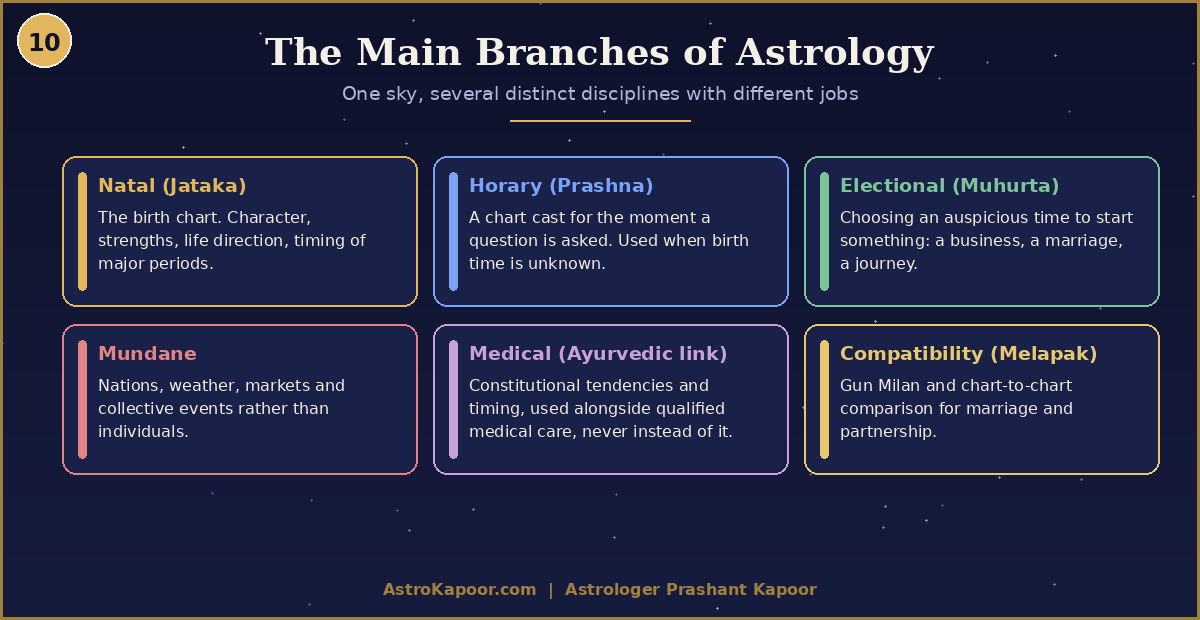
Astrology is not a single activity. It comprises several distinct disciplines with different methods and different jobs, and confusing them is a common source of disappointment.
- Natal astrology, or Jataka. The birth chart. Character, capacity, life direction and long-range timing. This is what most people mean by astrology.
- Horary astrology, or Prashna. A chart cast for the exact moment a question is asked, used when birth data is missing or when a single specific question needs an answer.
- Electional astrology, or Muhurta. Selecting an auspicious time to begin something: a marriage, a business launch, a property registration, a journey.
- Mundane astrology. The chart of nations, seasons, markets and collective events rather than individuals.
- Medical astrology. Constitutional tendencies and vulnerable periods. In responsible practice a medical astrology reading sits alongside qualified medical care and never in place of it.
- Compatibility astrology, or Melapak. Chart-to-chart comparison for marriage and partnership.
- Financial and business astrology. Timing and capacity questions applied to enterprise, investment and cash flow.
A single practitioner may work across several of these, but the techniques genuinely differ. A business astrology prediction and a medical astrology consultation are not the same reading with different labels attached.
Vedic, Western and KP: Three Systems Compared
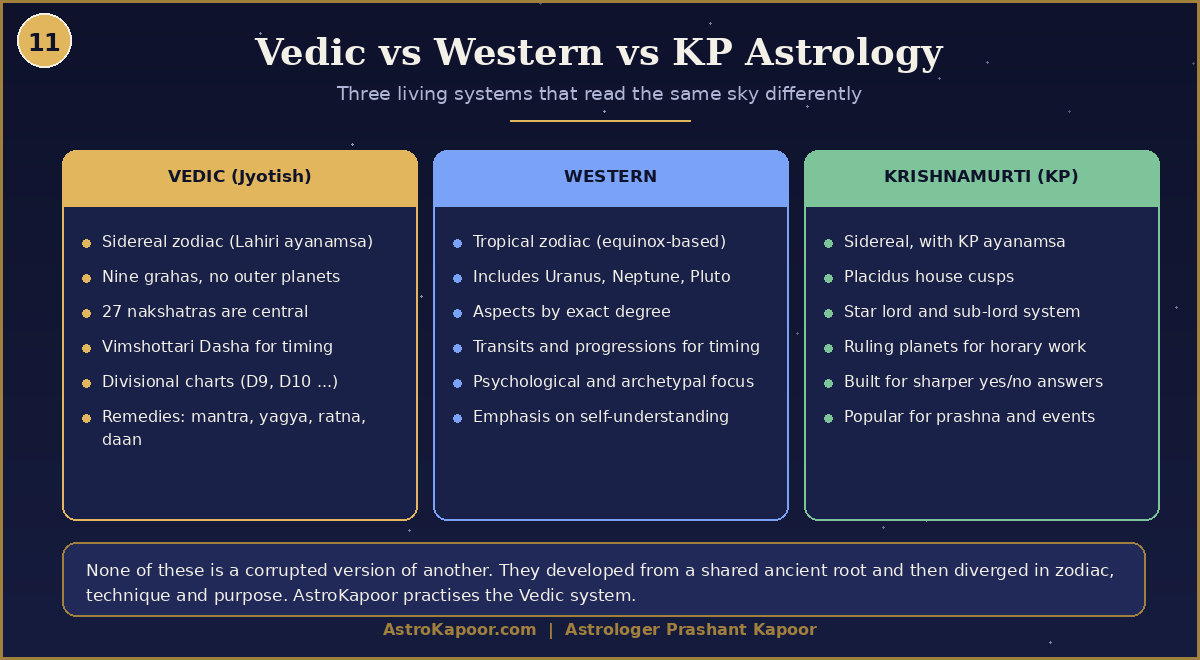
These three systems are the ones a reader in India is most likely to encounter. They share an ancient common ancestry and then diverge in zodiac, technique and emphasis. None is a degraded version of another.
Vedic astrology, or Jyotish, uses the sidereal zodiac with the Lahiri ayanamsa, works with nine grahas, treats the twenty-seven nakshatras as central, times events primarily through Vimshottari Dasha, cross-checks through divisional charts, and carries a well-developed system of remedial measures.
Western astrology uses the tropical zodiac, includes Uranus, Neptune and Pluto, measures aspects by exact degree, times events through transits and progressions, and since the twentieth century has leaned strongly toward psychological and archetypal interpretation rather than concrete prediction.
The Krishnamurti Paddhati, or KP system, developed in twentieth-century India, is sidereal like Vedic astrology but uses the Placidus house division and adds the star lord and sub-lord framework. It was designed to produce sharper, more decisive answers to specific questions and is especially popular for horary work.
A reasonable way to choose between them is by what you want. If you want a psychological portrait, Western astrology is well developed for that. If you want dated periods, remedial guidance and the framework used in Indian tradition, Vedic astrology is the appropriate system. AstroKapoor practises Vedic astrology, and an Online astrologer on this site will read your chart within that tradition.
The Logical Side: What Can and Cannot Be Claimed
A guide that only presents the favourable case is not a guide. This section states the objections to astrology fairly, gives the responses that practitioners actually make, and marks the boundary that honest practice observes.
The mechanism problem
The most fundamental objection is that there is no known physical mechanism by which a planet’s position could influence an individual life. Gravitational and electromagnetic effects from distant planets on a human body are vanishingly small, far smaller than those of nearby objects. Astrology has no accepted answer to this in physical terms.
The traditional response is that astrology does not claim a causal force at all. The classical position, expressed in the Hermetic formula “as above, so below” and in the Indian understanding of rita, cosmic order, is that celestial and terrestrial patterns correspond because they are part of one ordered whole. The sky is read as a clock and a map rather than as a cause. A clock does not make it three o’clock. Whether that reframing is philosophically satisfying is a fair question, but it is the argument that is actually made.
The empirical objections
Several distinct criticisms are worth stating clearly:
- Controlled studies. The best-known test is Shawn Carlson’s 1985 double-blind study published in Nature, in which astrologers failed to match natal charts to personality profiles at better than chance. Several meta-analyses have reached similar conclusions.
- The Barnum effect. People readily accept vague, broadly flattering descriptions as accurate portraits of themselves, a tendency demonstrated repeatedly since Bertram Forer’s 1948 experiment. Much popular astrology writing is vulnerable to this.
- Because the constellations no longer align with the tropical signs, the sign labels used in Western astrology no longer correspond to the visible star groups.
- Twins and time twins. Individuals born minutes apart in the same location share nearly identical charts yet frequently lead very different lives.
- Confirmation bias. Predictions that land are remembered and repeated; those that miss are quietly forgotten.
How practitioners respond
The responses that carry weight are technical rather than dismissive. On controlled studies, practitioners note that most trials test simplified factors such as Sun sign against standardised personality inventories, which is not what a working astrologer does; a chart is read as an integrated whole and a fair test would need to test that. On precession, the Vedic tradition’s answer is that it uses the sidereal zodiac precisely because it tracks the fixed stars, which is why the ayanamsa exists at all. On twins, the traditional reply points to divisional charts, where small differences in birth time separate, and to the fact that identical charts have never been claimed to produce identical lives, since the same chart is understood to operate on different circumstances of family, country and prior karma.
It is worth being straightforward about the status of these responses. They are reasonable arguments within the tradition. They have not produced the kind of controlled, replicated evidence that would establish astrology as a science, and no responsible practitioner should claim otherwise.
Where the honest line falls
What can reasonably be said is this. Astrology is a coherent symbolic system with a long documented history, an internally consistent technical structure and a genuine capacity to give people a frame for reflection and decision-making. Many people find that frame useful. What cannot be said is that it has been scientifically validated, or that any chart guarantees any outcome.
Both halves of that statement matter. Overstating astrology’s claims is what damages it; understating what it offers ignores why it has survived for three thousand years across every major civilisation.
The Spiritual Side: Karma, Dharma and the Purpose of Jyotish
In the Indian tradition astrology is not primarily a predictive service. It sits inside a larger philosophical framework, and that framework determines both what a chart is understood to show and what a reading is supposed to achieve.
Jyotish means light
The Sanskrit word Jyotish derives from jyoti, light. It is classified as one of the six Vedangas, the auxiliary limbs of Vedic study, and is traditionally described as the eyes of the Vedas, the limb by which time itself is measured. Its original function was calendrical and ritual: determining the correct moment for observances. Personal prediction grew out of that function rather than the other way round.
The three karmas, and where free will lives
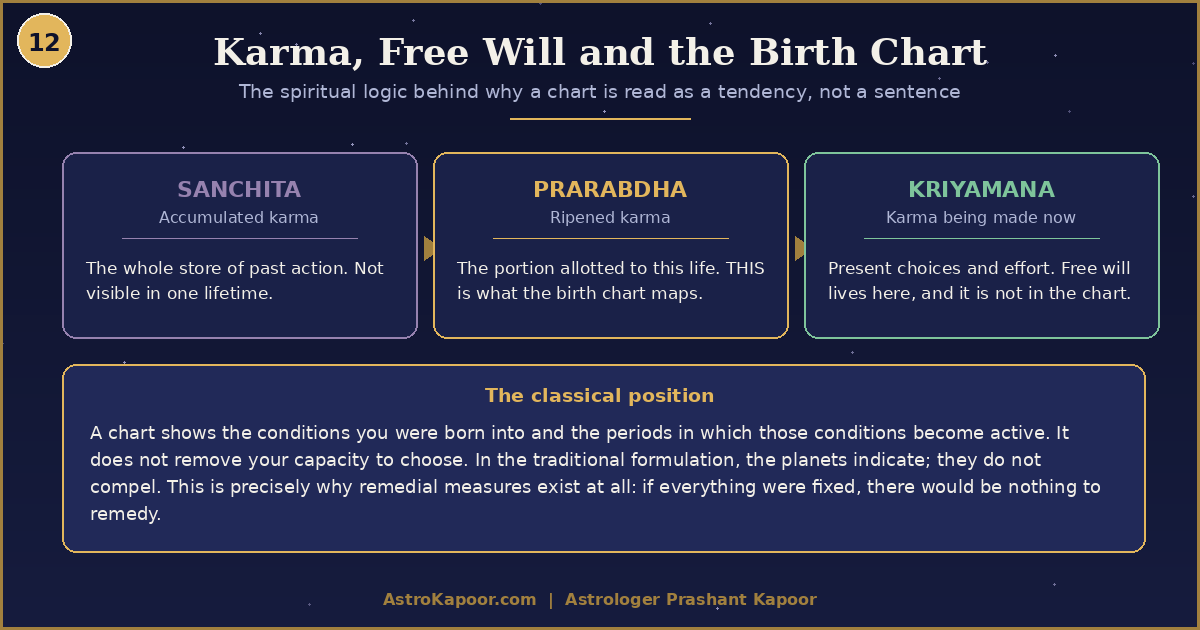
The framework rests on a threefold division of karma. Sanchita karma is the entire accumulated store of past action. Prarabdha karma is the portion of it that has ripened and been allotted to the present life. Kriyamana karma is what you are generating right now through present choice and effort.
The birth chart is understood to map prarabdha karma, the allotted portion. It does not map kriyamana karma, because kriyamana karma has not happened yet and is being made by you as you live. This is the traditional resolution of the free-will problem: the chart shows the conditions you were born into and the periods in which those conditions become active, not the decisions you will make within them.
The classical formulation is that the planets indicate, they do not compel. This is not a modern softening. It is the reason remedial measures exist at all. If everything were fixed there would be nothing to remedy, and the entire remedial literature of the tradition would be incoherent.
Dharma and the four aims of life
Classical Indian thought organises human purpose into four aims: dharma, right conduct and purpose; artha, material security; kama, legitimate desire and enjoyment; and moksha, liberation. The twelve houses map directly onto these, in a repeating pattern of dharma, artha, kama and moksha across houses one to twelve. Read this way, a chart is a description of how a person is configured to pursue all four aims, and a reading that only addresses money and marriage is using a quarter of the instrument.
What remedies are actually for
Vedic remedial measures fall into recognised categories: mantra, the repetition of sound; daan, charitable giving; ratna, the wearing of gemstones associated with a graha; vrata and upvas, observances and fasts; and yagya or homa, the fire ritual. AstroKapoor’s yagyas and anushthan section covers the last of these in detail.
Their traditional purpose is worth understanding properly, because it is widely misrepresented. Remedies are described as strengthening a weak planet, pacifying an afflicted one, or building the discipline and attention of the person performing them. They are not transactions that purchase a specified result, and the tradition does not present them as such. A remedy that requires escalating payments, that is presented as the only thing preventing disaster, or that is aimed at influencing another person’s will, has left the tradition entirely. That last case matters: no legitimate Vedic remedy is designed to override another person’s free choice.
What Astrology Can and Cannot Do
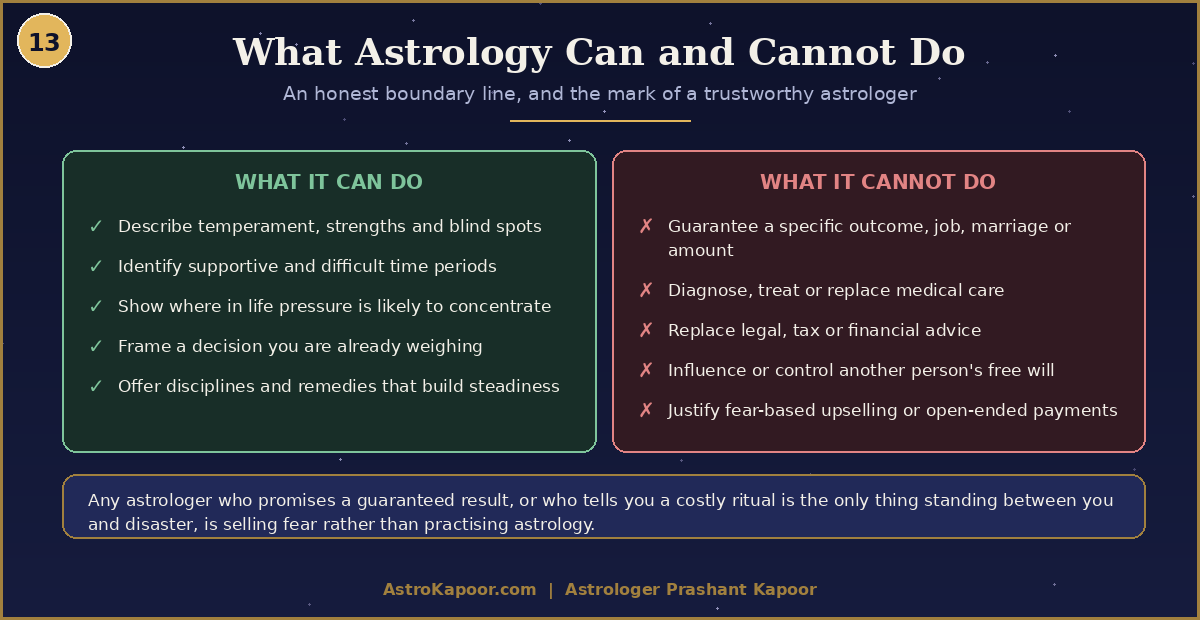
This is the most practically useful section of the article, and it is also the clearest test of whether an astrologer is worth consulting.
Astrology can describe temperament, natural strengths and blind spots. It can identify periods that are likely to be supportive and periods that are likely to be demanding. It can show where in a life pressure tends to concentrate. It can give structure to a decision you are already weighing. And it can offer disciplines and observances that build steadiness during difficult stretches.
Astrology cannot guarantee a specific outcome, whether that is a job, a marriage, a court verdict or an amount of money. It cannot diagnose or treat illness and must never be used in place of medical care. It cannot replace legal, tax or financial advice. It cannot control another person’s free will, and any service that claims to is both unethical and outside the tradition. And it cannot justify fear-based upselling or open-ended payment demands.
If you take one thing from this article, take this: an astrologer who promises a guaranteed result, or who tells you that a costly ritual is the only thing standing between you and catastrophe, is selling fear rather than practising astrology.
A Beginner’s Order for Reading Your Own Chart
If you want to start reading your own chart rather than only having it read to you, the sequence below is the one most traditional teachers use. Work through it slowly and resist the temptation to jump ahead.
- Find your ascendant and its ruling planet, then locate where that ruler sits. This alone tells you a great deal.
- Find the Moon: its sign, its house and its nakshatra. In Vedic astrology the Moon carries far more weight than the Sun.
- Note which houses are occupied and which are empty. Empty houses are read through their lord, not ignored.
- Identify the strongest and weakest planets by dignity and placement before looking at anything else.
- Look up your current Mahadasha and Antardasha, then read the condition of those two planets specifically.
- Only after all of that, check the Navamsa and the transits.
The most common beginner error is reading a single factor in isolation, seeing something alarming and concluding the worst. Almost every difficult indication in a chart is modified by something else. Reading one line of a chart is like reading one line of a medical report: it is genuinely uninformative on its own.
How an Astrology Consultation Actually Works
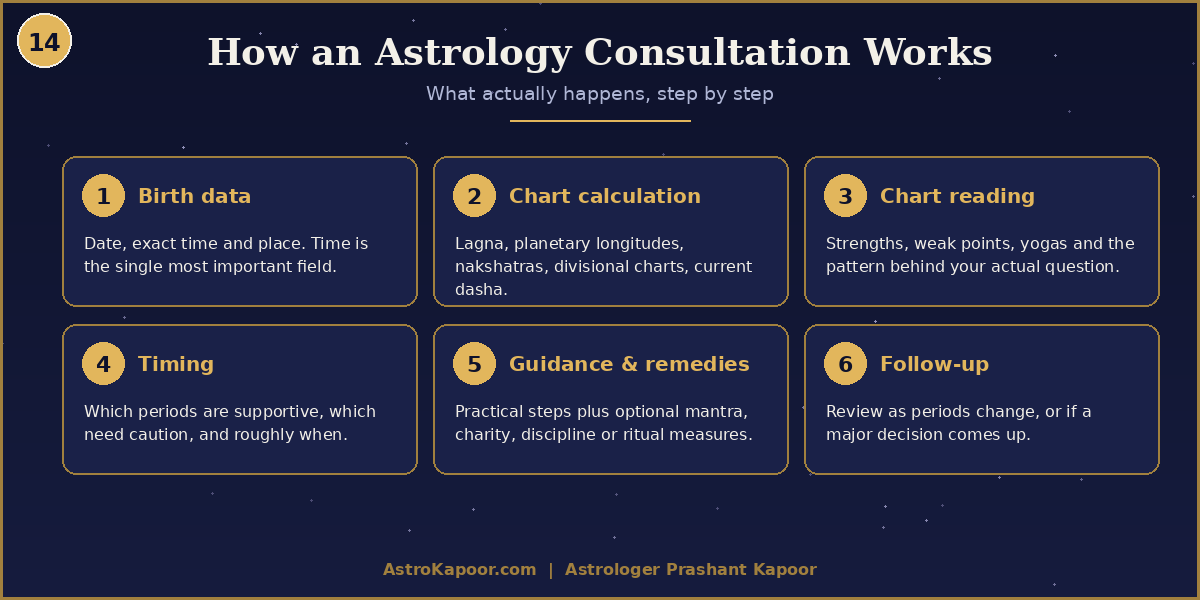
A first consultation is often approached with some apprehension, usually because people are unsure what will be asked of them or what they will be told. The process is more ordinary than expected.
You provide your date of birth, your birth time as precisely as you can establish it, and your place of birth. The astrologer calculates the ascendant, the planetary longitudes, the nakshatra positions, the relevant divisional charts and the current dasha sequence. They then read the chart as a whole before addressing your specific question, whether that concerns career, marriage, health, property or business. Timing follows: which periods look supportive, which need caution, and approximately when. Guidance and any remedial suggestions come last, and a follow-up may be advised when a major period changes.
You can bring an unformed question. “Something feels stuck and I don’t know what” is a legitimate starting point and often more productive than a narrow yes-or-no query. If you want to try the process before committing, an Astrology consultancy session is the usual starting point, and specific reports such as a marriage timing prediction or a finance report can follow once you know which area you want examined.
How to Choose an Astrologer
The quality of astrological advice varies enormously, and the difference is not subtle. These are the signals worth attending to.
Encouraging signs: the astrologer asks for your exact birth time and cares about its accuracy; explains their reasoning in terms of the chart rather than issuing pronouncements; distinguishes what is likely from what is certain; states clearly what falls outside their scope, particularly medical, legal and financial matters; quotes a fixed fee before the consultation; and gives you the space to disagree.
Warning signs: guaranteed outcomes; refusal to explain how a conclusion was reached; a diagnosis of curses, black magic or possession offered within minutes of meeting you; a remedy priced dramatically higher than a consultation; escalating charges as the problem is described as worsening; discouragement from seeking medical or legal help; and any offer to influence, bind or control another person.
Credentials in this field are informal, so judge by conduct, by the clarity of the reasoning and by whether the practitioner is willing to say “I don’t know.” You can read about the background and approach of Astrologer Prashant Kapoor before booking anything, which is a reasonable step to take with any practitioner.
Common Myths About Astrology, Corrected
A few persistent misconceptions are worth clearing up directly.
- “Astrology says everything is fixed.” It does not. The tradition’s own position is that planets indicate rather than compel, and the entire remedial literature depends on that being true.
- “Your Sun sign is your chart.” It is one of dozens of factors, and in Vedic astrology the Moon and ascendant usually carry more weight.
- “There is a thirteenth sign.” Ophiuchus is a constellation that the ecliptic passes through. The zodiac is a set of twelve equal 30-degree divisions and has never been a list of constellations.
- “Manglik dosha ruins a marriage.” It is one factor among many in compatibility analysis, it has recognised cancellation conditions in the classical texts, and it is routinely overstated.
- “Astrology and religion are the same thing.” Astrology is a technical discipline practised by people of every faith and of none.
- “Gemstones work for anyone.” In Vedic practice a ratna is prescribed against a specific chart. Wearing a stone because it is attractive or because it helped someone else is not how the system is meant to be used.
Where to Go From Here
If this article has answered the question you arrived with, that is a good outcome on its own. Astrology is worth understanding whether or not you ever consult anyone about it, and a reader who now knows what an ascendant is and why birth time matters is in a considerably better position than one relying on a Sun-sign column.
If you want to see your own chart properly cast and read, that is the natural next step. AstroKapoor has been offering Vedic readings for clients in India and abroad for many years, working within the traditional system described above and holding to the boundaries described above as well. Start with a Vedic matchmaking assessment if marriage compatibility is your concern, a career or business astrology prediction if your question is professional, or simply an open consultation if you are not sure yet.
Frequently Asked Questions
What is astrology in simple words?
Astrology is the study of how the positions of the Sun, Moon and planets at a particular moment relate to events and character on earth. An astrologer records those positions as a chart and interprets the chart using an established symbolic system of signs, houses, planets and time periods.
Is astrology a science?
Astrology is not a science in the modern sense. It has not produced controlled, replicated evidence of the kind the sciences require, and there is no known physical mechanism for the effects it describes. It is more accurately called a traditional interpretive discipline: it has a rigorous technical structure, a documented history of several thousand years and an internally consistent method, but it does not meet the standard of scientific validation, and any practitioner claiming otherwise is overstating the case.
What is the difference between astrology and astronomy?
Astronomy is the physical science of celestial objects; it asks what they are and how they behave. Astrology asks what their positions mean for human life. Both use the same measured planetary data and the same coordinate systems, but they ask different questions and use different methods to answer them.
What is the difference between Vedic and Western astrology?
The largest difference is the zodiac. Vedic astrology uses the sidereal zodiac, anchored to the fixed stars, while Western astrology uses the tropical zodiac, anchored to the equinox. The two are currently about twenty-four degrees apart, which is why your Vedic Sun sign is often one sign earlier. Vedic astrology also uses nine grahas rather than including Uranus, Neptune and Pluto, relies heavily on the twenty-seven nakshatras, and times events through the Vimshottari Dasha system.
Why is my Vedic Sun sign different from my Western one?
Because of the precession of the equinoxes. The earth’s axis wobbles in a cycle of roughly 25,800 years, which moves the equinox point backwards by about one degree every seventy-two years. The two zodiacs coincided around two thousand years ago and have drifted apart since. The gap is called the ayanamsa. Neither system is miscalculating; they measure from different reference points.
How accurate does my birth time need to be?
As accurate as you can reasonably establish. The ascendant changes sign roughly every two hours, and the ascendant sets the entire house structure of the chart. A few minutes of error is usually tolerable, but an error of an hour or more can shift every planet into a different house. If your birth time is unknown, an astrologer can attempt rectification from dated life events, or can work from a Prashna chart cast for the moment you ask your question.
What are the nine grahas in Vedic astrology?
The Sun, Moon, Mars, Mercury, Jupiter, Venus, Saturn, Rahu and Ketu. Rahu and Ketu are not physical planets but the north and south lunar nodes, the points where the Moon’s orbit crosses the ecliptic. Vedic astrology does not use Uranus, Neptune or Pluto.
What is a dasha and why does it matter?
A dasha is a planetary period. In the Vimshottari system a notional 120-year lifespan is divided into nine consecutive Mahadashas, each ruled by one graha and each subdividing into smaller periods. Dashas matter because they are how Vedic astrology assigns timing: a planet tends to deliver its results during its own period, so the same chart produces different emphases at different stages of life.
What is Sade Sati and should I be worried about it?
Sade Sati is the period of approximately seven and a half years during which Saturn transits the sign before your natal Moon, the sign of your natal Moon, and the sign after it. Its popular reputation is considerably worse than the classical texts support. It is traditionally read as a period of increased responsibility, pressure and consolidation, and its actual effect depends on Saturn’s condition in your birth chart. It is not a guarantee of misfortune.
Can astrology predict the future?
Not in the sense of stating what will definitely happen. It can identify periods that are likely to be supportive or demanding and describe the kind of themes those periods tend to bring. It cannot guarantee specific events, and predictions phrased as certainties should be treated with suspicion regardless of who is making them.
Does astrology mean I have no free will?
No, and the tradition itself says so. The birth chart is understood to map prarabdha karma, the portion of past action allotted to this life. It does not map kriyamana karma, which is what you are creating now through your own choices. The classical formulation is that the planets indicate but do not compel. If everything were fixed, remedial measures would make no sense.
Do gemstones and remedies actually work?
Within the tradition, remedies are described as strengthening a weak planet, pacifying an afflicted one, or building discipline and attention in the person performing them. They are not presented as transactions that purchase a guaranteed outcome, and there is no scientific evidence for gemstone effects. If you choose to use them, use them as a supportive practice, prescribed against your actual chart, and never as a substitute for medical treatment, legal advice or practical action. Be very cautious of any remedy that costs far more than a consultation or is described as the only thing preventing a disaster.
Is Manglik dosha a serious problem for marriage?
It is one factor among many, and it is routinely overstated. Manglik dosha refers to Mars occupying certain houses from the ascendant, Moon or Venus. The classical texts list a number of conditions under which it is considered cancelled or neutralised, including when both partners have it. It should be assessed as part of a full compatibility analysis rather than treated as a verdict on its own.
What are nakshatras and how are they used?
The nakshatras are twenty-seven lunar mansions, each spanning 13 degrees and 20 minutes of the zodiac, tracking the Moon’s daily motion. The nakshatra occupied by the Moon at birth determines where your Vimshottari Dasha sequence begins, and nakshatra positions are the basis of the Gun Milan scoring used in traditional Indian matchmaking.
Can astrology tell me about my health?
Medical astrology describes constitutional tendencies and periods of possible vulnerability. It cannot diagnose a condition, identify a disease or prescribe treatment, and it must never delay or replace consulting a qualified doctor. Any astrologer who offers to cure a medical condition, or who advises you against medical care, should be avoided entirely.
How long does it take to learn astrology?
The basic vocabulary of signs, houses and planets can be learned in a few weeks. Reading a chart with reasonable competence takes years of study and a great deal of practice with real charts, because the difficulty lies in weighing many factors against each other rather than in memorising meanings. Most serious students work under a teacher for a considerable period before reading for anyone else.
Which is better, Vedic or Western astrology?
Neither is better in the abstract; they answer different questions. Western astrology has developed a rich psychological and archetypal vocabulary and is well suited to self-understanding. Vedic astrology has a far more developed timing apparatus and a formal system of remedial measures, which makes it better suited to dated forecasting and traditional guidance. Choose according to what you actually want from a reading.
Do I need to believe in astrology for a reading to be useful?
No. Many people approach a consultation as a structured way of thinking through a situation from an unfamiliar angle, without any commitment to the underlying claims. A competent astrologer will not require belief from you, and a reading that only works if you already agree with it is not worth much.
About the Author
This guide was prepared by the editorial team at AstroKapoor and reviewed by Astrologer Prashant Kapoor, who has practised Vedic astrology for clients across India, the United Kingdom, the United States, the UAE and Singapore. AstroKapoor offers natal chart analysis, compatibility assessment, career and business guidance, muhurta selection and traditional remedial services, working within the classical Vedic framework described in this article.
Editorial policy: AstroKapoor does not guarantee outcomes, does not offer services intended to influence another person’s free will, and does not present astrological guidance as a substitute for medical, legal or financial advice.
Disclaimer
This article is provided for informational and educational purposes. Astrology is a traditional interpretive discipline and is not a recognised science. Nothing here should be taken as medical, psychological, legal or financial advice. If you are dealing with a health condition, a legal matter or a financial decision, please consult a qualified professional in that field. If you are experiencing significant distress, please reach out to a doctor, a mental health professional or someone you trust.
🌟 Subscribe to AstroKapoor for insightful content on Astrology, Health, and Spiritual Well-being!
📺 YouTube: AstroKapoor Channel
🔮 Join Our Upcoming Webinar
👉 Register here: astrokapoor.com/webinar
🌐 Become a Channel Member for exclusive perks:
👉 Join Now
📞 Book Your Personalised Astrology Consultation:
🔗 Astrology Consultancy
📜 Order Your Custom Astrology & Numerology Report
📲 Contact: +91 9289205568
🔗 Purchase Report Online
💎 Buy 100% Authentic Gemstones
🌐 Visit: astrokapoor.net
📩 For enquiries: media.astrokapoor@gmail.com
🌐 Website: astrokapoor.com
🔔 Follow Prashant Kapoor for Daily Insights & Tips:
- 🐦 Twitter: @AstroKapoor
- 📘 Facebook: Prashant Kapoor
- 📸 Instagram: @pkapoor80
- 📸 Instagram (Official): @astrokapoorcom
🔢 Follow Akanksha Srivastava for Numerology Guidance:
- 📘 Facebook: Akanksha Srivastava
- 📸 Instagram: @akankshasri84
