
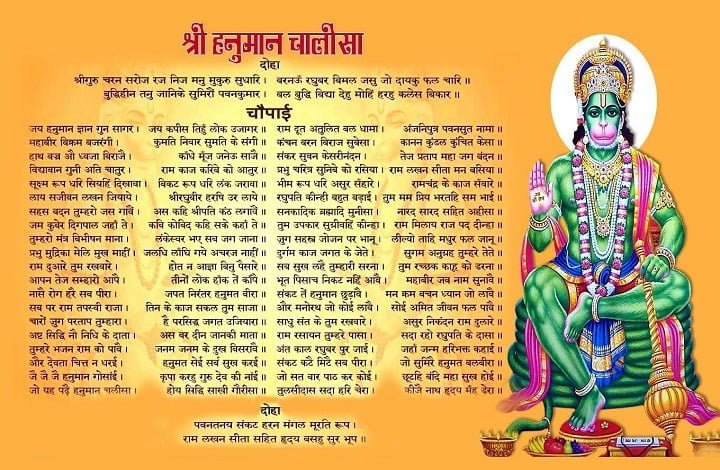
Benefits of Reciting Hanuman Chalisa
The Hanuman Chalisa is one of the most widely recited devotional hymns dedicated to Lord Hanuman. It is traditionally attributed to Goswami Tulsidas and consists of forty verses praising Hanuman’s strength, wisdom, devotion to Lord Rama and protective qualities.
The word Chalisa refers to forty, reflecting the forty main verses of the composition. Devotees recite it while seeking courage, devotion, mental strength and spiritual protection.
Traditional Hanuman Chalisa benefits include overcoming fear, strengthening faith, developing confidence and finding spiritual support during challenging situations. These benefits should be understood within Hindu devotional tradition rather than as guaranteed supernatural or medical outcomes.
Spiritual Significance of Hanuman Chalisa
Lord Hanuman represents devotion, courage, strength, humility, wisdom and selfless service. The Hanuman Chalisa describes his dedication to Lord Rama and recalls important episodes connected with his role in the Ramayana.
Several verses themselves describe Hanuman as a source of strength and protection for devotees. The Chalisa includes traditional references to protection from fear and suffering and to overcoming difficult circumstances.
Reciting the hymn can therefore become a spiritual practice centred on courage, discipline and devotion.
Best Time to Recite Hanuman Chalisa
Hanuman Chalisa can be recited whenever a devotee is able to pray with concentration and sincerity.
Many devotees prefer:
- Early morning after bathing
- Evening prayer
- Before sleeping
- Tuesday
- Saturday
- During periods of personal difficulty
Tuesday is widely associated with Hanuman worship, while Saturday is also important in traditions connecting Hanuman devotion with Shani or Saturn.
There is no requirement that every devotee must follow exactly the same time or number of repetitions. Regular devotion and concentration are generally considered more important than rigid counting.
Hanuman Chalisa on Tuesday
Tuesday is traditionally considered an auspicious day for Lord Hanuman worship. Devotees may visit a Hanuman temple, recite the Chalisa, chant Hanuman mantras or offer prayers.
From an astrological perspective, Tuesday is associated with Mars or Mangal, a planet traditionally linked with courage, strength and action. Hanuman worship is also commonly included among spiritual practices connected with Mars.
Regular Tuesday recitation may therefore be used as a devotional practice for developing determination, courage and self-control.
Hanuman Chalisa, Saturn and Sade Sati
Hanuman worship is also popularly associated with relief from difficulties traditionally connected with Shani or Saturn.
In Vedic Astrology, Sade Sati refers to a period associated with Saturn’s transit around the natal Moon. People following astrological traditions may recite Hanuman Chalisa on Saturdays while seeking courage, patience and spiritual protection during this period.
It is common to encounter recommendations for repeating Hanuman Chalisa several times on Saturday. However, specific prescriptions such as chanting it exactly eight times are devotional or astrological practices and should not be presented as a universal rule contained in the Hanuman Chalisa itself.
Main Hanuman Chalisa Benefits
1. Courage and Fearlessness
Lord Hanuman is a symbol of extraordinary courage and strength. Devotees may recite Hanuman Chalisa when facing fear, uncertainty or challenging situations.
Regular prayer can also serve as a reminder to respond to difficulties with discipline rather than panic.
2. Confidence and Inner Strength
Traditional belief associates Hanuman worship with greater confidence and determination.
The Chalisa repeatedly praises Hanuman’s strength, wisdom and devotion, providing devotees with an inspiring spiritual model of courage combined with humility.
3. Peace and Positive Thinking
Recitation involves repetition, concentration and focused prayer. For devotees, this may create a peaceful spiritual routine and provide time away from distracting thoughts.
The hymn should not be promoted as a medical treatment for anxiety, depression or other mental-health conditions, but prayer can remain meaningful as part of a person’s spiritual life.
4. Spiritual Protection
Hanuman Chalisa traditionally contains verses associated with protection from fear, adversity and negative influences.
For example, its devotional tradition describes remembrance of Hanuman as offering protection and helping devotees overcome difficulties.
Such protection should be understood spiritually rather than as a guarantee that a person cannot experience physical, financial or other real-world harm.
5. Devotion and Faith
One of the deepest benefits of reciting Hanuman Chalisa is strengthening Bhakti or devotion.
Hanuman represents complete devotion to Lord Rama. Reciting the Chalisa reminds devotees of values such as loyalty, humility, service and faith.
6. Forgiveness and Spiritual Reflection
Some devotees recite Hanuman Chalisa while seeking forgiveness and reflecting upon past actions.
Rather than assuming that a fixed number of repetitions automatically removes past sins, the practice may be approached as an opportunity for repentance, better conduct and spiritual improvement.
7. Strength During Difficult Periods
People commonly turn to Hanuman Chalisa during periods of conflict, uncertainty or obstacles.
Its verses repeatedly describe Hanuman as a protector and remover of difficulties. This can offer spiritual reassurance and help devotees focus on courage and perseverance.
How Many Times Should Hanuman Chalisa Be Recited?
There is no single repetition count that every devotee must follow.
A person may recite it once daily, on Tuesdays or Saturdays, or according to a personal devotional routine.
The Chalisa itself includes a traditional statement concerning repeated recitation, including reference to one hundred recitations. This belongs to the devotional promise contained in the hymn and should be understood in its religious context.
More important than simply increasing the count is reciting with:
- Faith
- Attention
- Correct intention
- Respect
- Understanding of the meaning
- Consistency
Hanuman Chalisa at Night
Some devotees prefer reciting Hanuman Chalisa at night, particularly before going to sleep or during Saturday worship.
A quiet night-time environment can make it easier to concentrate on the words and meaning of the prayer.
There is no need to claim that night recitation produces supernatural results that cannot occur at other times. Morning, evening and night are all suitable when the devotee can pray peacefully.
Hanuman Chalisa and Evil Spirits
The Hanuman Chalisa contains a verse traditionally interpreted as saying that negative or harmful spiritual forces do not approach where the name of the powerful Hanuman is remembered.
For devotees, this verse represents divine protection and freedom from fear.
Claims regarding ghosts, evil spirits or supernatural attacks belong to religious belief. If someone is experiencing persistent fear, unusual perceptions or psychological distress, spiritual practice may be combined with appropriate professional support rather than used as its replacement.
How to Recite Hanuman Chalisa
A simple devotional practice may include:
- Choose a clean and peaceful place.
- Sit comfortably and calm the mind.
- Keep an image or idol of Lord Hanuman if desired.
- Begin with remembrance of Lord Rama and Hanuman.
- Recite the Chalisa slowly and attentively.
- Try to understand its meaning rather than rushing through it.
- Conclude with prayer and gratitude.
Devotion, sincerity and regularity are more meaningful than treating Hanuman Chalisa as a formula for guaranteed results.
FAQs About Hanuman Chalisa Benefits
1. What are the main benefits of reciting Hanuman Chalisa?
Traditional Hanuman Chalisa benefits include courage, confidence, devotion, spiritual protection, mental strength and support while facing obstacles. These are devotional beliefs rather than guaranteed outcomes.
2. Who wrote Hanuman Chalisa?
Hanuman Chalisa is traditionally attributed to Goswami Tulsidas, the celebrated poet and devotee of Lord Rama. It consists of forty main verses praising Lord Hanuman.
3. What is the best time to recite Hanuman Chalisa?
It may be recited at any peaceful time. Morning and evening are popular choices, while Tuesday and Saturday have particular importance in many Hanuman devotional traditions.
4. Can Hanuman Chalisa reduce Sade Sati effects?
Hanuman worship is traditionally recommended in some Vedic astrological practices during Sade Sati. It should be understood as a spiritual remedy for courage and devotion rather than a scientifically established method of altering Saturn’s effects.
5. How many times should Hanuman Chalisa be recited?
There is no compulsory universal count for ordinary devotion. It can be recited once daily or according to personal practice. Larger repetition counts belong to particular devotional traditions and should be followed according to one’s faith or spiritual guidance.
