What Is Italian Red Coral (Lal Moonga)?
Quick answer: Italian red coral stone, known as Lal Moonga in India, is the gemstone of Mars (Mangal). It is worn to strengthen a weak or afflicted Mars in the birth chart analysis and is traditionally associated with courage, confidence, physical stamina, land and property matters, and relief from Mangal Dosha. Genuine Italian red coral (Corallium rubrum) from the Mediterranean is the most sought-after variety, and its price depends on colour saturation, size, surface finish and origin certification.
Red coral gemstone is the common trade name for Corallium rubrum and several related species. The original Corallium rubrum — the variety sold as Italian red coral stone — is found mainly in the Mediterranean Sea, where it grows at depths of roughly 10 to 300 metres.
Unlike almost every other gemstone, red coral is not mined from rock. It is an organic gemstone, formed from the hardened skeletons of tiny marine animals called polyps. These polyps live in colonies on dark, rocky sea beds with heavy sediment deposits, and build a branching structure of intermeshed calcium carbonate spicules. Although it looks like a plant, the red coral gem is animal in origin — which is why it is grouped with pearl and amber rather than with ruby or sapphire.
Red Coral Gemstone at a Glance
| Property | Detail |
|---|---|
| Indian name | Moonga / Lal Moonga |
| Planet | Mars (Mangal) |
| Colour | Red |
| Cosmic colour | Yellow |
| Composition | Calcium carbonate (organic) |
| Zodiac signs | Aries, Scorpio |
| Day to wear | Tuesday |
| Metal | Copper or gold |
| Finger | Ring finger |
| Mantra | Om Mangalaya Namah |
Why “Italian” red coral is the premium variety?
Mediterranean Corallium rubrum is prized for its even, deep red colour, dense structure and smooth natural polish. It is harvested under regulated quotas, which keeps genuine supply limited — and is the main reason italian moonga stone commands a higher price than corals sourced elsewhere.
Red coral quality factors
A good red coral moonga stone should have:
- Even, saturated colour with no patchy or faded zones
- Smooth, natural lustre — lustre is a sign of quality, not a flaw
- No cracks, pits, crevices, white spots or blemishes on the surface
- Uniform, symmetrical shape with a well-finished dome
- No holes, borings or worm marks, which are common in lower grades
Italian Red Coral Stone Price
Red coral stone price in India is quoted per ratti (approximately 0.91 carat) or per carat, and varies widely depending on quality.
What determines coral stone price?
| Factor | Effect on price |
|---|---|
| Origin | Italian/Mediterranean commands the highest premium; Japanese and Taiwanese corals are more moderately priced |
| Colour | Deep, uniform “ox-blood” and rich saturated red are the costliest; pale pink, orange-red and patchy tones cost less |
| Size (weight) | Price per ratti rises sharply above 8–10 ratti, as large flawless pieces are rare |
| Surface quality | Clean, unblemished, pit-free surfaces cost considerably more |
| Cut and finish | Well-proportioned capsule, oval and triangular cuts with an even dome are valued higher |
| Certification | Lab-certified natural coral carries a premium over uncertified stock |
Indicative price range
| Quality grade | Description | Indicative price per ratti |
|---|---|---|
| Commercial | Lighter or uneven colour, minor surface marks | |
| Fine | Good saturation, clean surface, well-finished | |
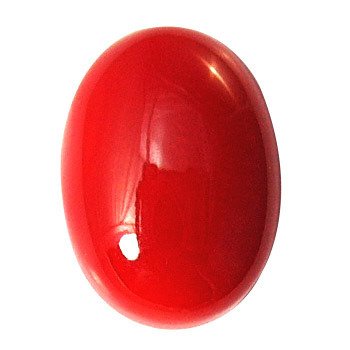
| Premium Italian | Deep even red, flawless surface, certified origin | 15.51 Carats Natural Italian Red Coral 14.12×11.02×9.50mm |
Rates move with the international coral market and stock availability. Please contact us for current italian coral price and live availability in your required weight.
Benefits of Italian Red Coral Gemstone
Red coral gemstone is the ratna of the planet Mars — Mangal Graha. In Hindu tradition, Mars is the commander of the celestial forces and the significator of energy, courage, action and victory, and Moonga is worn to align the wearer with that energy.
The benefits traditionally attributed to red coral moonga include:
- Increased confidence, courage and decisiveness
- Greater physical stamina and drive, turning a passive nature into an active one
- Improved control over anger and emotional reactions
- Strengthened leadership qualities and command over others
- Support in land, property and real estate dealings
- Protection — historically it was given to children to ward off the evil eye and negative influences
- Name, fame and recognition in competitive fields
- Removal of persistent obstacles in a difficult phase of life
Astrological Benefits of Red Coral / Lal Moonga
Red coral stone is prescribed to strengthen Mars and to reduce the malefic effects of a badly placed, debilitated or afflicted Mars in the birth chart.
Red coral for Mangal Dosha
Mars is the planet behind Mangal Dosha, commonly linked with delay and difficulty in marriage. Where the chart supports it, Moonga is prescribed to steady Mars and ease the obstruction. Mangal Dosha must be assessed in full context, however — it is frequently cancelled by other placements — so this should follow a chart reading rather than a general assumption.
Signs of a strong, benefic Mars
A person with a well-placed Mars typically shows independent thinking, decisiveness, success in competitive examinations and defence services, gains through land and immovable property, and the drive to finish what they start. Red coral gemstone is worn to help develop these qualities.
Zodiac signs and lagnas
Mars rules Aries and Scorpio, so red coral is most naturally suited to these lagnas. It is also traditionally considered favourable for Cancer, Leo, Sagittarius and Pisces ascendants, where Mars owns auspicious houses.
For Gemini, Virgo, Libra and Taurus ascendants, Mars owns less supportive houses, and red coral should not be worn without a proper horoscope analysis. Ultimately, suitability depends on the exact position, strength and functional role of Mars in your own chart — not on your sign alone.
Career and Profession Supported by Red Coral
Fields traditionally associated with a strong Mars, where Moonga is most often recommended:
Medicine and surgery | Scientific research | Engineering | Army and defence services | Police and paramilitary | Agriculture | Sports and athletics | Gold and metals trading | Land, construction and immovable property
Red Coral in Traditional Wellbeing Practice
In classical Vedic gemstone texts, red coral is described as converting the cosmic colour yellow, and Mars is treated as the karaka of rakta dhatu (blood), muscle, marrow and vitality. On this basis, Moonga has long been worn as a supportive measure for general strength, stamina and physical resilience.
Important: red coral is a spiritual and astrological support, not a medical treatment. It does not cure any disease, and it must never be used in place of proper medical care. If you have symptoms such as persistent fatigue, low haemoglobin, fever, bleeding, or any pregnancy-related concern, please consult a qualified doctor. Astrological remedies work best alongside medical treatment, never instead of it.
Who Should Wear Red Coral Stone?
Red coral moonga stone is generally recommended when:
- Mars is weak, debilitated (in Cancer), combust or badly aspected in your chart
- Mars is the lagna lord or a yogakaraka for your ascendant
- You are running a Mars Mahadasha or Antardasha that needs strengthening
- Mangal Dosha is confirmed after a full chart reading
- You lack drive, confidence or the ability to assert yourself
- Property and land matters remain repeatedly stuck
Who should be cautious
Red coral is a powerful, heating gemstone. It is not advisable where Mars is already very strong or is a functional malefic for your ascendant, as this can increase aggression, impatience and conflict. Never wear Moonga together with blue sapphire, diamond or emerald without expert guidance, as these belong to planets traditionally inimical to Mars. A short consultation before purchase is always cheaper than wearing the wrong stone.
Method of Wearing Red Coral Gemstone
| Detail | Recommendation |
|---|---|
| Metal | Copper, or gold |
| Finger | Ring finger of the working hand |
| Day | Tuesday |
| Time | Sunrise to around two hours after sunrise, during Shukla Paksha |
| Weight | Determined by chart strength and body weight — confirm with your astrologer |
| Form | Ring or pendant |
Steps to wear Italian Red Coral Gemstone
- Clean the ring gently with mild soap and water, or with raw milk and Gangajal.
- Place it on a red cloth and offer red flowers and incense.
- Chant the Mars mantra, then wear the ring on a Tuesday morning.
- Keep it clean thereafter; remove it if the coral develops a crack, and consult before replacing.
Vedic mantra for red coral
“Om Mangalaya Namah”
Beej mantra: “Om Kraam Kreem Kraum Sah Bhaumaya Namah”
How to Identify a Genuine Red Coral Stone Before Buying
The red coral gem market carries a great deal of dyed, reconstituted and imitation material. Common substitutes include dyed bamboo coral, glass, plastic, pressed coral powder and synthetic resin.
Identification checklist
| Feature | Genuine red coral |
|---|---|
| Colour | Natural, even red; not artificially bright or uniform-plastic in tone |
| Shape | Capsule, oval, triangular or round, with an even surface |
| Lustre | Smooth, soft and natural |
| Structure | Fine natural growth striations visible under magnification |
| Bubbles | None — internal air bubbles indicate glass or resin |
| Weight and feel | Denser and cooler to touch than plastic imitations |
| Colour bleed | Genuine coral does not release colour; dyed material may stain a wet cloth |
Six key steps in examining a stone
- Wherever possible, examine the stone unmounted.
- Make sure the gem is thoroughly clean before inspection.
- Hold the unmounted stone so that your fingers touch only the girdle.
- View the gem under proper, consistent lighting.
- Inspect the whole surface under magnification for pits, borings and repairs.
- Insist on a certificate from a recognised laboratory confirming natural origin.
Acid and heat tests do identify calcium carbonate, but they permanently damage the stone — leave these to a certified laboratory rather than attempting them at home.
Source of Red Coral Gemstone
Gem-quality red coral is harvested from the Mediterranean Sea — off the coasts of Italy, Spain, Algeria, Tunisia, Corsica and Sardinia — which is the source of true Italian red coral stone. Related coral species used in the trade are also sourced from the waters around Japan, Taiwan and parts of the Indian Ocean.
Because supply is limited and regulated, authenticated Mediterranean material is significantly scarcer than the volume of “Italian coral” offered in the market would suggest. Certification of origin matters as much as certification of authenticity.
Buy Certified Italian Red Coral Stone at AstroKapoor
We at AstroKapoor offer natural and certified gemstones of excellent quality. Each gemstone is tested by our own team of gemologists and certified by government-approved laboratories, and only the best quality is selected for our clients.
You can buy natural red coral / Moonga gemstones directly from our online store by sending us your details and requirements. We offer the best competitive rates to our clients — kindly provide your requirement by filling in the given form.
Note — corporate supplies and wholesale requirement: Please click here.
Energisation (Pran Pratishtha) of Your Gemstone
Please note that all gems are energised (Pran Pratishtha) before dispatch by special Pundits and Purohits with in-depth knowledge of the Vedas.
- An auspicious day and Nakshatra is chosen using the client’s name, date of birth and place of birth.
- A mat is placed facing East, North or North-East for the pooja.
- Two red silk cloths, tuar dal, red flowers, a copper plate, ragi and honey are used for energising the gemstone.
- Tuar dal is placed on the red silk cloth and a copper plate set over it; the process is repeated with the second cloth.
- The client’s name, date of birth and place of birth are then chanted by our Pundits to link the gemstone to that individual.
- An incense stick is lit before the gemstone and the mantra of the concerned gemstone is chanted.
- The gemstone is washed with holy Gangajal and milk.
- With eyes closed, the mantra is chanted as prescribed for that stone — for red coral, the Mangal mantra is chanted 10,000 times.
- This completes the procedure known as Pran Pratishtha, which establishes a live energy within the gemstone.
- Ragi and honey are offered as Prasad, and the tuar dal is donated after the pooja.
- Once this is complete, the gemstone is ready to be dispatched to you.
What Is Italian Red Coral (Lal Moonga)?
Quick answer: Italian red coral stone, known as Lal Moonga in India, is the gemstone of Mars (Mangal). It is worn to strengthen a weak or afflicted Mars in the birth chart analysis and is traditionally associated with courage, confidence, physical stamina, land and property matters, and relief from Mangal Dosha. Genuine Italian red coral (Corallium rubrum) from the Mediterranean is the most sought-after variety, and its price depends on colour saturation, size, surface finish and origin certification.
Red coral gemstone is the common trade name for Corallium rubrum and several related species. The original Corallium rubrum — the variety sold as Italian red coral stone — is found mainly in the Mediterranean Sea, where it grows at depths of roughly 10 to 300 metres.
Unlike almost every other gemstone, red coral is not mined from rock. It is an organic gemstone, formed from the hardened skeletons of tiny marine animals called polyps. These polyps live in colonies on dark, rocky sea beds with heavy sediment deposits, and build a branching structure of intermeshed calcium carbonate spicules. Although it looks like a plant, the red coral gem is animal in origin — which is why it is grouped with pearl and amber rather than with ruby or sapphire.
For those exploring Italian Red Coral Stone, understanding its origin, composition, quality and astrological significance is important before making a purchase. The suitability of Lal Moonga also depends on the individual horoscope, particularly the position and strength of Mars.
Red Coral Gemstone at a Glance
| Property | Detail |
|---|---|
| Indian name | Moonga / Lal Moonga |
| Planet | Mars (Mangal) |
| Colour | Red |
| Cosmic colour | Yellow |
| Composition | Calcium carbonate (organic) |
| Zodiac signs | Aries, Scorpio |
| Day to wear | Tuesday |
| Metal | Copper or gold |
| Finger | Ring finger |
| Mantra | Om Mangalaya Namah |
Why “Italian” Red Coral Is the Premium Variety?
Mediterranean Corallium rubrum is prized for its even, deep red colour, dense structure and smooth natural polish. It is harvested under regulated quotas, which keeps genuine supply limited — and is the main reason Italian Moonga stone commands a higher price than corals sourced elsewhere.
Italian red coral is particularly valued by gemstone buyers because genuine Mediterranean material can have strong colour saturation, good density and an attractive natural surface. However, origin and authenticity should always be verified through proper certification before purchasing an expensive red coral gemstone.
Red Coral Quality Factors
A good red coral moonga stone should have:
- Even, saturated colour with no patchy or faded zones
- Smooth, natural lustre — lustre is a sign of quality, not a flaw
- No cracks, pits, crevices, white spots or blemishes on the surface
- Uniform, symmetrical shape with a well-finished dome
- No holes, borings or worm marks, which are common in lower grades
These factors play an important role when comparing natural Italian red coral stones. A clean, well-finished and evenly coloured coral generally commands a higher value than a stone with visible surface imperfections.
Italian Red Coral Stone Price
Red coral stone price in India is quoted per ratti (approximately 0.91 carat) or per carat, and varies widely depending on quality.
What Determines Coral Stone Price?
| Factor | Effect on price |
|---|---|
| Origin | Italian/Mediterranean commands the highest premium; Japanese and Taiwanese corals are more moderately priced |
| Colour | Deep, uniform “ox-blood” and rich saturated red are the costliest; pale pink, orange-red and patchy tones cost less |
| Size (weight) | Price per ratti rises sharply above 8–10 ratti, as large flawless pieces are rare |
| Surface quality | Clean, unblemished, pit-free surfaces cost considerably more |
| Cut and finish | Well-proportioned capsule, oval and triangular cuts with an even dome are valued higher |
| Certification | Lab-certified natural coral carries a premium over uncertified stock |
Indicative Price Range
| Quality grade | Description | Indicative price per ratti |
|---|---|---|
| Commercial | Lighter or uneven colour, minor surface marks | Varies according to quality |
| Fine | Good saturation, clean surface, well-finished | Varies according to quality |
| Premium Italian | Deep even red, flawless surface, certified origin | Varies according to quality |
19.92 Carats Natural Italian Red Coral 18.40×13.04×9.43mm
22.00 Carats Natural Italian Red Coral 19.09×15.83×7.90mm
15.51 Carats Natural Italian Red Coral 14.12×11.02×9.50mm
Rates move with the international coral market and stock availability. Please contact us for current Italian coral price and live availability in your required weight.
Benefits of Italian Red Coral Gemstone
Red coral gemstone is the ratna of the planet Mars — Mangal Graha. In Hindu tradition, Mars is the commander of the celestial forces and the significator of energy, courage, action and victory, and Moonga is worn to align the wearer with that energy.
The benefits traditionally attributed to red coral moonga include:
- Increased confidence, courage and decisiveness
- Greater physical stamina and drive, turning a passive nature into an active one
- Improved control over anger and emotional reactions
- Strengthened leadership qualities and command over others
- Support in land, property and real estate dealings
- Protection — historically it was given to children to ward off the evil eye and negative influences
- Name, fame and recognition in competitive fields
- Removal of persistent obstacles in a difficult phase of life
The red coral gemstone benefits are traditionally connected with the positive qualities of Mars. However, the gemstone should be selected according to the individual’s horoscope rather than simply based on general zodiac recommendations.
Astrological Benefits of Red Coral / Lal Moonga
Red coral stone is prescribed to strengthen Mars and to reduce the malefic effects of a badly placed, debilitated or afflicted Mars in the birth chart.
Red Coral for Mangal Dosha
Mars is the planet behind Mangal Dosha, commonly linked with delay and difficulty in marriage. Where the chart supports it, Moonga is prescribed to steady Mars and ease the obstruction. Mangal Dosha must be assessed in full context, however — it is frequently cancelled by other placements — so this should follow a chart reading rather than a general assumption.
Signs of a Strong, Benefic Mars
A person with a well-placed Mars typically shows independent thinking, decisiveness, success in competitive examinations and defence services, gains through land and immovable property, and the drive to finish what they start. Red coral gemstone is worn to help develop these qualities.
Zodiac Signs and Lagnas
Mars rules Aries and Scorpio, so red coral is most naturally suited to these lagnas. It is also traditionally considered favourable for Cancer, Leo, Sagittarius and Pisces ascendants, where Mars owns auspicious houses.
For Gemini, Virgo, Libra and Taurus ascendants, Mars owns less supportive houses, and red coral should not be worn without a proper horoscope analysis. Ultimately, suitability depends on the exact position, strength and functional role of Mars in your own chart — not on your sign alone.
Career and Profession Supported by Red Coral
Fields traditionally associated with a strong Mars, where Moonga is most often recommended:
Medicine and surgery | Scientific research | Engineering | Army and defence services | Police and paramilitary | Agriculture | Sports and athletics | Gold and metals trading | Land, construction and immovable property
Because Mars is traditionally associated with courage, action, competition, technical ability and physical strength, red coral is often considered supportive for professions connected with these qualities.
Red Coral in Traditional Wellbeing Practice
In classical Vedic gemstone texts, red coral is described as converting the cosmic colour yellow, and Mars is treated as the karaka of rakta dhatu (blood), muscle, marrow and vitality. On this basis, Moonga has long been worn as a supportive measure for general strength, stamina and physical resilience.
Important: red coral is a spiritual and astrological support, not a medical treatment. It does not cure any disease, and it must never be used in place of proper medical care. If you have symptoms such as persistent fatigue, low haemoglobin, fever, bleeding, or any pregnancy-related concern, please consult a qualified doctor. Astrological remedies work best alongside medical treatment, never instead of it.
Who Should Wear Red Coral Stone?
Red coral moonga stone is generally recommended when:
- Mars is weak, debilitated (in Cancer), combust or badly aspected in your chart
- Mars is the lagna lord or a yogakaraka for your ascendant
- You are running a Mars Mahadasha or Antardasha that needs strengthening
- Mangal Dosha is confirmed after a full chart reading
- You lack drive, confidence or the ability to assert yourself
- Property and land matters remain repeatedly stuck
Who Should Be Cautious?
Red coral is a powerful, heating gemstone. It is not advisable where Mars is already very strong or is a functional malefic for your ascendant, as this can increase aggression, impatience and conflict. Never wear Moonga together with blue sapphire, diamond or emerald without expert guidance, as these belong to planets traditionally inimical to Mars. A short consultation before purchase is always cheaper than wearing the wrong stone.
Method of Wearing Red Coral Gemstone
| Detail | Recommendation |
|---|---|
| Metal | Copper, or gold |
| Finger | Ring finger of the working hand |
| Day | Tuesday |
| Time | Sunrise to around two hours after sunrise, during Shukla Paksha |
| Weight | Determined by chart strength and body weight — confirm with your astrologer |
| Form | Ring or pendant |
Steps to Wear Italian Red Coral Gemstone
- Clean the ring gently with mild soap and water, or with raw milk and Gangajal.
- Place it on a red cloth and offer red flowers and incense.
- Chant the Mars mantra, then wear the ring on a Tuesday morning.
- Keep it clean thereafter; remove it if the coral develops a crack, and consult before replacing.
Following the traditional red coral wearing method can help ensure that the gemstone is worn according to established Vedic gemstone practices.
Vedic Mantra for Red Coral
“Om Mangalaya Namah”
Beej mantra: “Om Kraam Kreem Kraum Sah Bhaumaya Namah”
The Mars mantra is traditionally recited while wearing or energising Lal Moonga to seek the positive influence of Mangal Graha.
How to Identify a Genuine Red Coral Stone Before Buying
The red coral gem market carries a great deal of dyed, reconstituted and imitation material. Common substitutes include dyed bamboo coral, glass, plastic, pressed coral powder and synthetic resin.
Identification Checklist
| Feature | Genuine red coral |
|---|---|
| Colour | Natural, even red; not artificially bright or uniform-plastic in tone |
| Shape | Capsule, oval, triangular or round, with an even surface |
| Lustre | Smooth, soft and natural |
| Structure | Fine natural growth striations visible under magnification |
| Bubbles | None — internal air bubbles indicate glass or resin |
| Weight and feel | Denser and cooler to touch than plastic imitations |
| Colour bleed | Genuine coral does not release colour; dyed material may stain a wet cloth |
Six Key Steps in Examining a Stone
- Wherever possible, examine the stone unmounted.
- Make sure the gem is thoroughly clean before inspection.
- Hold the unmounted stone so that your fingers touch only the girdle.
- View the gem under proper, consistent lighting.
- Inspect the whole surface under magnification for pits, borings and repairs.
- Insist on a certificate from a recognised laboratory confirming natural origin.
Acid and heat tests do identify calcium carbonate, but they permanently damage the stone — leave these to a certified laboratory rather than attempting them at home.
Source of Red Coral Gemstone
Gem-quality red coral is harvested from the Mediterranean Sea — off the coasts of Italy, Spain, Algeria, Tunisia, Corsica and Sardinia — which is the source of true Italian red coral stone. Related coral species used in the trade are also sourced from the waters around Japan, Taiwan and parts of the Indian Ocean.
Because supply is limited and regulated, authenticated Mediterranean material is significantly scarcer than the volume of “Italian coral” offered in the market would suggest. Certification of origin matters as much as certification of authenticity.
Understanding the source of Italian red coral is important because the market contains different types and grades of coral that can vary significantly in quality, appearance and price.
Buy Certified Italian Red Coral Stone at AstroKapoor
We at AstroKapoor offer natural and certified gemstones of excellent quality. Each gemstone is tested by our own team of gemologists and certified by government-approved laboratories, and only the best quality is selected for our clients.
You can buy natural red coral / Moonga gemstones directly from our online store by sending us your details and requirements. We offer the best competitive rates to our clients — kindly provide your requirement by filling in the given form.
Note — corporate supplies and wholesale requirement: Please click here.
Energisation (Pran Pratishtha) of Your Gemstone
Please note that all gems are energised (Pran Pratishtha) before dispatch by special Pundits and Purohits with in-depth knowledge of the Vedas.
An auspicious day and Nakshatra is chosen using the client’s name, date of birth and place of birth.
A mat is placed facing East, North or North-East for the pooja.
Two red silk cloths, tuar dal, red flowers, a copper plate, ragi and honey are used for energising the gemstone.
Tuar dal is placed on the red silk cloth and a copper plate set over it; the process is repeated with the second cloth.
The client’s name, date of birth and place of birth are then chanted by our Pundits to link the gemstone to that individual.
An incense stick is lit before the gemstone and the mantra of the concerned gemstone is chanted.
The gemstone is washed with holy Gangajal and milk.
With eyes closed, the mantra is chanted as prescribed for that stone — for red coral, the Mangal mantra is chanted 10,000 times.
This completes the procedure known as Pran Pratishtha, which establishes a live energy within the gemstone.
Ragi and honey are offered as Prasad, and the tuar dal is donated after the pooja.
Once this is complete, the gemstone is ready to be dispatched to you.
Frequently Asked Questions – Italian Red Coral Stone
What is red coral stone used for?
Red coral stone, or Lal Moonga, is worn to strengthen the planet Mars in the birth chart. It is traditionally associated with courage, confidence, physical stamina, leadership, success in competitive fields, gains in land and property, and relief from the effects of Mangal Dosha.
What is the price of Italian red coral stone?
Italian red coral stone price is quoted per ratti and depends on colour saturation, size, surface cleanliness, cut and certification. Deep, evenly coloured Mediterranean coral with a flawless surface commands the highest coral stone price, while paler or blemished pieces cost considerably less.
Which is the best red coral — Italian or Japanese?
Italian (Mediterranean) Corallium rubrum is generally regarded as the finest red coral gem because of its even deep-red colour and dense structure, which is why Italian Moonga stone carries a premium. Japanese coral is also genuine and of good quality, and is often the better value option.
Who should wear red coral moonga?
Red coral is suited to Aries and Scorpio ascendants, and is often recommended for Cancer, Leo, Sagittarius and Pisces lagnas. It is prescribed when Mars is weak, debilitated or afflicted, or during a Mars dasha. Always confirm with a chart reading before wearing it.
On which finger and day should red coral be worn?
Red coral gemstone is worn on the ring finger of the working hand, set in copper or gold, on a Tuesday morning during the waxing moon phase, after chanting “Om Mangalaya Namah”.


