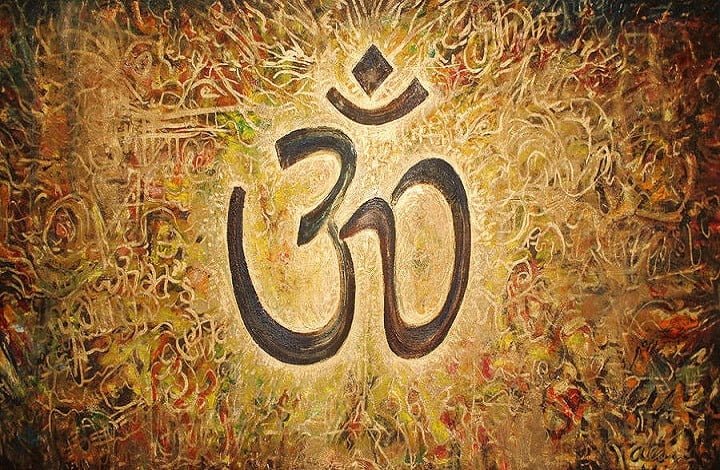
The power of the Om mantra has been recognised in the Vedic tradition for thousands of years. Om (also written Aum) is regarded as the primordial sound — the vibration from which all creation is said to arise. It is the seed of almost every Hindu mantra, prayer and meditation, and even a few minutes of sincere chanting is believed to steady the mind, deepen the breath and connect the individual with a larger cosmic rhythm. Whether you are new to meditation or a long-time practitioner, understanding Om helps you unlock the foundation of all mantra practice.
What Does the Om Mantra Mean?
Om is not an ordinary word; it is a sound-symbol that represents the whole of existence — the past, the present and the future, and everything beyond time. In the Mandukya Upanishad, Om is broken into three sounds, each carrying its own meaning:
- A (अ) — the waking state, creation and the physical world.
- U (उ) — the dream state, sustenance and the mental world.
- M (म) — the deep-sleep state, dissolution and the causal world.
The silence that follows the three sounds represents pure consciousness — the absolute reality the mantra ultimately points to. Chanting Om is therefore a way of experiencing wholeness in a single syllable.
The Spiritual and Mental Power of Chanting Om
The real power of Om lies in its vibration. When chanted correctly, the sound resonates through the chest, throat and head, producing a gentle physical hum that many people find deeply calming. Regular chanting is traditionally associated with a range of benefits: a quieter, more focused mind, relief from stress and restlessness, better concentration during study or work, and a sense of inner stability. Because Om is the base note of the Gayatri Mantra and countless other prayers, mastering it also strengthens every other mantra you may recite.
Many practitioners describe Om as a bridge between effort and surrender — you actively produce the sound, then rest in the stillness it leaves behind. That alternation between sound and silence is what trains the mind to settle.
How to Chant the Om Mantra Correctly
To experience the full power of Om, the technique matters more than the volume. A simple approach:
- Sit comfortably with a straight spine, in a quiet place, ideally in the early morning.
- Take a slow, deep breath in.
- As you exhale, chant “Aum” — letting the “A” begin in the belly, the “U” roll through the chest, and the “M” hum at the lips until the breath is complete.
- Rest in the silence for a moment before the next breath.
- Repeat for 5–15 minutes, ideally in cycles of 9, 27 or 108 with a mala.
Consistency matters more than duration. A few focused minutes every day will do far more than an occasional long session.
When and Why to Chant Om
Om can be chanted at any time, but early morning and dusk are considered especially auspicious. It is often used to open and close meditation, yoga and puja, because it clears the mind at the start and seals the practice at the end. If you combine mantra practice with astrological remedies, Om pairs naturally with planetary and personal mantras — you can read more in our guide on the power of a personalised mantra and explore how sound remedies fit into a wider practice through a personalised chart reading.
Frequently Asked Questions
What is the power of the Om mantra?
The power of the Om mantra lies in its vibration and symbolism. Chanting Om is believed to calm the mind, improve focus, reduce stress and connect the individual with universal consciousness, which is why it forms the base of most Vedic mantras.
How many times should I chant Om?
There is no fixed rule, but chanting in rounds of 9, 27 or 108 with a mala is traditional. Even 5–15 minutes of daily chanting is enough to feel the calming effect over time.
What is the best time to chant Om?
Early morning (around sunrise) and dusk are considered the most auspicious times. However, Om can be chanted whenever you need to steady your mind, before meditation, study or sleep.
Is Om a Hindu mantra only?
Om originates in the Vedic and Hindu tradition, but it is also used in Buddhism, Jainism and Sikhism, and today many people of all backgrounds chant it purely for its meditative and stress-relieving qualities.
Can beginners chant the Om mantra?
Yes. Om is the simplest and most accessible mantra to begin with. Sit quietly, breathe slowly, and let the sound extend through the full exhale — no prior training is needed.
