
Ancient Lord Shiva Temples
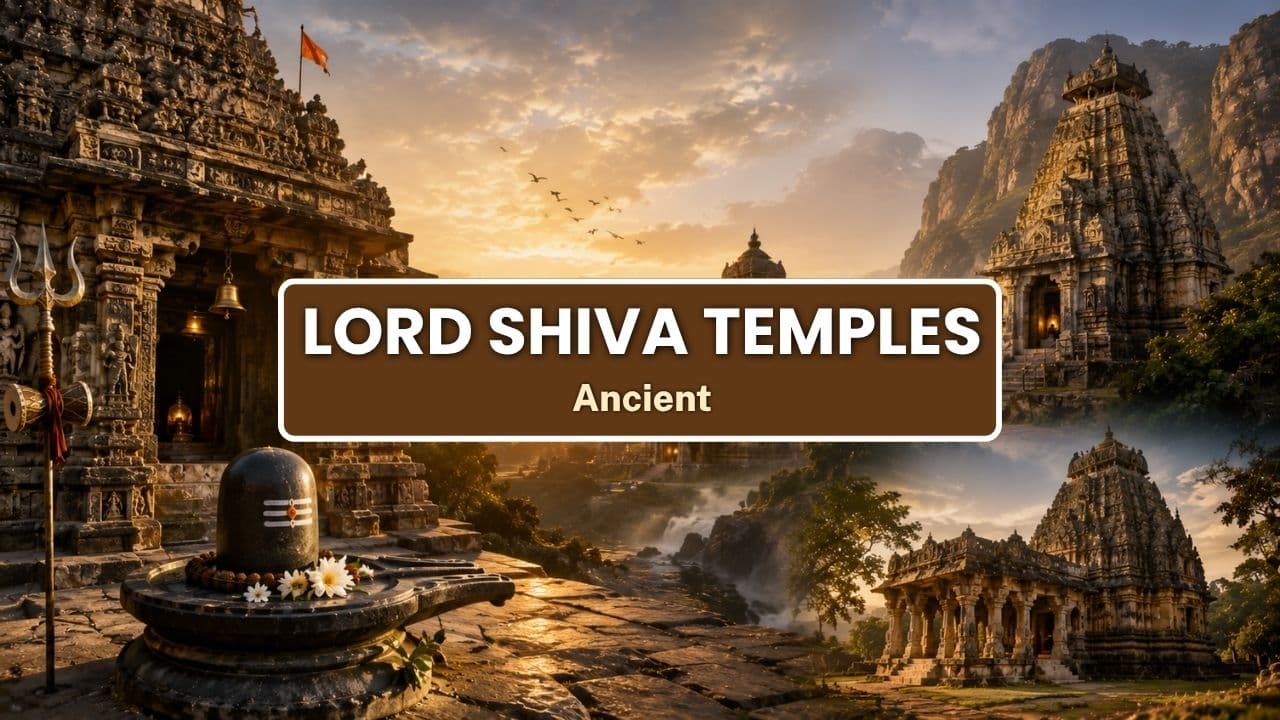


Discover the Pancha Bhoota Stalam the 5 ancient Lord Shiva temples representing Earth, Water, Fire, Air and Space, from Kanchipuram to Kalahasti. Their significance and locations.
Lord Shiva is one of the most important deities in Hinduism — revered as both the creator and the destroyer, and honoured as the God of Gods. Among the countless temples dedicated to him, five hold a uniquely sacred place: the Pancha Bhoota Stalam — the five ancient Shiva temples that each represent one of the five great elements (Pancha Mahabhoota): Earth, Water, Fire, Air and Space.
The Five Pancha Bhoota Shiva Temples
Each of these temples enshrines Lord Shiva as a manifestation of one of the five elements that make up all of creation:
The Significance of the Element Temples
Each temple expresses its element through a living, physical sign within the sanctum:
- Earth (Ekambareswarar, Kanchipuram): The self-manifested lingam here is made of sand, marking the deity's association with the earth element.
- Water (Jambukeswarar, Thiruvanaikaval): An underground spring flows within the innermost sanctum, a manifestation of the water element that keeps the lingam perpetually surrounded by water.
- Fire (Arunachaleswarar, Thiruvannamalai): The fire element is honoured through the great Karthigai Deepam festival, when a giant lamp is lit atop the Annamalai hill.
- Air (Srikalahasti): The wind element is revealed by the constantly flickering flame of the temple's lamps, which move even in a sealed inner sanctum.
- Space / Ether (Nataraja Temple, Chidambaram): The formless "space" element is represented by the Chidambaram Rahasya — an empty, formless space in the sanctum, symbolising the Supreme Being as formlessness itself.
The Sacred Design of Hindu Temples
Hindu temples are far more than places of worship — they are a connecting link between the divine, the human and the universal. Every temple is built on a sacred geometric design based on the and ancient Vastu principles. The East direction is considered especially auspicious, as the sun rises there, and an ideal temple carefully considers its entrances, placement and proportions. These guidelines are described in classical scriptures such as the Mayamatam and the Manasara.
According to yogic science, the Pancha Bhoota temples are also said to be geographically aligned along a sacred axis, giving each site extraordinary spiritual power.
Frequently Asked Questions
What are the Pancha Bhoota Stalam?
The Pancha Bhoota Stalam are five ancient Lord Shiva temples in South India, each representing one of the five elements — Earth, Water, Fire, Air and Space (Ether).
Which temple represents which element?
Ekambareswarar (Kanchipuram) represents Earth, Jambukeswarar (Thiruvanaikaval) Water, Arunachaleswarar (Thiruvannamalai) Fire, Srikalahasti Air, and the Nataraja Temple (Chidambaram) Space.
What is the significance of the Pancha Bhoota temples?
Each temple enshrines Lord Shiva as a manifestation of one of the five great elements that make up all creation, expressed through a physical sign — sand, water, fire, wind or formless space — within its sanctum.
Where are the five element Shiva temples located?
Four are in Tamil Nadu (Kanchipuram, Thiruvanaikaval, Thiruvannamalai and Chidambaram) and one, Srikalahasti, is in Andhra Pradesh.
What is the space element temple of Shiva?
The Nataraja Temple at Chidambaram represents the space (ether) element. It is famous for the Chidambaram Rahasya — an empty, formless space symbolising the Supreme Being as formlessness.
Explore the Spiritual Significance of Lord Shiva
The Pancha Bhoota temples are among the most sacred pilgrimage sites in India. To learn more about Lord Shiva and his worship, explore the importance of the Shivalingam at AstroKapoor.

Comments (0)
Sign in to join the conversation.
Login to comment